The government is reportedly reviewing the formation of a special investigation headquarters for the “insurrection case” to hold accountable those involved in the December 3 emergency martial law, as revealed on the 23rd. Following the establishment of the “Constitution-Respecting Government Innovation Task Force” immediately after the current administration took office and two rounds of special counsel investigations to purge those complicit in martial law, another special unit may be launched. Political circles speculate this move could target Chief Justice Jo Hee-de, who has clashed with Cheong Wa Dae over the re-nomination of a Justice candidate.
A ruling party official stated, “As criticism arose that the insurrection special counsel ended incompletely, there is widespread agreement that reinvestigation is unavoidable. Various methods, including the formation of a special unit, are reportedly being considered to purge remaining insurrection forces.” It is also known that President Lee is considering directly ordering the formation of the insurrection special unit upon his return from state visits to the U.S. and Mexico for the UN General Assembly and a summit with Mexico.
If President Lee indeed orders the formation of the insurrection special unit, it is likely to be established under the police and collaborate with the Serious Crimes Investigation Agency, set to launch in October. The insurrection case could become the agency’s first major case.
While Cheong Wa Dae denies this, interpretations suggest the plan targets Chief Justice Jo, who recently opposed President Lee’s re-nomination request. Chief Justice Jo was accused of participating in martial law, including convening an emergency meeting at the Supreme Court to transfer judicial authority to the martial law command immediately after the declaration. However, both the insurrection special counsel and the second comprehensive special counsel dismissed the charges, citing insufficient grounds. The ruling party, however, continues to label Jo as a “remaining insurrection force” and speculates the special unit could pressure him again.
This move is also interpreted as an attempt to appease supporters amid President Lee’s declining approval ratings post-local elections and internal doubts about his reform resolve. The People Power Party criticized, “This administration’s ‘insurrection obsession’ is escalating. It’s an ‘insurrection-dependent regime’ that cannot sustain power without the insurrection frame.”
◇Third ‘Insurrection Card’ After Joint Investigation Unit and Two Special Counsels… Attempt to Shift Declining Approval Ratings
The ruling party’s proposal to establish a special unit stems from the judgment that “remaining insurrection forces” persist despite extensive investigations by the prosecution-police joint unit and two special counsels. Speculation arises that this targets Chief Justice Jo, who rejected President Lee’s re-nomination request.
◇Targeting Chief Justice Jo Hee-de?
Chief Justice Jo was accused of knowing the unconstitutionality and illegality of the emergency martial law but failing to stop it, even discussing transferring judicial authority to the martial law command. However, both the insurrection special counsel and the second special counsel dismissed the charges, deeming them unfounded.
The ruling party, however, rebranded Jo as an “insurrection force” after he rejected the re-nomination request and launched a full-scale offensive. Democratic Party of Korea leader Kim Min-seok called Jo’s rejection “the last outburst of a lone insurrection force already suppressed” and “inherently insurrectionist.” Lee Sung-yoon, a Democratic Party Supreme Council member, vowed to hold Jo accountable during the upcoming parliamentary audit for delaying insurrection purging, creating a justice vacuum, and alleged illegalities in the nomination process.
Analysts suggest the special unit’s formation is also linked to internal criticism from hardliners like Gyeonggi Governor Choo Mi-ae, who accuse President Lee of lacking reform resolve. A ruling party official noted, “Even the nomination of Kim Ji-yong, a former prosecutor as head of the Serious Crimes Investigation Agency, sparked internal debate. President Lee is reportedly considering various measures to purge remaining insurrection forces and demonstrate reform commitment.” This could also politically unify the fractured ruling party under the banner of “eradicating insurrection remnants.”
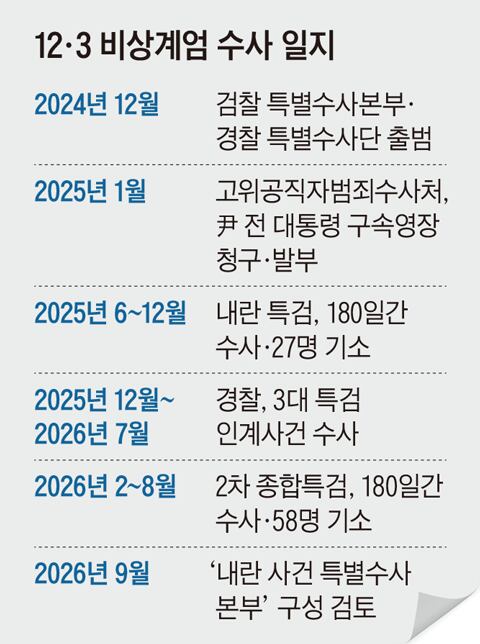
◇1 Year and 9 Months Into the December 3 Martial Law Investigation
Investigations into the December 3 emergency martial law have continued for 1 year and 9 months since December 2024. Immediately after the martial law declaration, the prosecution, police, and Corruption Investigation Office for High-ranking Officials (CIO) launched simultaneous investigations. The Supreme Prosecutors’ Office established a special investigation headquarters, indicting former Defense Minister Kim Yong-hyun, former Defense Counterintelligence Command Chief Yeo In-hyeong, and former Capital Defense Command Chief Lee Jin-woo. The CIO arrested former President Yoon Suk-yeol.
The Lee Jae Myung government launched the “three major special counsels” in June last year. The insurrection special counsel, part of this initiative, investigated from June 18 to December 14, 2025, with a budget of 10.03 billion Korean won and 267 personnel, indicting 27 individuals, including former Prime Minister Han Duck-soo, former Interior Minister Lee Sang-min, and former Justice Minister Park Sung-jae.
Unfinished investigations were transferred to the police, but the ruling party formed a second special counsel in February ahead of the June 3 local elections. The second special counsel, operating for 180 days with a 9.79 billion won budget and 271 personnel, indicted 58 individuals and arrested 7. Special prosecutor Kwon Chang-young reportedly told former Democratic Party lawmaker Choe Kang-wook during a witness interview in April, “To eradicate martial law, a special joint investigation unit should operate for at least three years,” and formally proposed establishing a permanent special unit. The National Police Agency stated on the 23rd, “We are reviewing an appropriate investigation system after receiving 46 cases from the second special counsel.”