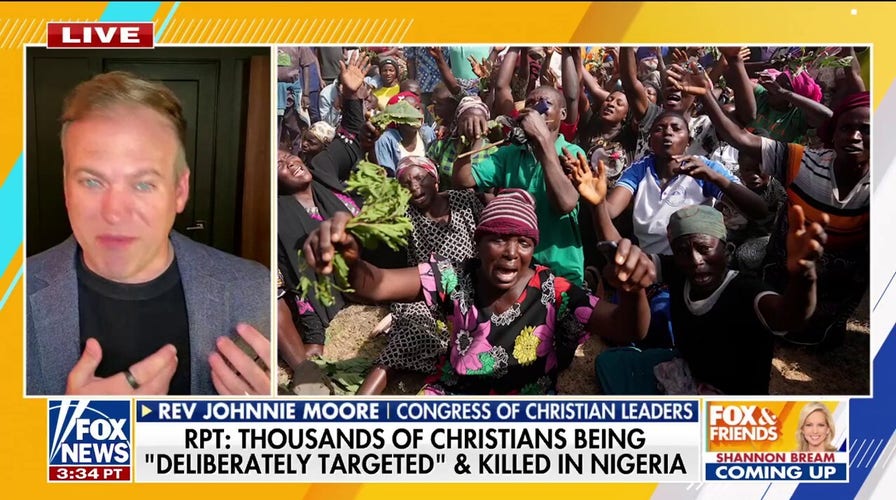
The Debate Over Christian Persecution in Nigeria
Christian groups, including the Pentecostal Fellowship of Nigeria (PFN), the Northern States Christian Association of Nigeria (CAN), and its Kaduna State Chapter, have strongly opposed the Nigerian Supreme Council for Islamic Affairs’ (NSCIA) dismissal of reports regarding a Christian genocide in Nigeria. The NSCIA has labeled these reports as false, divisive, and part of a larger geopolitical conspiracy aimed at destabilizing the country.
Bishop Francis Wale Oke, the president of the PFN, has emphasized that describing the attacks on Christian communities as anything other than genocide would be a “desecration” to the memory of thousands of victims. Following a meeting of the Ulamah Council in Abuja, the national secretary of the NSCIA, Prof Is-haq Oloyede, stated that both Muslims and Christians are victims of a failed security system, poverty, and criminality. He argued that the issue is not one of religious persecution but rather a broader crisis involving poverty, climate change, poor governance, and armed criminals.
“We turn to our genuine Christian brothers and sisters and tell them: you are not our enemies. You are our compatriots, colleagues, and neighbours,” Oloyede said. “We have never denied our collective pain. Do not allow foreign political gladiators or domestic separatists to exploit our real suffering to destroy our shared home.”
The NSCIA called on the international community and the press to reject the narrative of a Christian genocide, urging the Nigerian government to focus on protecting all citizens, defeating bandits and terrorists, and exposing corrupt instigators of this divisive agenda. According to Oloyede, the narrative of genocide is being pushed by foreign political interests seeking to fragment Nigeria along religious lines.
Oloyede warned that the attempt by some Western powers, particularly the United States, to label Nigeria’s security crisis as genocide was a geopolitical ploy designed to fragment the nation. He accused certain foreign actors of exploiting Nigeria’s insecurity for “geopolitical profits” while ignoring atrocities elsewhere, including in Gaza.
The NSCIA insisted that there is no religious war in Nigeria, highlighting that the constitution guarantees freedom of religion through three co-existing legal systems—common law, sharia, and customary law. It also noted that Amnesty International and other credible global bodies had found no evidence of a coordinated campaign to exterminate Christians in the country.
A Call for Action from Religious Leaders
Bishop Oke, the President of the PFN, reiterated that it would be a “desecration” to the memory of thousands of victims to describe the killings targeting Christian communities as anything other than genocide. During an interview with journalists, he highlighted the scale and persistence of attacks on Christians in several parts of Northern Nigeria, stressing that the situation demands urgent and sincere government action.
Worried by the ongoing spate of killings of Christians, Oke raised questions about the fate of individuals like Lea Sharibu and the Chibok girls, noting that the situation in Benue and Plateau states remains dire. He pointed out that even former U.S. President Donald Trump had previously designated Nigeria as a ‘Country of Particular Concern,’ citing what he described as ‘Christian genocide.’ While Nigerian authorities have rejected that classification, Oke said Trump’s concerns reflect a reality that many Nigerians were witnessing.
The Anglican Primate, Most Rev’d Henry Ndukuba, also called on the federal government to seek foreign assistance if it is unable to end the violent killings and persecution of Christians in the country. He confirmed the grim reality of targeted attacks, revealing that several pastors and their families remain in captivity after being abducted from their churches.
Faith-Based Killings in Nigeria
Contrary to insinuations that there are no faith-based killings in Nigeria, the Christian Association of Nigeria (CAN) has affirmed that such killings are a reality and should not be denied by any God-fearing person. Rev. Caleb Maaji, chairman of Kaduna State CAN, stated that killings in Nigeria are a reality and that no one has the right to take another person’s life.
Rev. Dr John Joseph Hayab, chairman of CAN in the Northern States and the Federal Capital Territory, echoed this sentiment, emphasizing that denial of the issue only prevents solutions from being found. “If you have a wound or you are sick and you refuse to accept that you are not sick… you will not get cured,” he said.
US Intelligence and Nigeria’s Response
Archbishop Emma Gospel Isong, former national publicity secretary and current National Vice president South South zone for PFN, stated that the U.S. has credible intelligence about the killings in Nigeria. She stressed that the U.S. move was justified and that Nigeria should be grateful for the designation.
Isong, who works under the Anti-Corruption and Inter-religious department of the U.S. Embassy, dismissed fears that the U.S. would hurt Nigerians. “Those perpetrating killings in the guise of ethno-religious crises are the ones who deserve sanction from the U.S. Government,” she said.


