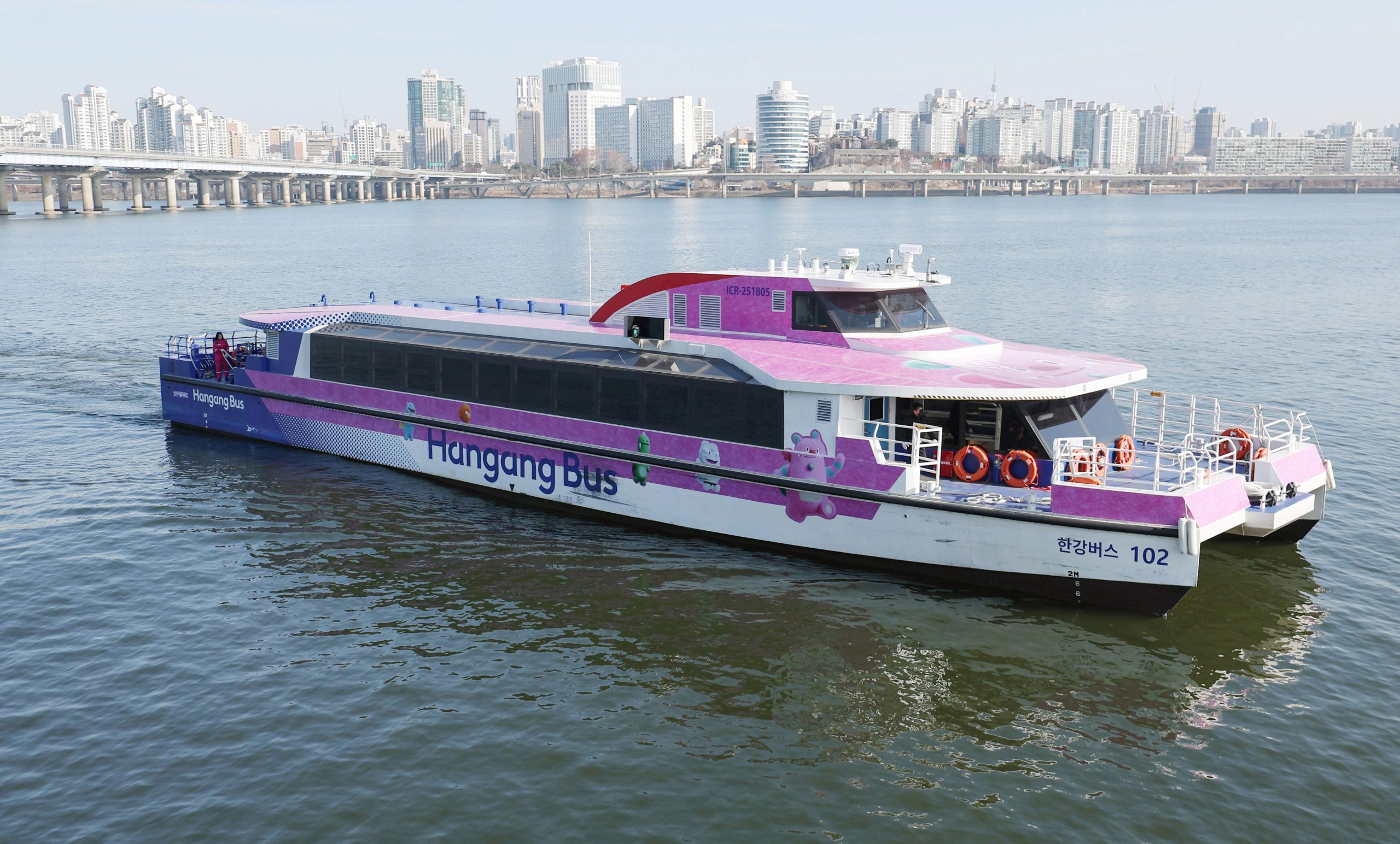
On the afternoon of September 27, the Hangang Bus terminal at Yeouido, Seoul, was crowded with people trying to board the boats. A family from Bucheon, Gyeonggi Province, Shin, 47 years old, said, “We had no idea the Hangang Bus would be this crowded.” They had arrived an hour early for the 1:35 p.m. Jamsil-bound boat but found boarding had already closed. A terminal employee explained, “Around 200 people were already lined up when we opened at 11 a.m.,” adding, “This ‘open run’ happens every weekend.”
It has been a year since the Hangang Bus began its first voyage in September last year. Mayor Oh Se-hoon initiated the project after benchmarking the Uber Boat on London’s Thames River. The goal was to actively utilize the river running through the city center, like in London, New York, and Tokyo, and establish it as a “third public transportation option” alongside subways and buses. However, the service faced challenges, including boats getting stuck in the riverbed and repeated suspensions due to monsoons, heavy rains, and cold waves. Full-scale operations across all routes only began in March this year. Controversy persisted over whether a boat was necessary in Seoul, where subway and bus networks are dense. Critics pointed out that, unlike London where the river is adjacent to the city center, Seoul’s wide riverbanks reduce accessibility from subway stations, and seasonal water level fluctuations are significant.
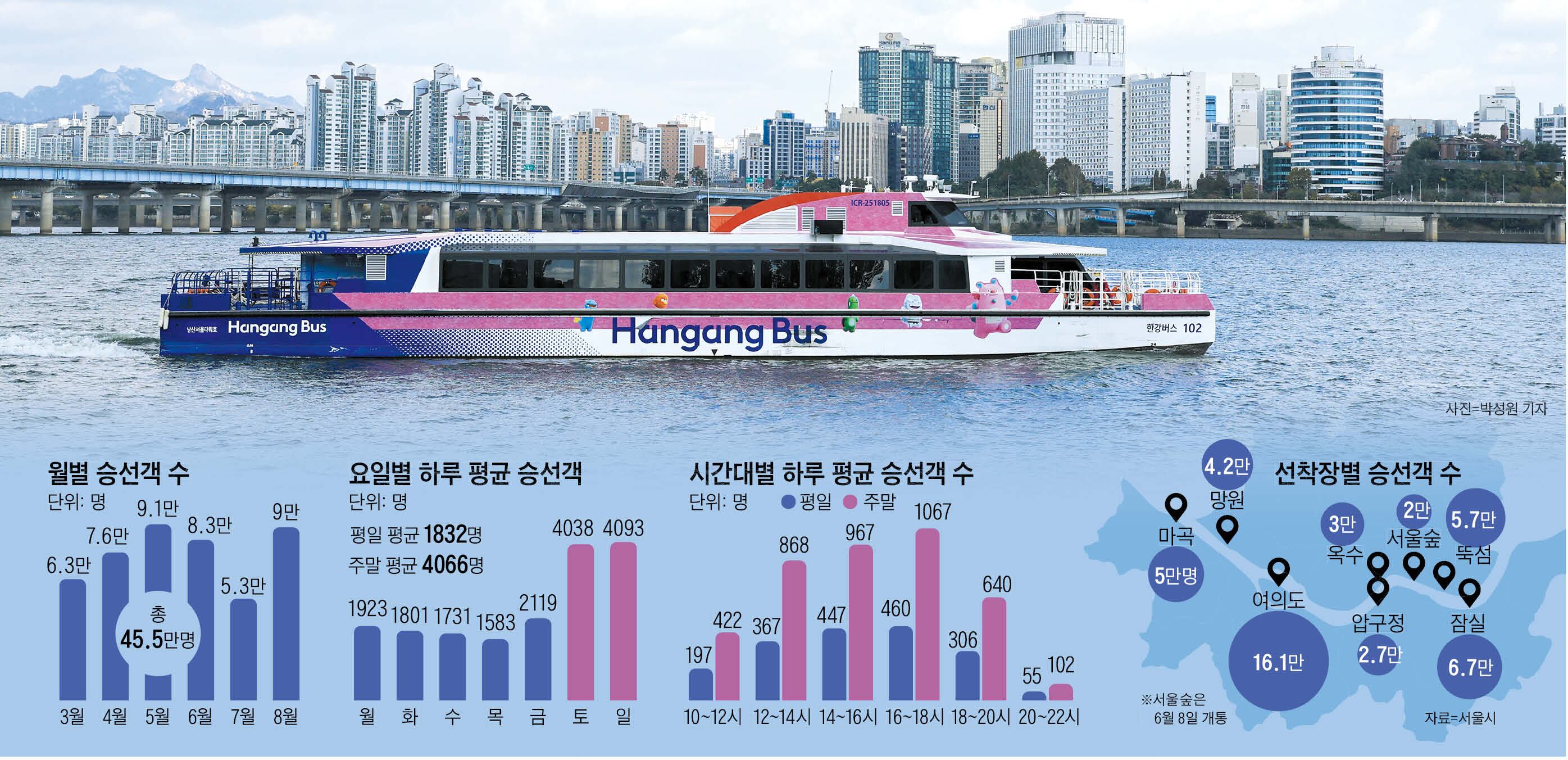
How has the Hangang Bus fared after a year? This newspaper analyzed boarding data from March to August to examine how citizens have utilized the service.
Passengers predominantly boarded on weekends and in the afternoon rather than weekdays or commuting hours. From March to August, the Hangang Bus carried 455,483 people. Weekend daily average passengers were 4,066, 2.2 times higher than weekdays (1,832). The peak boarding time was 4–6 p.m. on both weekdays and weekends. While commuting demand exists, the Hangang Bus currently operates from 11 a.m., missing morning commuters. A Seoul City official stated, “We lack boats to deploy during commuting hours immediately.” This has led to criticism that the service remains a “low-cost sightseeing cruise” rather than a true public transportation option. Weather also impacted ridership: July saw a 36% drop compared to June due to frequent cancellations from heavy rains.
However, the past year revealed potential. From March to August, 35.4% (161,447 people) boarded at Yeouido, followed by Jamsil (14.8%·67,458 people) and Ttukseom (12.5%·56,857 people). These three terminals accounted for 62.7% of total passengers. In contrast, Oksu, near a subway station, saw only 6.7% of passengers, lower than initial expectations. Yeouido, Jamsil, and Ttukseom are all near Han River Parks, which saw visitors increase from 47.42 million in 2022 to 86.89 million last year—a 83% rise over three years. This suggests that the wide riverbanks, once seen as a weakness, could become a competitive advantage. Transportation experts noted, “It’s clear that subway accessibility alone doesn’t explain terminal demand. The presence of destinations around terminals is a key variable.”
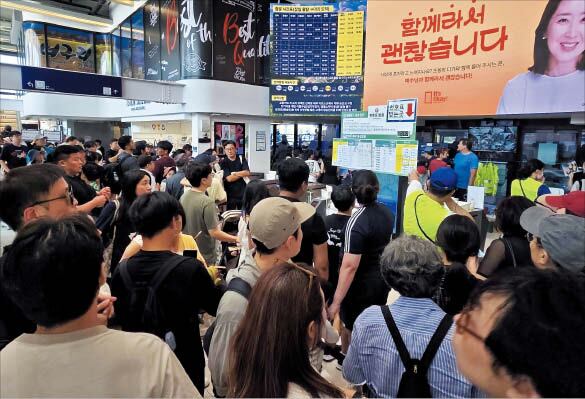
On September 27, dozens of passengers boarded and disembarked at Seoul Forest, Ttukseom, and other stops as the boat departed Yeouido. At Ttukseom, around 80 people got off while a similar number boarded, highlighting its role as a transportation link for Han River Park visitors.
In some sections, travel time was comparable to subways. The Yeouido–Seoul Forest route takes about 53 minutes by Hangang Bus, versus one hour with a subway transfer. The boat directly connects along the river, whereas subways require detours. In such cases, the Hangang Bus could complement subways and buses as a “third transportation option.”
Riverside urban development is another variable. London expanded its Uber Boat network while redeveloping old ports and power plants along the Thames. Seoul is also pursuing large-scale developments along the Han River, including the Yongsan International Business District and Apgujeong redevelopment, both emphasizing river connectivity. The completion of the Jamsil MICE complex in 2032 could generate new demand around the Jamsil terminal. A new terminal will also be built on Nodeul Island, designed by world-renowned architect Thomas Heatherwick.
Operational stability has improved. According to Seoul City, the Hangang Bus’s on-time departure rate is 99.3% (defined as departing within 10 minutes of the scheduled time). On September 27, despite crowded terminals, boats adhered to their schedules.
Currently, Hangang Bus operates approximately every hour due to having only 12 boats. On weekends, passengers engage in “open runs,” arriving early to collect numbered tickets. After disembarking at Seoul Forest, Shin’s wife and children headed to the park, while Shin stayed behind to secure a return ticket.
To become a reliable public transportation option without waiting, Seoul must increase the number of boats. With 12 boats, the Hangang Bus has half as many as London’s Uber Boat (23) and a third of New York’s NYC Ferry (38). Seoul plans to expand to 24 boats by 2035, reducing intervals from 1 hour to 15–20 minutes. Experts suggest intervals should be around 15 minutes for convenient use without checking schedules.
The challenge is funding. Each Hangang Bus costs approximately 4 billion Korean won, and adding 12 boats would require 50 billion Korean won. Seoul’s solution is to generate revenue at terminals through cafes, convenience stores, and advertising, unlike London and New York, which lack such facilities.
According to Seoul’s cost estimates, this year’s operating cost is 18 billion Korean won, with fare revenue of only 2.6 billion Korean won, resulting in a 15.4 billion Korean won deficit. By 2028, ancillary business profits (16.7 billion Korean won) are projected to exceed operating deficits (16.4 billion Korean won).
On September 27, Starbucks and chicken restaurants at Yeouido terminal were packed, not just with passengers but also Han River Park visitors. A Seoul City official said, “Once we turn profitable in 2028, we’ll have the funds to purchase more boats.” The past year confirmed demand for river transportation in Seoul; now, the focus is on sustaining it as a viable public transit option.
London Uber Boat Also Started with 80 Daily Passengers… Rapid Growth Alongside Riverside Development
Seoul’s Hangang Bus model is London’s Thames River Uber Boat. Launched in 1999, it now operates 23 boats across 24 terminals, with 10–20 minute intervals on major routes and 10,000 daily passengers. It is recognized as a public transportation option alongside subways and double-decker buses.
The Uber Boat also faced early accidents and delays, including fatalities, with only 80 daily passengers per three boats. Growth accelerated with developments like Canary Wharf, a global financial hub created by redeveloping an old port. Subsequent riverfront projects expanded the water network.
Routes diversified beyond upstream-downstream lines to include cross-river services like Canary Wharf–Rotherhithe, areas requiring detours by subway or bus. Special routes operate during events at venues like the O2 Arena. The Uber Boat segments its role based on passenger demand.
Tourists constitute a significant portion, attracted by views of Big Ben, the London Eye, and Tower Bridge. Commuters fill seats in the morning and evening, while tourists dominate daytime.
The Uber Boat’s strength lies in its services: a dedicated app provides real-time boat locations and congestion levels. It offers weekly, monthly, and annual passes, as well as morning commute discounts for office workers.
The Uber Boat emphasizes a new commuting style—enjoying London’s scenery on boats instead of crowded subways or traffic-jammed buses. It is also transitioning to eco-friendly transportation with hybrid and electric boats.
The Uber Boat’s 27-year history shows that water transportation wasn’t an instant success. By expanding terminals, boats, and routes alongside riverfront development, it grew to serve both tourism and commuting needs.
- 월 5900원 멤버십, 신문 독자에게는 2900원, 조선멤버십
- 55000원 상당의 신문-잡지 8종 마음껏 보기, 조선멤버십
- 현금처럼 쓸 7000포인트 받아 알뜰한 쇼핑, 조선멤버십

Related posts:

Fiction park: He was the best in class. He still wasn’t good enough

Gagan Thapa takes oath as Congress president, vows to regain public trust

Inside knowledge that has locals gripped by fear after gran’s body found decomposing in cattle dip

New property purchase disclosure rule in Japan sparks fears it may curb foreign investment

Dino-mite treasures: inside Singapore’s Fort Knox storing playthings of ultra-rich