Hong Kong’s National Day Celebrations and Political Tensions
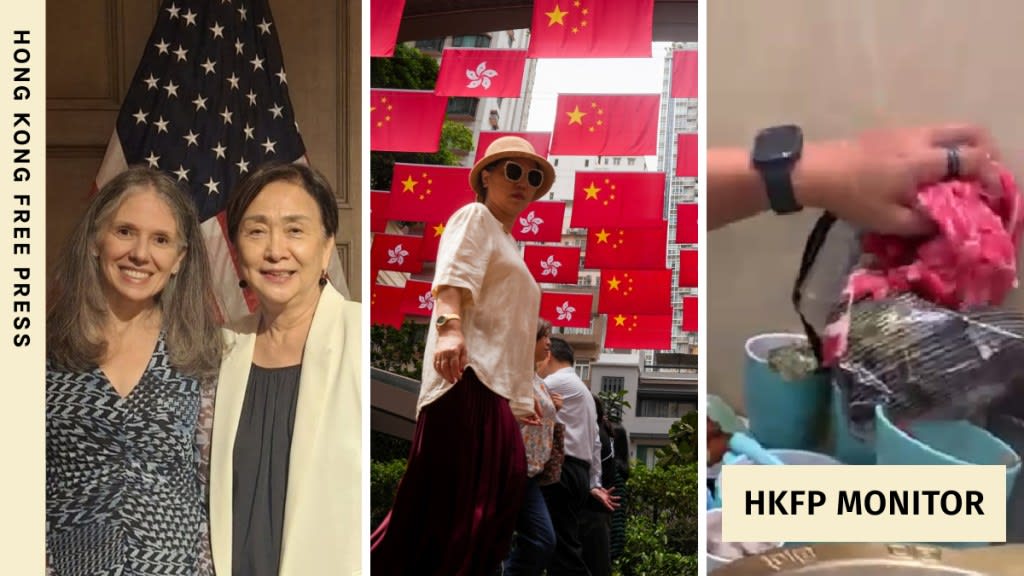
Hong Kong has once again transformed into a sea of red, as around 130,000 festive decorations were installed across the city to mark the 76th anniversary of the founding of the People’s Republic of China on October 1. The celebrations included banners, stickers, posters, lamppost buntings, digital displays, flower plaques, lighting features, and large-scale installations. According to the Home Affairs Department (HAD), the expenses for these decorations are absorbed by individual bureaux and departments under their existing budgets, in line with the principle of fiscal prudence.
The cost of the decorations in 2023 was revealed to be HK$31.2 million, but the true cost for this year remains undisclosed. This echoes previous years when similar requests for information took months to process. Despite the high costs, the government continues to invest in these displays, which have become a symbol of national pride and unity.
A History of Protest and Change
China’s National Day has not always been a time of celebration in Hong Kong. In the first half of the past decade, annual demonstrations reflected frustration with Beijing’s increasing influence. From protests at the National Day reception in 2016 to tens of thousands marching in 2017 against “authoritarianism,” dissent was a regular feature of the holiday. In 2019, during the opposition to the extradition bill, the National Day celebration was overshadowed by protests and violent clashes across the city. It was also the first time during the unrest that a police officer fired a live round at a demonstrator, who was later jailed for rioting and assault.
After the imposition of the national security law in 2020, the annual march was banned, citing Covid-19 restrictions and security concerns. However, hundreds defied the ban, resulting in dozens of arrests. By 2021, the trend began to shift as patriotic groups staged grand flag installations, with one massive display even draped across the outdoor staircase of the Hong Kong Cultural Centre by Victoria Harbour. Since then, pro-Beijing organisations have continued flag-waving campaigns, especially in Tsim Sha Tsui, while the government has ramped up its own efforts.
Continued Criticism of US Envoy
Beijing’s offices in Hong Kong, state-backed media, and pro-establishment figures have continued their criticism of new US Consul General Julie Eadeh. The top American diplomat for Hong Kong and Macau has faced scrutiny since taking office in August, with controversy resurfacing over her meeting with pro-democracy activists Joshua Wong and Nathan Law during the 2019 protests and unrest. The attacks began after she reportedly invited former chief secretary Anson Chan and veteran democrat Emily Lau to her welcome receptions.
The Hong Kong and Macao Affairs Office (HKMAO) shared an article from Ta Kung Pao last Saturday, accusing Eadeh of being the “black hand” behind the 2019 protests. The commentary questioned the diplomat for inviting Chan and refused to describe the former No. 2 official as a “retired official,” instead calling her an “out-and-out anti-China agitator who brings chaos to Hong Kong.” On Sunday, Wen Wei Po published fresh criticism from Legislative Council (LegCo) members. Lawmaker Doreen Kong warned that Eadeh’s conduct may “touch the red line” of the national security law, urging transparency in consular activities and cautioning against involvement in local political disputes.
A few days later, Eadeh had a meeting with Cui Jianchun, commissioner of the Chinese foreign ministry in Hong Kong, during which he spelt out “four don’ts”: don’t meet people the consul general shouldn’t meet, don’t collude with “anti-China forces,” don’t interfere with national security cases, and don’t engage in activities that undermine stability.
Despite the tensions, Eadeh attended a flag-raising ceremony on Wednesday to mark China’s National Day. She stayed through the October 1 event and greeted fellow diplomats as well as South China Morning Post editor-in-chief Tammy Tam.
Rumours of New Government Leadership
Former chief superintendent John Tse – best known for fronting daily police briefings during the 2019 protests – is rumoured to be in line to head the government’s Information Services Department (ISD). According to Ming Pao’s political column, insiders suggest Tse could replace current ISD chief Apollonia Liu, who took up the post in May 2024. If confirmed, this move would break with the long-standing tradition of appointing career administrative officers to the government’s top PR role.
Tse joined the administration in 2022 as a principal assistant secretary in the Security Bureau before being transferred to Chief Executive John Lee’s office, where he managed Lee’s social media accounts. He was promoted to information co-ordinator in the CE’s office in June last year. His current role carries a monthly salary between HK$256,985 and HK$272,745 on Point 4 of the Directorate Pay Scale. Liu, meanwhile, is speculated to be moving up to the post of permanent secretary for the Security Bureau.
Viral Incident and Public Reaction
A video from an all-you-can-eat hotpot restaurant went viral this week after staff confronted a man suspected of stashing away food meant for dine-in only. The clip showed an employee telling two diners that CCTV had caught the man slipping food into a bag. Asked to hand the items back, the customer reluctantly produced a Ziploc bag of raw food, a fistful of beef slices, and eventually a tote bag stuffed with a large Tupperware of seafood – oysters, shrimp and all – plus two packs of instant noodles.
The incident sparked heated discussions online, with many netizens criticising the man for being greedy. But things escalated when his personal information was posted online – an act that amounts to doxxing, a criminal offence in Hong Kong. Privacy Commissioner Ada Chung told lawmakers on Thursday that her office had received six complaints linked to the case. While she declined to comment further due to ongoing investigations, she reminded the public that forwarding improperly disclosed personal data could also breach the law.
Recent Incidents and Public Safety
A viral video this week showed a man hugging a woman from behind in Causeway Bay, grabbing at her purse as she clutched it tightly. Passersby quickly stepped in to separate the pair, after which the woman called the police. A separate post on Xiaohongshu claimed to show another incident in the same district on Sunday evening. The user said a man she didn’t know hugged her, told her he liked her, and even asked if she would be his girlfriend. She thanked bystanders who helped her and the person who recorded the encounter, adding that the man was later arrested and charged. Police confirmed to HK01 that they received a report from a 41-year-old woman, who said she was attacked on Paterson Street by a 42-year-old man.
Cultural Highlights
A 12.8-metre-tall lantern inspired by a fairy character took centre stage at Hong Kong’s West Kowloon Cultural District this week to celebrate China’s National Day. Set against the city’s iconic skyline, the lantern sat on the harbourside Art Park lawn as part of a four-day carnival themed around huafu – traditional Chinese dress – marking the 76th anniversary of the founding of the People’s Republic of China. The main display depicted a bust of a female figure dressed in blue while holding a traditional fan and surrounded by flowers. It was a tribute to Zixia Fairy, a character from the 1995 Hong Kong film A Chinese Odyssey, played by Athena Chu.


