Legislative Changes and Political Shifts in Hong Kong
Welcome back to HKFP Monitor. This week, 15 members of the “patriots only” Legislative Council (LegCo) announced they would bow out of the upcoming race – including eight who are in their 70s – fuelling speculation about an age cap and who might be tapped to take their places.
Amid these announcements, Chief Executive John Lee delivered a speech calling for “effective democracy” and a “perfect partnership of patriots” between the government and the legislature.
As of Friday evening, less than two months before the December 7 polls, a total of 15 Hong Kong lawmakers announced they would not be seeking re-election.

The Hong Kong Economic Journal’s (HKEJ) political column summarised the exodus as being contingent on four main factors: age, performance or involvement in scandals, outspokenness, and affiliation with a political party.
The age limit is apparent, as eight of the 15 lawmakers are septuagenarians. Local media have cited unnamed sources in Hong Kong’s political circles, saying a line will be drawn for the next LegCo term to exclude those aged 70 or above.
However, other septuagenarian lawmakers, such as Regina Ip, also the convenor of the top government advisory body, have not indicated whether they would stay on.
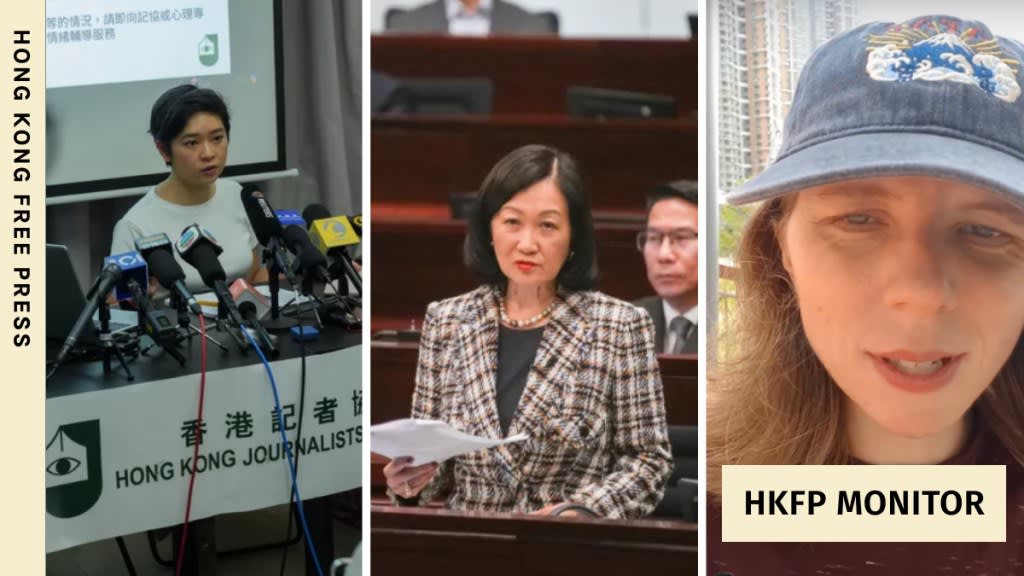
Ip, 75, appeared visibly upset as she avoided questions from reporters on Monday, saying: “Don’t stand in my way to the meeting. Back off.”
The veteran politician was also one of the few lawmakers to support a bill that would have granted limited legal rights to same-sex partners in Hong Kong – the only piece of legislation voted down in the current term.
Younger LegCo members have also joined the LegCo exodus.
Former MTR engineer Gary Zhang, 36, and social worker Connie Lam, 37, are the two youngest LegCo members to quit.
Meanwhile, lawmaker and solicitor Doreen Kong, seen as an outspoken voice – even in the opposition-free legislature – told reporters on Wednesday that she would be announcing her decision at the legislature’s final council meeting next week.
Asked if the cakes she bought for reporters signalled her farewell, Kong told them not to be “too pessimistic.”
The city’s two largest pro-establishment political parties, the Democratic Alliance for the Betterment and Progress of Hong Kong (DAB) and the Hong Kong Federation of Trade Unions (FTU), may be feeling the heat.

Citing anonymous sources, local media said several other lawmakers, including those on the younger side, would be on the chopping block.
All but one bill passed:
The wave of announcements comes as the legislature passed its final, 130th bill to legalise and regulate online ride-hailing platforms. Save for the same-sex partnerships bill, this legislative term has passed every single other piece of legislation.
But that near-perfect track record has also given rise to perceptions that lawmakers were passive in their work, lacking their own insights and only intending to flatter Beijing. As such, public opinion of the legislature has declined further in recent years.
According to the HKEJ, the coming LegCo term will also see fewer party-affiliated lawmakers in the Election Committee, the powerful electoral body that votes for the city’s chief executive, to ensure that legislators do not simply vote along party lines.
The newspaper also cited anonymous sources saying that young political elites would be taking over LegCo, including delegates to the National People’s Congress and the Chinese People’s Political Consultative Conference.
Lau Siu-kai, a consultant for semi-official Beijing think tank the Chinese Association of Hong Kong & Macao Studies, said that Beijing’s wish for a younger LegCo was clear, and consistent with the central government’s introduction of younger leaders.

China Daily editor joins Liaison Office:
Former deputy editor-in-chief at state-run China Daily Sun Shangwu has been appointed deputy director of Beijing’s Liaison Office in Hong Kong.
State-backed paper Wen Wei Po described Sun as having “extensive experience in external propaganda,” while HK01 cited sources saying that Sun’s appointment demonstrated Beijing’s recognition of Hong Kong’s importance in external communications.

Effective democracy:
Amid the wave of lawmakers opting out of the elections, Chief Executive John Lee called for the “perfect partnership of patriots” between the government and the legislature, demonstrating “effective democracy.”
His speech at a seminar on executive-legislative collaboration on Thursday made front-page news in both local newspaper Ming Pao and media outlet Wen Wei Po.
Lee lauded the “patriots only” legislature for its efficiency. The electoral overhaul of 2021 “completely reversed the destructive situation” when democrats still held seats in the legislature, he added.
The chief executive said that the overhaul, which was the result of a resolution by Beijing’s top legislative body, put an end to filibustering, insults to officials, collusion with foreign forces, calls for sanctions, and acts jeopardising national security.
To achieve high-quality governance, Hong Kong needed an “effective and functional democracy and perfect partnership of patriots,” he added.
The 2021 legislative revamp reduced democratic representation in the chamber, tightened control of the elections and introduced a pro-Beijing vetting panel to select candidates. Beijing’s overhaul made it almost impossible for traditional democrats to stand – most are now behind bars, are in self-exile, or have quit politics.

Video games:
Chan Tong-kai, the murder suspect whose case sparked Hong Kong’s 2019 extradition law crisis, became the focus of a profile of lawmaker Reverend Peter Koon published in Sing Tao this week.
Chan, who allegedly killed his girlfriend in Taiwan and fled back to Hong Kong, cannot be sent back to Taiwan for trial, as the two places do not have an extradition agreement. He now lives in a remote hilly region, separated from society, Koon said.
Whereas a convict could take responsibility by serving a jail sentence, Chan’s life was at a “complete standstill,” said Koon, addressing remarks that the murder suspect was “playing video games all day.”
The reverend, known for acting as an unofficial spokesperson for Chan, said: “How could anyone be happy playing video games all day?”

Press freedom rebounds:
Press freedom in Hong Kong has shown a slight rebound from a historic low, according to a trade union’s survey of journalists in the city, reflecting what the group calls the “resilience” of the media sector.
The Hong Kong Journalists Association’s (HKJA) latest “Press Freedom Index” stood at 28.9 points on a hundred-point scale, a score that the press group said remained “extremely low” and did not reflect “any substantive improvement in Hong Kong’s press freedom landscape.”
For the first time, the HKJA survey did not include a public poll. “Due to budgetary and environmental constraints… the public rating section was temporarily suspended,” it said.
Kate Barr, a Scottish tutor in Hong Kong, was allegedly doxxed by social media users after her exchange with a street vendor went viral.
In a video posted Sunday, Barr told a chestnut hawker she wanted to buy a single chestnut and a quail egg, saying she would pay for the items, and handed over a HK$500 bill.
The vendor gave her the chestnut and quail egg for free.
The video later received comments criticising her for failing to observe local customs and accusing her of pressuring the vendor to give her the food for free.
Barr said in another now-deleted video on Instagram that her workplace reached out to her after social media users revealed where she worked, citing concerns for student safety.
In a later update, she said that she would be allowed to finish the rest of her contract, which ends next month.
Some drew attention to Barr identifying as an “Aspie,” or someone with Asperger’s Syndrome, an outdated diagnosis now understood as a form of autism.
They said criticism directed towards Barr demonstrated a lack of mental health awareness and a general sense of intolerance, especially on social media.
Barr did not respond to HKFP’s enquiries.
The Guardian: ‘Americans are democracy’s equivalent of second-generation wealth’: a Chinese journalist on the US under Trump
Wired: The City That Made the World Fall for a Monster

Related posts:

Fiction park: He was the best in class. He still wasn’t good enough

Gagan Thapa takes oath as Congress president, vows to regain public trust

Inside knowledge that has locals gripped by fear after gran’s body found decomposing in cattle dip

New property purchase disclosure rule in Japan sparks fears it may curb foreign investment

Dino-mite treasures: inside Singapore’s Fort Knox storing playthings of ultra-rich