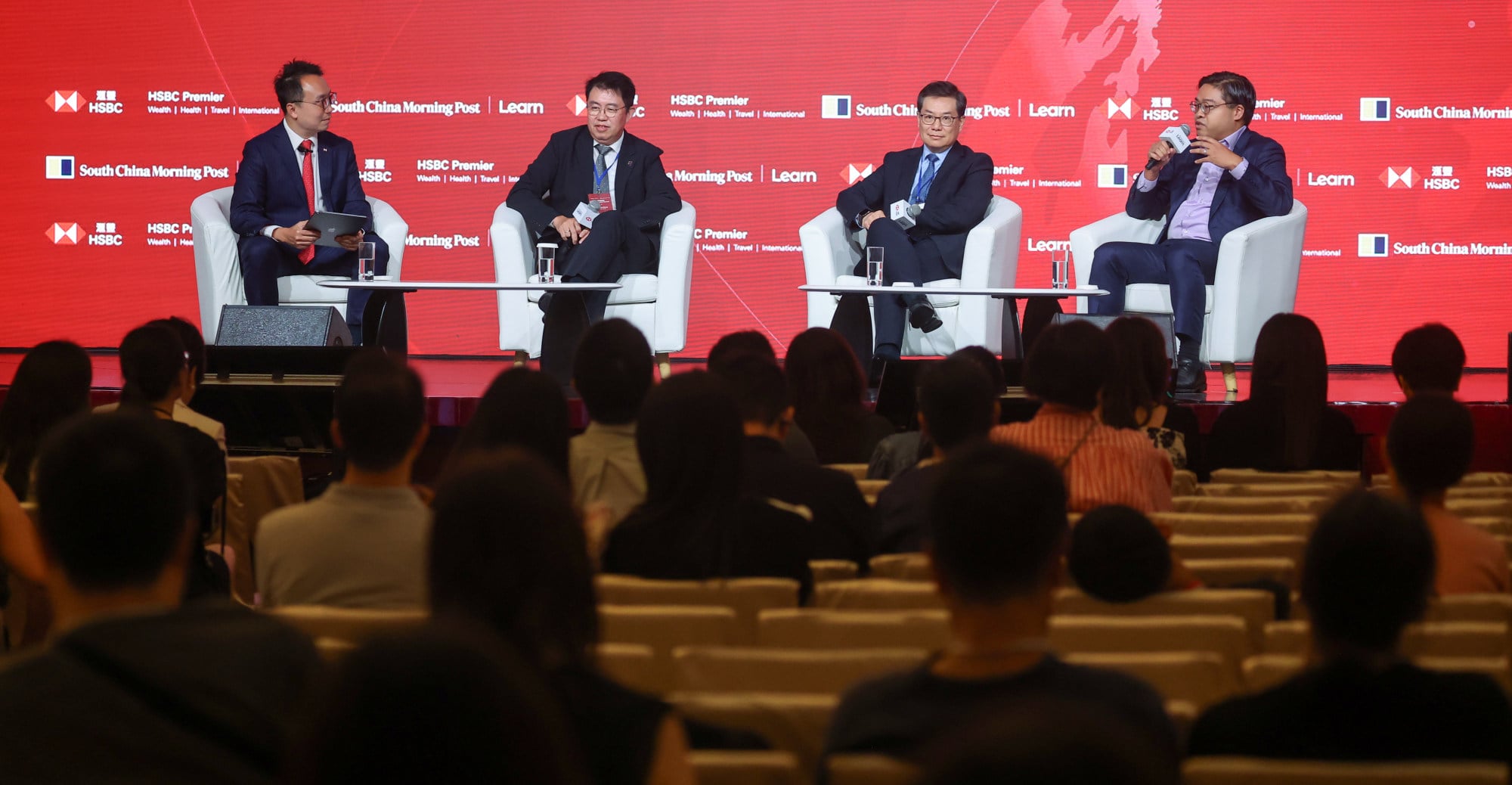
During Global Education Summit, medical leaders say AI won’t replace doctors, but will reward those who ask better questions
Medical experts have stressed that Hong Kong’s next generation of healthcare professionals must combine clinical rigour with emotional resilience, an open-minded approach to artificial intelligence (AI) and the drive to transform the sector.
The remarks came during a panel discussion on the first day of the inaugural Global Education Summit, co-organised by the South China Morning Post and HSBC Premier.
“We always talk about people going north, going to Shenzhen … for medical services. But I would say that it’s a good thing for a future doctor. You’re going to be a doctor not just for 7 million people. You’re going to be a doctor for 18 million people,” Dr Chung Kin-lai, chief executive officer of CUHK Medical Centre, said on Saturday.
Do you have questions about the biggest topics and trends from around the world? Get the answers with SCMP Knowledge, our new platform of curated content with explainers, FAQs, analyses and infographics brought to you by our award-winning team.
The discussion, titled “Powering Hong Kong’s healthcare talent pipeline: from medical education to research and industry impact”, explored how the sector was preparing young doctors and healthcare talent for this changing landscape.
The summit, which runs for two days, brought together about 5,000 policymakers, educators and parents from around the world to discuss regional talent development, AI integration and evolving academic pathways.
With AI reshaping clinical workflows, medical leaders warned that traditional metrics for evaluating future doctors were changing. Chung noted that soft skills had become increasingly vital.
“The old stuff when we ask about the ingredients to be a good doctor … are something like good language, good presentation, and also something like good memory,” Chung said.
“But nowadays, memory is not that important. When you ask the internet, when you ask AI, everything comes up.
“I think more important is your training of the other side – the soft side, your human touch.
“How you communicate with people, especially with empathy.”
Dr Kenneth Tsang, regional chief executive officer of IHH Healthcare North Asia and chief executive of Gleneagles Hospital Hong Kong, highlighted a generational divide in technology adoption.
“What we found is that doctors in middle age and above are quite resilient when it comes to adopting AI. They actually resisted taking up AI,” he said.
“So we are now actually moving into finding the younger generation of doctors who are very open and already, I would say, very knowledgeable about AI to join us and work with us on AI and healthcare.”
With AI tools more prevalent, panellists told students that innovation required asking insightful questions, not just memorising answers.
Innovation also required asking insightful questions rather than just memorising answers, said Dr Ricky Chiu, chairman and chief executive officer of PHASE Scientific and adjunct associate professor at the Chinese University of Hong Kong, during the session curated by SCMP Learn, the newspaper’s education arm.
“My advice is really right now trying to learn how to ask the question that no one asks or ask the right question,” he said.
“If I ask AI what the best way to screen for cervical cancer is, AI will give me a textbook answer. There’s nothing useful about that, right? But if I ask AI, how come these tests are available but yet all the women are still not doing that? And you’ve got a company.”
Chiu encouraged students to view healthcare opportunities and career paths beyond traditional clinical roles, outlining three primary ways to contribute: treating patients; teaching doctors; and developing healthcare tools.
“A doctor saves lives one at a time, and I think it’s a great life’s work. A good diagnosis can really change people’s lives,” he said.
For students and parents considering medical studies, the experts also stressed that young people should ask themselves whether they understood it was a lifelong commitment before choosing this path.
Chung warned high-achieving students against choosing medicine out of habit or simply because it was a top priority, noting that the extensive training required could often take 12 to 15 years.
Tsang emphasised that real-world clinical readiness hinged on humility, while Chiu urged parents to let their children make their own choices, ensuring medicine was a genuine “lifetime dream”.
Echoing the transformation seen in medicine, an adjacent panel discussed the qualities that tech and innovation leaders looked for in the next generation of talent.
The panel featured industry leaders including Michael Yue, managing director and general manager of Google Hong Kong, Terry Wong, chief executive officer of the Hong Kong Science and Technology Parks Corporation, and Yiyin Zhao, managing director of Samsung Electronics Hong Kong.
Experts discussed some qualities they valued in future talent beyond academic results, including curiosity, adaptability, problem-solving and resilience.
They also stressed the importance of students maintaining “the attitude to keep learning” and the ability to build relationships, work with people, and have empathy for others.
More Articles from SCMP
Hong Kong mega bridge’s popularity takes toll on helicopter, ferry services: lawmaker
SCMP Best Bets: Ovation an opening day target for punters at Sha Tin
Asia-Pacific media outlets forge new partnerships ahead of Shenzhen Apec summit
Taiwan remains Asia’s ‘most dangerous’ issue, former Singaporean diplomat warns
This article originally appeared on the South China Morning Post (www.scmp.com), the leading news media reporting on China and Asia.
Copyright (c) 2026. South China Morning Post Publishers Ltd. All rights reserved.

Related posts:

Fiction park: He was the best in class. He still wasn’t good enough
Gagan Thapa takes oath as Congress president, vows to regain public trust

Inside knowledge that has locals gripped by fear after gran’s body found decomposing in cattle dip

New property purchase disclosure rule in Japan sparks fears it may curb foreign investment
Dino-mite treasures: inside Singapore’s Fort Knox storing playthings of ultra-rich