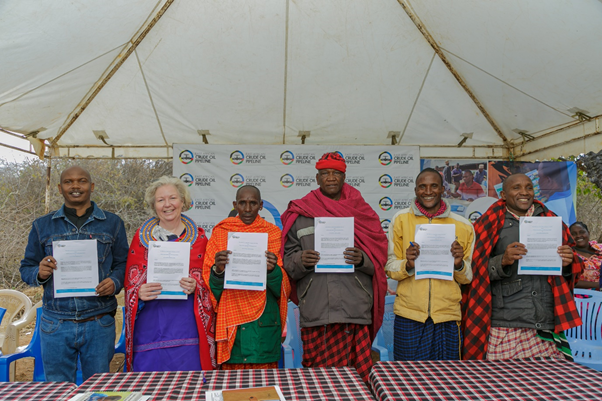
Overview of the EACOP Pipeline Project
The East African Crude Oil Pipeline (EACOP) project, a significant regional oil pipeline connecting western Uganda to the Port of Tanga in Tanzania, has successfully secured its financing. This achievement marks the conclusion of a complex deal that faced considerable opposition from environmental campaigners who had sought to halt its construction. Despite these challenges, the project is now fully funded and on track for its First Oil milestone.
Funding Sources and Financial Breakdown
The project’s funding comes from a mix of shareholders’ equity, commercial loans, and sponsor debt facilities. These financial arrangements were finalized earlier this year, ensuring the project is fully funded until the First Oil phase. According to Irene Batebe, Uganda’s Permanent Secretary at the Ministry of Energy, shareholders have provided equity since the final investment decision (FID) in February 2022. Banks and sponsor debt facilities were secured earlier this year, allowing the project to proceed without further delays.
The financing strategy included bonds issued by TotalEnergies in February and June, with proceeds partially allocated to the pipeline’s construction. This move surprised observers, as it was initially expected that financing would primarily come from China. However, the involvement of various international and regional banks has significantly bolstered the project’s financial standing.
Project Milestones and Progress
Uganda has set the second half of 2026 as its First Oil milestone. The upstream operator, China National Offshore Oil Corporation (Cnooc), at the Kingfisher oilfield, has already surpassed the number of drilled wells needed to produce the first barrels of crude from the Albertine Graben. Last month, Cnooc geologists reported that 16 wells had been drilled, with 15 of them cased and cemented, and all producing wells confirmed to contain oil. This progress keeps the field on schedule for the government’s target.
The Tilenga project, designed to produce up to 190,000 barrels per day, is also nearing readiness, adding pressure on the midstream crude export pipeline meant to transport Uganda’s oil to international markets.
Recent Financial Developments
According to Ms. Batebe, $775 million was disbursed in March 2025. Since then, additional banks have joined, raising the commercial bank debt facility to $1.2 billion, with further refinancing discussions ongoing. “Therefore, Eacop is fully funded and financed,” she said. The $755 million raised earlier came through a syndicated loan from local, regional, and international lenders, plugging financing gaps and pushing EACOP to 72 percent completion.
Peter Muliisa, chief legal officer at the Uganda National Oil Company (Unoc), noted that the final tranche of debt will come from Chinese banks. Seven other banks have joined the financing of the 1,443-kilometre pipeline, including the African Export-Import Bank, the Islamic Corporation for the Development of the Private Sector, Standard Bank of South Africa, Stanbic Bank, and KCB Uganda.
Construction Updates
Project updates show horizontal directional drilling at the Sigi River is ongoing, with 38-inch, 44-inch, and 50-inch reaming works completed in the third quarter. The 54-inch reaming is underway in preparation for pipe pulling. The third quarter also marked the arrival of the last shipment of line pipes at the Port of Dar es Salaam, concluding a major supply contract by Chinese manufacturer Chu Kong Steel Pipe, which shipped over 87,000 pipe joints over two years.
“We are at a point where we can’t stop. We are not panicking over financing,” Mr. Muliisa said. “Laying of line pipes is targeted for the end of December. We’ve done pretty much all the engineering [work] on the Ugandan section, except for a few kilometres.”
Environmental Concerns and Opposition
Since 2020, environmental groups have campaigned against the Hoima–Tanga pipeline and its associated upstream projects, Kingfisher and Tilenga. They argue that the heated 24-inch pipeline, designed to transport Uganda’s waxy crude at 50°C, will produce millions of tonnes of greenhouse gas emissions. The #StopEACOP campaign prompted many Western banks initially lined up for debt financing to withdraw, forcing shareholders to raise additional equity. This reversed the original 60:40 debt-equity split to a 52:48 ratio for the $5 billion project.
EACOP Financiers and Their Roles
In separate interviews, officials stated that the final tranche of debt will come from Chinese lenders and the seven banks that have since joined the financing of the 1,443-kilometre pipeline. When it became apparent that Western lenders would not bankroll the project, EACOP shareholders in 2023 went on a mission to China, initially targeting $3 billion to bridge the shortfall. However, Chinese lenders Exim Bank and Sinosure reportedly committed smaller amounts.
Other banks later joined, including the African Export-Import Bank, the Islamic Corporation for the Development of the Private Sector, Standard Bank of South Africa, Stanbic Bank, and KCB Uganda, leading to the $755 million debt close in March.
Financial Audit and Investor Involvement
An Ernst & Young audit of EACOP Ltd — the entity overseeing the pipeline’s construction and operations — showed that the first debt tranche amounted to $755 million. The audit also revealed that additional facilities were signed with shareholder-affiliated companies to fund the remaining portion of the budget, prompting TotalEnergies to seek sponsor debt facilities to avoid delays.
EACOP shareholders include TotalEnergies (62 percent), Unoc (15 percent), Tanzania Petroleum Development Corporation (15 percent), and Cnooc (eight percent).
Bond Issuance and Underwriters
In February 2025, TotalEnergies issued €3.15 billion ($3.62 billion) in bonds underwritten by Citi, Santander, Mizuho, Société Générale, Standard Chartered, and UniCredit. The bonds included €1 billion ($1.14 billion) maturing in March 2033, €1.3 billion ($1.49 billion) maturing in 2045, and €850 million ($976 million) maturing in 2037.
In June, the French energy major issued a second round of bonds worth €3 billion ($3.44 billion), underwritten by Citi, BBVA, Deutsche Bank, JPMorgan Chase, MUFG, Royal Bank of Canada, Société Générale, and Wells Fargo. This tranche comprised €900 million ($1.03 billion) maturing in 2040, €1.1 billion ($1.26 billion) maturing in 2035, and €1 billion ($1.14 billion) maturing in 2031.
Insights from BankTrack
Ryan Brightwell, BankTrack’s Human Rights Campaign Lead, noted that some Western lenders that had distanced themselves from EACOP have since underwritten bonds for TotalEnergies, the project’s lead investor. “These banks seem to have seen their commitment as a very narrow one – they committed not to join a project finance loan that would be exclusively for EACOP,” he said. “When it comes to general-purpose financing for TotalEnergies, the banks probably hope there is more distance between their finance and the project,” he argues.


