The Rise of Price Match Schemes in Supermarkets
Supermarkets are increasingly using price match schemes to retain customers who might otherwise switch to Aldi, a German discount supermarket. These schemes allow shoppers to get the same price as Aldi on certain products. However, a recent study has revealed that these price matches are not always equivalent in terms of product quality or ingredients.
Discrepancies in Products
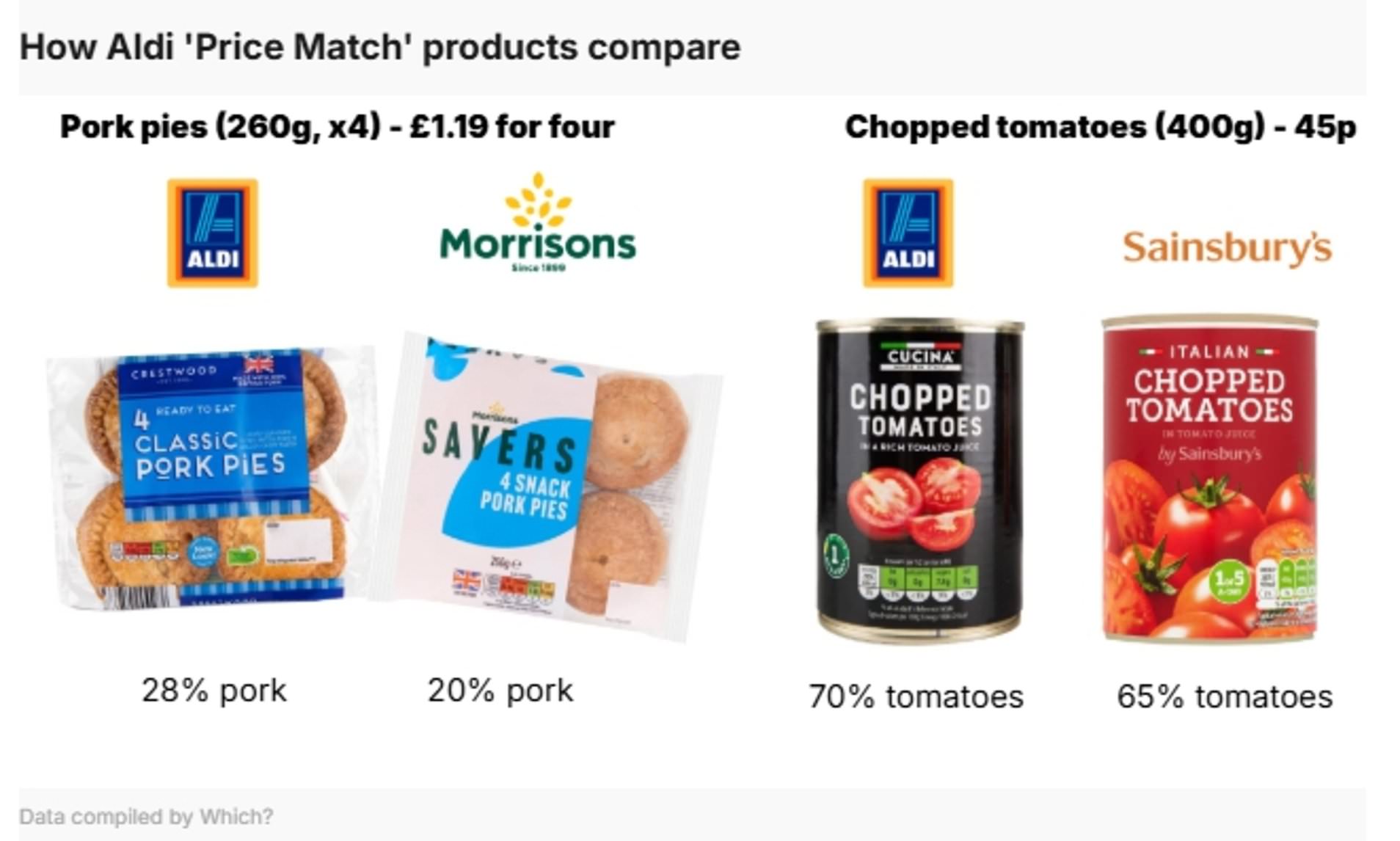
Which? conducted an investigation and found several discrepancies in products that were claimed to be price matches. For example, pork pies from different supermarkets may have different amounts of pork. A specific case involved Aldi’s “Crestwood Classic Pork Pies 4 Pack,” which contains 28% pork, while Morrisons’ “Savers 4 Snack Pork Pies” only contain 20% pork, despite being priced the same.
Similarly, tins of chopped tomatoes from different supermarkets can have varying proportions of tomatoes. While Aldi’s “Chopped Tomatoes in a Rich Tomato Juice” contains 70% tomatoes, Sainsbury’s “Sainsbury’s Chopped Tomatoes Can” only has 65%. These differences can be significant for consumers who expect identical products when they see a price match.

Variations in Product Ranges
Another finding was that some supermarkets offer different ranges of products when matching Aldi’s prices. For instance, three chains matched Aldi’s cream of tomato soup, but the Morrisons version was a budget item, while the others were standard-range products. This variation can confuse shoppers who assume that all price-matched items are the same.
Additionally, researchers noted that while unit prices (price per 100g or 100ml) are often matched, pack sizes can differ. This means that a larger pack might not necessarily offer better value, as the actual quantity and content can vary.
Multiple Matches and Flavors
The study also highlighted that some products are matched by multiple supermarkets in various sizes. For example, Aldi’s Cucina Spaghetti is matched by four other supermarkets in different sizes, resulting in 12 total matches. This can give shoppers more options, but it may not always align with their expectations of what a “match” should be.
Moreover, supermarkets sometimes match several different flavors of a product to just one Aldi version. This practice can provide more choice, but it may not reflect the exact product that consumers associate with the term “match.”

Supermarket Strategies
Several major supermarkets have developed price match schemes to compete with Aldi. Sainsbury’s, Tesco, and Morrisons have implemented these strategies, while the Co-Op offers a similar scheme only for loyalty members. Asda previously had a scheme but discontinued it after one year to focus on a new “Rollback” campaign of price cuts.
Which? experts found that Morrisons, Sainsbury’s, and Tesco have the largest range of price-matched products. Sainsbury’s currently leads with 898 price-matched items, followed by Tesco with 761 and Morrisons with 504. These schemes include a variety of products, with Sainsbury’s focusing more on own-label items and Tesco offering more alcoholic beverages.
Product Categories and Availability
Most products included in price match campaigns are non-perishable foods, followed by chilled items. Fewer alcohol, frozen, pet, baby, homecare, and beauty products are available in these schemes. This trend reflects the challenges that supermarkets face in maintaining competitive pricing across all product categories.
Reena Sewraz, Which? retail editor, emphasized that while price matches can help shoppers save money, they should carefully examine the products they are purchasing. She warned that matches may not always represent the same quality or ingredients, and that larger packs may not always offer better value.
Conclusion
As the competition between supermarkets intensifies, the use of price match schemes continues to evolve. While these strategies can benefit consumers, they also highlight the need for greater transparency and awareness. Shoppers should remain vigilant and compare products carefully to ensure they are getting the best value for their money.


