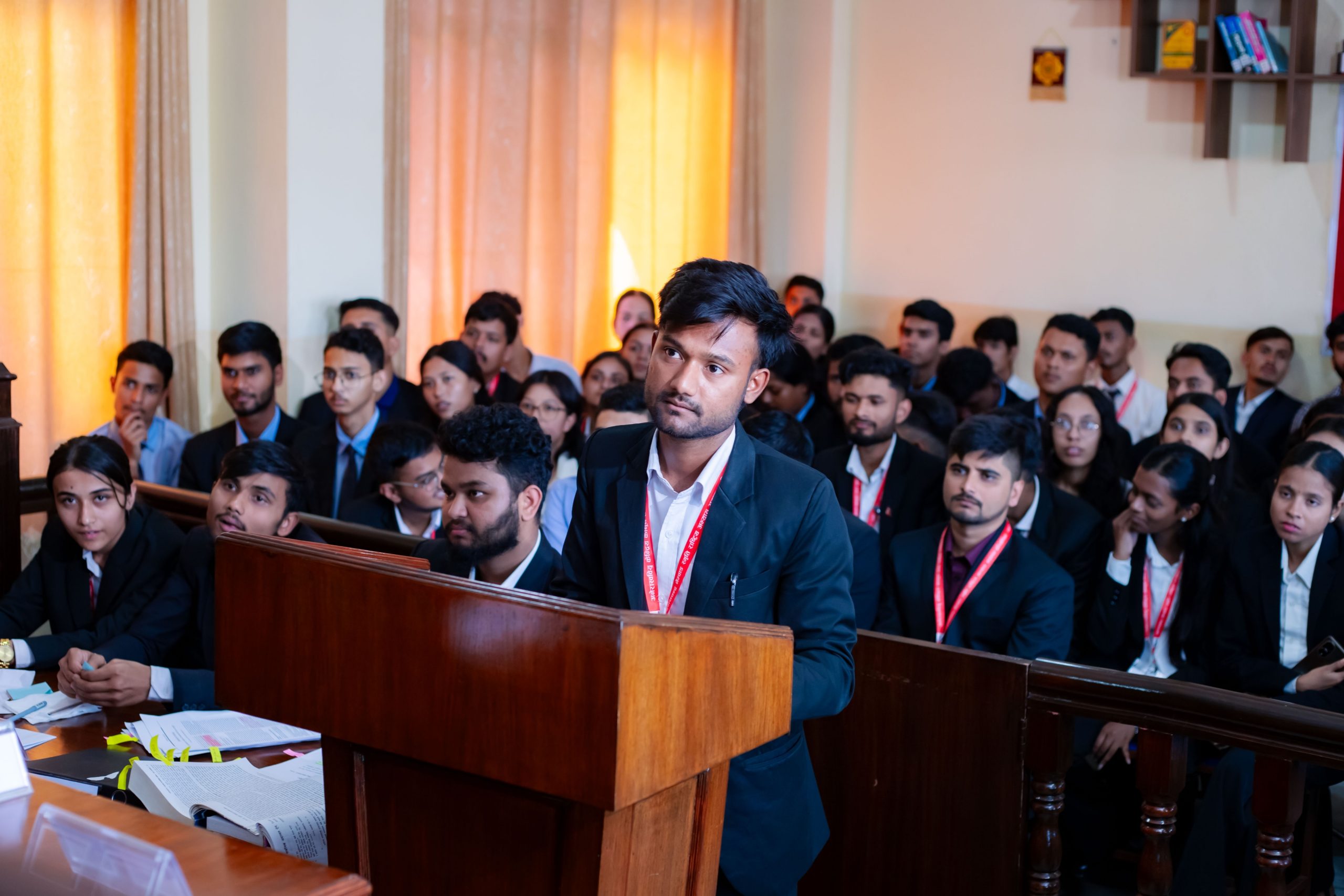
A Journey of Legal Awareness and Social Activism
For Majid Ansari, law is more than an academic discipline; it is a means to address the inequalities and injustices he has observed throughout his life. “More than an influencer, I’d like to call myself a legal awareness campaigner,” he says. As a ninth-semester BALLB student at Nepal Law Campus, Ansari’s focus is on the “rule of law and constitutionalism” rather than ideology or political affiliation.
Early Life and Educational Struggles
Born and raised in Morang, Ansari’s journey to law was anything but straightforward. He attended Shree Sharada Higher Secondary School, where the lack of qualified teachers was a major challenge. “One teacher, qualified only up to class five, taught all math and science subjects.” He recalls, “In class eight, a teacher came from Kathmandu to teach English but left after two months when his scooter got destroyed during the Madhesh Andolan.” With little guidance, he and his classmates relied on rote learning to pass exams.
Despite these obstacles, Ansari persevered. “I didn’t even know law could be studied in high school,” he says. So, he joined Maryland College to study management, hesitant about his English skills. “I was advised not to choose science, since it’s in English; failing it would cost me years, making it a risky choice,” he says.
A humiliating classroom incident pushed him to learn English from YouTube. Shortly after, he discovered that law was available at the higher secondary level in Biratnagar and switched streams, later joining Bright Vision College for his bachelor’s. Encouraged by advocates Bikash Kumar Gupta and MD Mazid Prawej, he moved to Kathmandu, passed the entrance exam with just fifteen days of preparation, and has lived in a hostel ever since.
Awakening to the Power of Law
Ansari’s interest in law began much earlier. In grade nine, he led an admission campaign in his village and met an eight-year-old from the Musahar community who told him he did not go to school. When Ansari asked why, the boy replied: “If I start studying, will you feed me?” That question, he says, “shook my moral foundation.”
The boy’s mother earned half the men’s wage, but her husband took her money, forcing her son to wash dishes to support the family. When Ansari inquired why children weren’t attending school despite available funding, his teacher replied that it wasn’t the school’s responsibility. “That’s the government’s work,” he said. Ansari then asked why he couldn’t compel the government to act. The teacher replied, “That’s the law’s role, not ours.” At that moment, he realized that law enables change.
Another incident involving his mother deepened that conviction. “She had a land dispute case and visited the court often,” he recalls. “She saw an officer extort money from a villager of the Musahar community, claiming his document was missing. My mother said if she questioned it, her case work would be delayed. That’s when I understood how people who lack legal awareness are always exploited.”
Civic Engagement and Grassroots Activism
Long before the protests, Ansari had already been involved in civic activities. “In school, I joined the UNESCO-funded ‘Green Club’ and later became secretary of the ‘Sagarmatha Teens Club’ under Province One’s Ministry of Law and Internal Affairs.” Through it, he says, “We invited Mahabir Pun, the current minister of Education, Science and Technology, for a tech-programme, and worked on banning tobacco sales near schools and hospitals, we even persuaded the canteen to replace junk food with local snacks.”
Back home, he founded the ‘Karsiya Yuwa Club’, leading cleaning drives and distributing food to 500 families during the Covid-19 pandemic. These experiences convinced him that grassroots networks were more effective than formal organizations. “They’re easier to mobilize and can make real changes,” he says.
Student Politics and Advocacy
Arriving in Kathmandu exposed Ansari to student unions and political influence. When his college delayed publishing entrance exam results, he made a video criticising the unions for inaction. “That video went viral,” he says. “Within a week, the results were out.”
His critique of student politics continued even as he joined the Free Student Union. “I’ve always believed unions are necessary to hold administrations accountable, but there must be transparency,” he says. “What I saw was corruption—fund misuse and inflated bills.” Refusing to sign off on questionable expenditures led to conflict. “They eventually called me back and replaced me,” he says. “I published the expense details on Facebook so students would know.” Despite setbacks, he continues to advocate for inclusivity in education—raising issues affecting Madhesi and Muslim students.
The Gen Z Protests and Personal Impact
The Gen Z-led protests in September marked another turning point in his activism. Ansari first learned about it through social media. “I saw discussions around September 5 and thought it was just another protest at Maitighar,” he says. “But by the 7th, it was clearly turning into a mass movement—the posts, videos, and comments made that obvious.”
He joined the protest on September 8. “At Maitighar, I expected a huge crowd but saw only around 2,000 people,” he recalls. “Still, watching young people—often dismissed as careless—stand up for accountability was powerful.” The mood, however, soon shifted. “When a poster of the then-Prime Minister KP Oli was torn down, I sensed it could turn violent. Minutes later, barricades fell, bikers rushed in, and gunshots followed.”
He escaped through Thapagaun and Old Baneshwar. “Hearing that 19 people were killed shook me. I believed in peaceful protest, but the government responded with violence.” Later that evening, he and a friend went to Civil Hospital to donate blood. “The scene was horrific—blood and bodies on the floor, announcements calling families. Even the hospital wasn’t safe; police were firing outside,” he says. “We had to switch off our phones and hide our location for safety after reaching the hostel.”
Despite witnessing violence, Ansari returned to the street the next day. He says, “When Oli resigned, our demand was met. But when the crowd moved towards Singha Durbar and the Supreme Court to burn it, I went to the hostel to campaign against it. We wanted accountability, not destruction.”
Calls for Reform and Accountability
On government accountability, Ansari is clear. “The first core demand of the Gen Z movement is tackling corruption,” he says. “All closed files should be reopened. Party members who suffered under corrupt leaders should speak up. Create public opinion, let people file complaints. If party insiders expose corruption, it becomes far easier to act.”
He stresses transparency, “Reports like Bhairav Prasad Lamsal’s case should remain public. Political leaders must be held accountable, or the government should take action backed by public opinion.”
He also calls for police reform. “The police are often the first point of contact for the public, yet they’re corrupt and violent. I’ve experienced it firsthand while seeking justice for my brother’s murder case. They told me, ‘You study law, but we play with law. You have it in books, we keep it in our pockets.’ Imagine how an ordinary person feels hearing that,” he says. “The system itself needs reform.”
Future Outlook and Advice
On the current interim government, he remains critical but measured. “They’ve been calm and thoughtful, but that’s not enough,” he says. “The biggest priority should be ensuring elections happen on time.” He believes the Sushila Karki government should obtain a written commitment from all major parties. “If the election is delayed, the country will fall into political instability,” he warns. “We need political authority, not anarchy.” He adds, “I’m not happy with their performance—politicians’ assets are still hidden, stolen rifles are missing, escaped prisoners are yet to be recaptured.”
He advises Gen Z activists to push constitutional amendments into party manifestos, prepare trustworthy candidates, and participate actively in elections. “Gen Z should go to constituencies, not just stay in Kathmandu. Make representatives win who align with our agendas. If elections are not recognized internationally, democracy suffers,” he warns.
On politics, Ansari says, “We need parties to run the country in a reformed manner. If they can’t reform, they should be replaced—not by a dictator or the army. Otherwise, we’ll lose our democracy.” He warns of elements seeking absolute power, adding, “The election should not be delayed, not even one day, or the country risks a political vacuum.”
He urges youth engagement: “If you’re not involved in politics, politics will happen to you. Gen Z already has leaders’ attention. Youths now get tickets at parties, but if you don’t fight for your rights, incapable people will rule you.” He stresses questioning leaders rather than idolizing them. “Power corrupts, only questioning keeps it in check.”
Reforms and Decentralization
On bureaucratic reform, he suggests a citizen-led “shadow government” monitoring corruption, reporting to the CIAA, and ensuring systemic transparency. He also proposes introducing a one-door system, applications, and removing unnecessary officer cabins.
Reflecting on the turbulent months, he says, “Maybe if Gen Z had cleaned the burnt Parliament and stayed outside for a few days, demanding reform peacefully, the Constitution could have been amended then. Not doing so set the country back six months. I might have achieved it if I’d been on the negotiating team. Now, the negotiating team is occupied and centralised, which limits effectiveness. That’s why I’ve left Kathmandu—to decentralize efforts and act independently.”