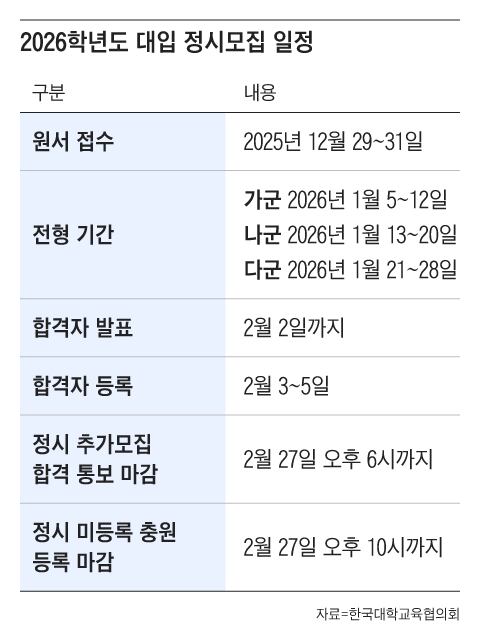
The application period for the 2026 academic year regular admissions will run from the 29th to the 31st. Regular admissions primarily select students based on their College Scholastic Ability Test (CSAT) scores. Universities rank applicants according to their CSAT scores, utilizing university-specific metrics and reflection ratios to determine admissions.
This year’s regular admissions will select 69,331 students nationwide, a decrease of 122 from last year. Admissions primarily based on CSAT scores account for 92.2% (63,902 students) of the total quota. The remaining quotas are allocated to practical skills-based admissions (7.5%, 4,726 students), comprehensive student record admissions (0.3%, 219 students), and student record subject-based admissions (0.5%, 317 students).
This year’s CSAT was particularly challenging in the Korean and English sections. A test is generally considered difficult if the highest standard score exceeds 140 points. This year, the highest standard score for Korean was 147, 8 points higher than last year. For English, the proportion of students achieving the top grade (Grade 1) under the absolute evaluation system dropped to 3.11%, the lowest since its introduction. Consequently, many students failed to meet the minimum academic requirements for early admissions, leading to predictions of a significant increase in the number of students transferring to regular admissions.
However, there are also numerous opinions suggesting that the number of students transferring to regular admissions may not increase significantly, as universities struggling to secure students due to population decline tend to maximize their early admissions quotas. The following summarizes key strategies for the 2026 academic year regular admissions, as reported by regional education research institutes and private admissions agencies.
◇Intensified Regular Admissions Amid ‘Difficult CSAT’
The CSAT score report displays three metrics: standard scores, percentiles, and grades. For Korean, Mathematics, and Social Studies/Science/Vocational Subjects, all three metrics are provided. For English, Korean History, and Second Foreign Languages/Classical Chinese, which are evaluated on an absolute scale, only grades are indicated. Since universities utilize different metrics, applicants should target institutions that favor metrics where they perform best to increase their chances of acceptance. While some universities use standard scores directly, others apply adjusted standard scores.
When narrowing down target universities, applicants should also calculate each institution’s converted scores. While some universities rank applicants based directly on the standard scores from the CSAT report, many apply their own criteria, such as subject-specific weightings and adjustments, to calculate converted scores. Applicants must verify their eligibility by computing these converted scores for each university. Even students with identical standard scores and percentiles may experience vast differences in rankings depending on a university’s converted score system.
Given the particularly challenging English section this year, applicants should examine how universities incorporate English scores. Institutions generally use two methods: assigning scores based on English grades, which are reflected at a certain ratio, or adding bonuses or penalties to the total score. Typically, when bonuses or penalties are applied, the score differences between grades are minimal, reducing English’s overall impact.
For example, Seoul National University deducts points from a total of 600 based on English grades, with only a 0.5-point difference between Grades 1 and 2. Korea University, with a total score of 1,000, deducts 3 points for Grade 2, meaning a single additional correct answer in another section can offset this penalty. In contrast, Yonsei University reflects English scores at 12.5% of the total, resulting in a score gap exceeding 5 points between Grades 1 and 2.
Woo Yeon-cheol, head of Jinhak Admissions Strategy Research Institute, stated, “Even with the same scores, admission chances can vary depending on how each university weighs English.” He emphasized, “Applicants must carefully analyze the pros and cons of each institution to devise their application strategies.”
◇Limit of One Application per Group in the ‘Three-Application System’
In regular admissions, applicants can submit up to three applications across the Ga, Na, and Da groups. It is advisable to compile a list of universities and departments within your score range after reviewing past cutoff scores released by institutions. The three applications should be categorized as ‘reach,’ ‘target,’ and ‘safety.’ Most preferred universities in Seoul and the metropolitan area are concentrated in the Ga and Na groups.
For instance, Korea University and Yonsei University are in the Ga group, while Seoul National University is in the Na group. While some applicants target the Da group, its competition rates and cutoff scores often fluctuate annually. It is generally advisable to strategize for acceptance in the Ga and Na groups.
For the 2026 regular admissions, some universities have changed their recruitment groups, necessitating prior confirmation. Konkuk University will recruit students for its College of Media and Communication, previously in the Da group with 5 spots, in the Na group this year. The College of Engineering’s Electrical and Electronic Engineering and Computer Engineering departments, previously in the Ga group, will now be in the Da group. The University of Seoul will recruit all majors of its newly established Convergence Science and Technology Division through the Da group starting this year. Seokyeong University will move Future Convergence Studies 1 to the Na group, Future Convergence Studies 2 remains in the Da group, and the Liberal Arts Department will be recruited in the Ga group.
◇Expansion of New Majors and Non-Major Admissions
Several universities are introducing new broad-based recruitment units in this year’s regular admissions. Dongguk University has established the ‘College of Business’ as a broad-based recruitment unit. Starting this year, it will recruit students for three departments—Business Administration, Accounting, and Business Informatics—under the College of Business in the Da group. Sangmyung University has integrated its liberal arts majors. The Humanities and Social Sciences and Business and Economics tracks are now under the Humanities division, while IT and Engineering tracks fall under the Sciences division.
The ‘non-major’ system, also known as the autonomous major selection system, allows students to choose their majors upon advancing to their second or third year. This year, regular admissions, like early admissions, are seeing an increase in non-major recruitment. Sungshin Women’s University’s ‘College of Creative Convergence’ admits students without a designated major, allowing them to select a major based on their aptitude and career goals when advancing to their second year. The university will recruit 210 students in the Ga group for liberal arts and 51 in the Na group for advanced fields. The University of Seoul will recruit 45 students each in the humanities and natural sciences tracks for its liberal arts department, a significant increase from last year’s 16 per track.
◇Reflection of School Violence Measures
Major universities will reflect school violence measures recorded in student records for regular admissions, similar to early admissions. This follows the Ministry of Education’s comprehensive school violence eradication measures announced in 2023. Universities may deduct points from total scores or disqualify applicants based on these measures. Most institutions do not admit students with Measures 8–9. Konkuk University and Dongguk University deduct points from a total of 1,000 based on a penalty table corresponding to recorded school violence measures. Hankuk University of Foreign Studies also deducts points from total scores according to the specific measures applied to applicants with school violence records.