The Power of Imagination in Climate Action
The phrase “I’ll believe it when I see it” is often used by those who are skeptical. However, in the world of Willy Wonka, the opposite philosophy prevails: “You’ll see it if you believe it.” This idea, central to the 1971 film Willy Wonka and the Chocolate Factory, suggests that imagination can shape reality. It’s a concept that has stayed with many, including the idea that only those who maintain a sense of wonder and hope can truly grasp the possibilities of the future.
In the story, Charlie, the young protagonist, is rewarded not for his virtue alone but for his ability to envision something beyond the immediate. This aligns with the modern concept of “imagination activism,” a term coined by Phoebe Tickell. According to her, the climate crisis isn’t about a lack of solutions—it’s about the absence of a creative, collective vision for what a better future could look like.
Imagination as Climate Infrastructure
Humans are naturally skeptical and inclined to follow the herd. Evolution has wired us to question threats and copy others’ behaviors—strategies that once kept us alive. Today, these instincts can hinder our response to climate change. Imagination activism works with these tendencies rather than against them. When we witness others believing in and working towards a shared vision—a world with clean air, thriving nature, and affordable clean energy—the herd follows, transforming paralysis into curiosity.
Tickell describes imagination as a “muscle that’s been atrophied” by systems such as education, capitalism, and media. Her work focuses on rebuilding this capacity through collaboration with communities and organizations, shifting internal cultures toward valuing creativity and long-term vision over short-term efficiency. She emphasizes the importance of expanding who gets to imagine, advocating for “imagination justice”—a belief that the ability to dream should be accessible to all.

Art as a Tool for Possibility
Art is perhaps the most powerful tool for expanding the sense of possibility. In 2014, artist Olafur Eliasson brought large blocks of ice from Greenland to public squares in cities like Paris and London, making climate change tangible and experiential. These installations later appeared at UN conferences, where they confronted people with both urgency and opportunity.
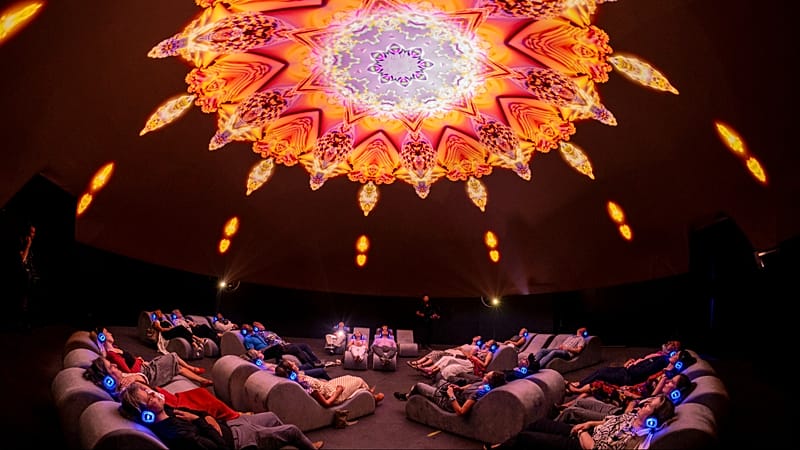
With global attention now focused on the COP30 climate summit in Brazil, a new installation is gaining traction. In Rio de Janeiro, the Museum of Tomorrow, known for exploring the future of our planet through sustainability, technology, and human impact, is home to a new project called The Lumisphere. Conceived by Visions2030, this immersive experience consists of three interconnected domes where light projections, surround sound, and interactive storytelling create a multi-sensory journey through possible futures.

A Journey Through Possible Futures
As visitors travel through the domes, a Wizard of Oz-like voice guides them through a 360° space, offering a particularly intense experience akin to a hallucinogenic trip. This immersive journey lifts visitors out of their bodies and into a literally effervescent world. The experience includes a voice that says:
“Imagine a world where clean water sparkles crystal blue, imagine the Earth’s abundance, dolphins and starfish, giant tortoises, osprey, eagles, butterflies, fireflies. Imagine jaguars and zebras, birds of dazzling hues, with so much for everyone. Imagine cities with amazing transportation and clean energy. What if technology combined with nature to make urban spaces magical?”
Of course, when we imagine an Eden of clean air and wild oceans, we often picture a world without people—an earth scrubbed of its human messiness. But the challenge is to imagine a future that includes us—flawed, creative, technological humans living differently, not disappearing.

Rehearsing the Future
The Lumisphere asks visitors to imagine what a thriving planet might look and feel like for us before inviting them to reflect on what choices could make those visions real. The team behind the project even collaborated with the Institute for the Future (IFTF) to measure the impact of the exhibit on public imagination, agency, and belief. Preliminary results show that the experience left visitors more confident about the future. Time will tell if this sense of optimism continues throughout different geographies, as the Lumisphere is just beginning a five-year global tour.

Beyond Utopia
Writers like Rebecca Solnit or George Monbiot might frame imagination activism as wishful thinking. Monbiot argues that some environmental narratives soothe rather than mobilize, offering “emotional relief instead of political change.” He calls for “adult conversations” about power and responsibility rather than sentimental “love the Earth” messaging.
Solnit, in one of her essays, warns that hope and imagination must be active, not naïve or escapist. She doesn’t criticize imagination itself but cautions against “false hope.”
Back in Willy Wonka, Charlie wins because he dares to believe—and that is what imagination activism ultimately calls for.
The Role of Imagination in Climate Activism
Carey Lovelace, creator and founder of Visions2030, says her goal is to “reawaken the human capacity to dream,” adding, “a radical stealth tool in the climate activist toolkit is the imagination. Having a dream is so motivating.”
Fabio Scarano, curator at the Museum of Tomorrow, agrees. “The crisis of imagination is the backbone of all crises, climatic, economic and humanitarian. We have a very hard time imagining futures that are different from the present—and it’s because we don’t have better images to help us.”
The installation taps into a growing realization among climate campaigners that policy alone is not enough to make change. It provides the cultural space to rehearse different possibilities before they exist.
In Brazil, where climate politics are now central to both national identity and global negotiations, that act of rehearsal feels particularly urgent.


