Political Turmoil in Nepal’s Nepali Congress
Nepal’s longest-serving political party, the Nepali Congress, is facing a deepening crisis. Despite a Supreme Court ruling that recognized the Gagan Thapa faction as the official party on April 17, the internal conflict has not been resolved. Instead, the party is now on the brink of a split, with multiple factions engaging in parallel activities and refusing to compromise.
The Supreme Court’s decision was meant to end a three-month-long dispute over the party’s legitimacy. However, it has only intensified the tensions between rival groups. According to former vice president Purna Bahadur Khadka, who leads a group of dissident voices within the party, the current situation shows that unification efforts are failing. His faction continues to challenge the Thapa-led leadership, arguing that Thapa has failed to secure the position of party president.
Khadka’s group is reportedly preparing to form a new party on May 29, which coincides with Republic Day. This move comes after repeated demands for the dissolution of the current central working committee led by Thapa and the formation of a new one to convene the party’s 15th general convention. The Khadka camp also proposed the inclusion of members from both factions in the central committee and called for the 15th general convention to be led by Sher Bahadur Deuba.
Deuba, who served as party president until mid-January, is currently living in Hong Kong after the government issued an arrest warrant against him and his wife in a money laundering case. Despite this, he remains a key figure in the party’s history. Khadka referenced past divisions within the party, particularly the split caused by Girija Prasad Koirala, and noted that Deuba later helped reunite the party. He emphasized that the decision to unite or split the party now rests entirely with Thapa.
During a recent event in Surkhet, Khadka reiterated his concerns about the party’s future. He mentioned that he had previously discussed the issue with Thapa and Vice President Bishwa Prakash Sharma, urging Thapa to take responsibility for uniting the party. “Whether to unite or split the party is your [Thapa’s] responsibility,” Khadka said.
The current discontent stems from Thapa’s decision, supported by Sharma, to call a special convention in January. This convention elected Thapa as party president, removing Deuba from his position. To manage the factional divide, Thapa offered tickets to some senior leaders from the Deuba-Khadka faction and another faction led by Shekhar Koirala. However, the Koirala faction has not succeeded in bridging the gap between the two sides.
Despite back-channel talks, no progress has been made in uniting the factions. Both camps have continued to hold parallel gatherings across the country. The Deuba-Khadka faction is even looking for a house to rent for a new contact office, signaling their intent to establish a separate entity if unity fails.
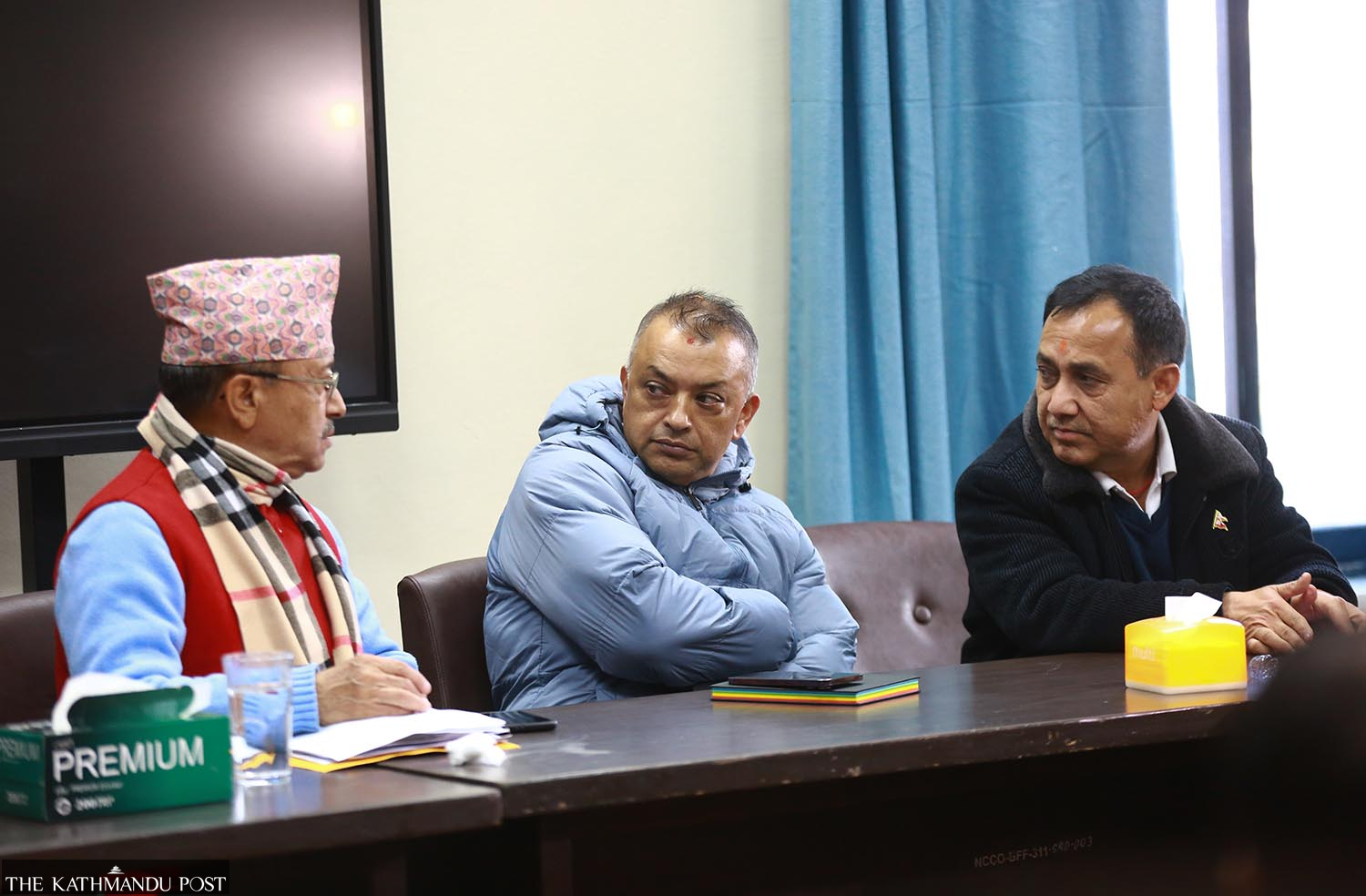
Recent meetings between Thapa and Khadka have focused on strategies to keep the party intact. Thapa also met with Koirala, who has shown some openness to collaboration. “The onus lies on Thapa to come up with a proposal for party unity,” Koirala told the Post. “I am ready to sacrifice anything for party unity.”
The main point of contention remains the Khadka faction’s demand to form an organizing committee for the 15th general convention. Thapa has not shown support for this initiative. Additionally, disputes over the distribution of active party membership and the recent appointment of 19 central working committee members have further complicated the situation.
Sharma, the party’s vice president, acknowledged the ongoing disputes but expressed hope that models for unity could be found. “Each side has its own model for resolving the dispute,” he said. “Efforts are underway to close the gap.”
Congress leader NP Saud, a former foreign minister, believes the chances of unity are slim. “The way both camps are engaging in parallel power exercises, I doubt the possibility of party unity now,” he said. “I do not know where these separate gatherings will take us.”