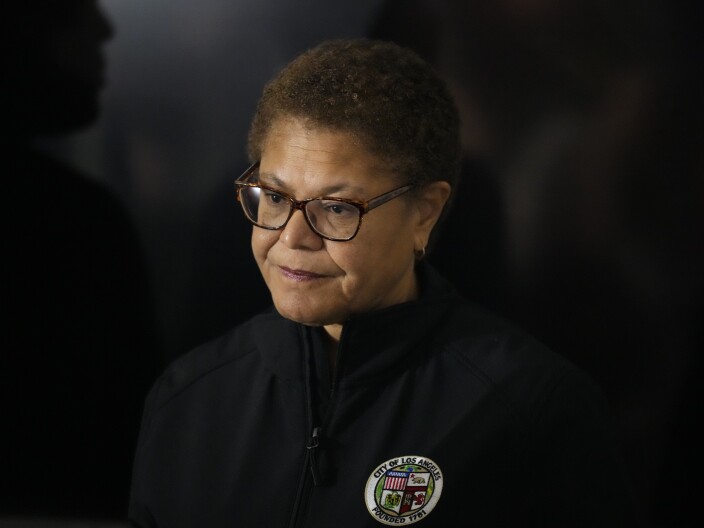
When Los Angeles Mayor Karen Bass’s team made public the text messages concerning the January wildfires a few days back,
Los Angeles Times
,
NBC Los Angeles
and
ABC7 Eyewitness News
A request submitted on January 15 is still pending. Despite numerous follow-up inquiries, the mayor’s office eventually released documents that had been previously provided to other news organizations.
The backstory
When the January fires broke out, Bass found herself in Ghana as part of a federal group attending the swearing-in ceremony of the nation’s newly elected leader. By the time she began her trip back home, lasting 24 hours, Los Angeles had been hit with its worst firestorm ever. The blaze claimed 30 lives across the Palisades and Eaton areas, including 12 fatalities within the boundaries of Los Angeles itself. Additionally, thousands of residences and structures succumbed to the inferno.
Here’s where things stand
Bass’ team initially said they needed until May 1 to respond to ’s records request, which went beyond the scope of texts released to the L.A. Times and other news organizations.
initially asked for the following texts and other communications:
- Messages exchanged via the city-issued cellphones assigned to Mayor Karen Bass between January 1, 2025, and January 8, 2025, which include one or more of these terms within their content: “red flag warning,” “strong winds,” “winds,” “fire,” “Pacific Palisades,” “Pacific Palisades Fire,” “Eaton Fire,” “Pasadena,” “Altadena,” “response,” and “Hurst Fire.”
- Emails dispatched and received by Mayor Karen Bass between January 1, 2025, and January 8, 2025, which include any of these terms within their content: red flag warning, powerful gusts, wind conditions, blaze, Pacific Palisades area, Pacific Palisades Blaze incident, Eaton Fire event, Pasadena region, Altadena vicinity, reaction details, and Hurst Fire occurrence.
- Email exchanges between Mayor Karen Bass and LAFD Fire Chief Kristin Crowley spanning from January 1, 2025, through January 8, 2025.
is still awaiting the completion of this request.
After text messages were disclosed to other media outlets, they were asked to examine the accessible documentation.
Bass’ team failed to reply when asked via email about reviewing the previously disclosed documents and providing reasons for the delay. The records were eventually acquired following a call made to Bass’ spokesperson regarding comments on a report detailing the delays.
David Loy from the First Amendment Coalition stated that Bass’ office does not have “any justification for withholding” documents that have already been provided to other media organizations.
“If a government entity shares public documents with an initial requestor willingly and deliberately, it must provide those exact records to subsequent requestors as well,” he stated.
Bass’ office might have just mixed things up or failed to send the documents over, he mentioned. However, “if a public entity is showing favoritism, that raises significant issues under the Public Records Act since they are legally bound,” he explained. “… Should they provide records to some, they must do so for everyone.”
When questioned regarding the discrepancy, Bass’ office stated that one should have contacted the communications team for the records. However, it noted that previous request procedures were adhered to in this case.
The Los Angeles Times reported that authorities originally stated Bass’ text message records concerning the fire response had been deleted as these messages automatically erased after 30 days. Subsequently, the mayor’s office mentioned they managed to retrieve the messages using “advanced technology” which was then provided to the Times.
Here are some significant interactions within the texts:
- The fires started on January 7th. On that same morning, meteorologists had warned about exceptionally dangerous and potentially lethal gusts. According to the exchanged messages made public from that day, up until 10:30 a.m., there wasn’t any mention of potential wind hazards before the commencement of the Palisades Fire. Prior to being informed about the initial blazes, Bass had communicated with her team requesting them to arrange flower deliveries for Monica Rodriguez, likely referring to the Los Angeles city councilmember.
- Councilmember Bob Blumenfield informed Bass via text message that he possessed “a warehouse brimming with supplies kept outside our usual channels maintained for emergency situations, and I’m supplying shelters and so forth—long story, but literally tons of resources.” Bass did not respond to this communication.
- “KYY,” presumably Los Angeles Councilmember Katy Young Yaroslavsky, told Bass that “Traci and my sense is that we don’t have nearly enough bodies on the ground helping folks get out and/or around. If national guard is an option it would probably be really helpful.” Traci Park serves on the Los Angeles City Council; her district includes the Palisades. Bass did not reply.
- Other messages indicate that Bass initially became aware of the Palisades Fire through her deputy chief of staff, Celine Cordero, during a gathering at the U.S. Embassy in Ghana. After the event, texts reveal that an anxious Bass hurried back home—a trip estimated to last about 24 hours—while attempting to manage remotely amid disrupted communications. Additionally, she received numerous messages from local, state, and national officials extending their assistance.
- Cordero messaged Bass less than 24 hours after the Palisades Fire started, stating that firefighters were “basically focused on saving lives,” with protecting buildings being a lower priority at that stage. According to Cordero, there were then “several injured civilians (# TBD)” and an unofficial count suggested around 200 houses had been destroyed.
The records are still awaiting updates.
Loy stated that the California Public Records Act “doesn’t establish specific record retention obligations for public agencies. It merely states that these entities must provide access to whatever documents they possess when a request is made.”
He mentioned, however, that the city’s administrative code mandates the preservation of records for
at least two years.
“I think this specific provision of the Los Angeles Administrative Code does indeed apply to communications such as emails and texts from the mayor’s office,” he stated. “Therefore, if the mayor were automatically deleting text messages related to official duties without keeping them for at least two years—as mandated by the city’s administrative code—it would constitute a considerable issue.”
Additionally, they have contacted City Attorney Hydee Feldstein Soto’s office for their input.

