A Historical Parallel: South Korean Leaders and North Korea’s Nuclear Stance
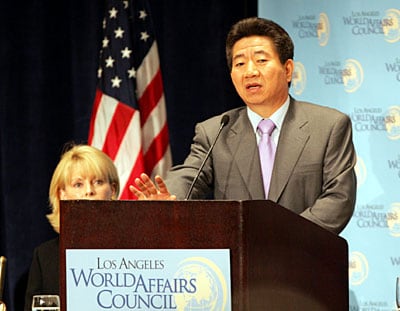
In 2004, a speech by President Roh Moo-hyun in Los Angeles sparked significant controversy when he suggested that North Korea’s possession of nuclear weapons had some validity as a means of self-defense. This remark drew comparisons to recent statements made by President Lee Jae-myung during an investment summit in New York, where he described North Korea’s nuclear development as being driven by the need for regime survival. The parallels between these two leaders’ remarks have raised questions about the evolving diplomatic stance of South Korea toward its northern neighbor.
During a “Korea Economic Briefing (IR) Investment Summit” at the New York Stock Exchange on the 25th, President Lee characterized North Korea’s nuclear program as a measure for regime maintenance. He also claimed that concerns about military tensions on the Korean Peninsula were politically motivated and that South Korea was provoking North Korea. These comments have been criticized for appearing to justify North Korea’s nuclear ambitions and suggesting that South Korea is the aggressor. Some analysts believe that President Lee’s remarks may have been influenced by President Roh’s 2004 speech, which led to widespread backlash both domestically and internationally.
The Context of President Roh’s 2004 Speech
President Roh Moo-hyun made his controversial remarks during a visit to Los Angeles in November 2004, en route to the APEC Summit in Chile. During a luncheon speech at the World Affairs Council (WAC), he defended North Korea’s position, stating that the country’s hardline stance aimed to secure regime security. He criticized the Bush administration’s approach to North Korea and emphasized the need for dialogue and the resumption of six-party talks. His claim that North Korea’s nuclear development had “some validity” caused significant controversy, with major newspapers covering the story as a top news item.
Roh’s speech was not impromptu but rather a carefully prepared statement. Delivered shortly after President Bush’s re-election, it aimed to counter the administration’s hardline policies and prevent a prolonged stalemate in the North Korean nuclear issue. Roh had consistently prioritized the North Korean nuclear issue since taking office in 2003, making similar statements at Cheong Wa Dae. Ko Young-koo, then Director of the National Intelligence Service, testified that he had heard similar remarks from the President multiple times before the LA speech.
Diplomatic Tensions and Internal Rivalries
The rivalry between pro-alliance and pro-independence factions within President Roh’s administration was intense. Foreign Minister Ban Ki-moon, who later became UN Secretary-General, closely monitored the pro-independence group within Cheong Wa Dae. Before the trip, Ban obtained a draft of the LA speech containing phrases like “North Korea has reasonable grounds to view nuclear weapons as self-defense.” Deeming the content provocative, Ban and Deputy Minister Choi Young-jin raised concerns at a National Security Council meeting but failed to persuade Roh. Ban even threatened to resign if the speech was delivered, but Roh refused to back down.
Despite the internal resistance, the speech was seen as a strategic move to engage North Korea and pave the way for future summits. A key government official later explained that the remarks were part of a deliberate strategy to clarify South Korea’s position on the nuclear issue and emphasize flexibility in achieving peaceful denuclearization. The official also stated that there was no prior coordination with North Korea, and that criticizing dialogue-oriented remarks was against common sense.
Impact on South-North Relations
President Roh’s remarks risked undermining the South-North Joint Declaration on the Denuclearization of the Korean Peninsula, which prohibits both Koreas from possessing nuclear reprocessing or uranium enrichment facilities. By seemingly legitimizing North Korea’s nuclear possession, the declaration faced challenges in being enforced. North Korea could counter South Korea’s demands by citing Roh’s comments, weakening South Korea’s position in inter-Korean and six-party talks.
North Korea responded positively to Roh’s remarks, with Jean Ping, President of the UN General Assembly, stating that Pyongyang had positively assessed the comments. This marked the first international acknowledgment of North Korea’s approval of a South Korean president’s remarks. However, North Korea has yet to officially respond to President Lee’s recent statements in New York.
Kim Song, North Korea’s Foreign Ministry Deputy Director-General, arrived in New York for the UN General Assembly and is scheduled to deliver a speech on the 29th. Given the similarities between President Lee’s remarks and North Korea’s stance, attention is now focused on Pyongyang’s response to these developments.

Related posts:

Mother Suffers Daily Allergic Attacks After Drinking Contaminated Coffee Syrup


Challenges of Climate Change in Africa and Lessons from China’s Green Revolution

Senate joint committee finally holds hearing on Ivanhoe deal

True measure of leadership lies not in power, privilege, pageantry – Tinubu at book presentation