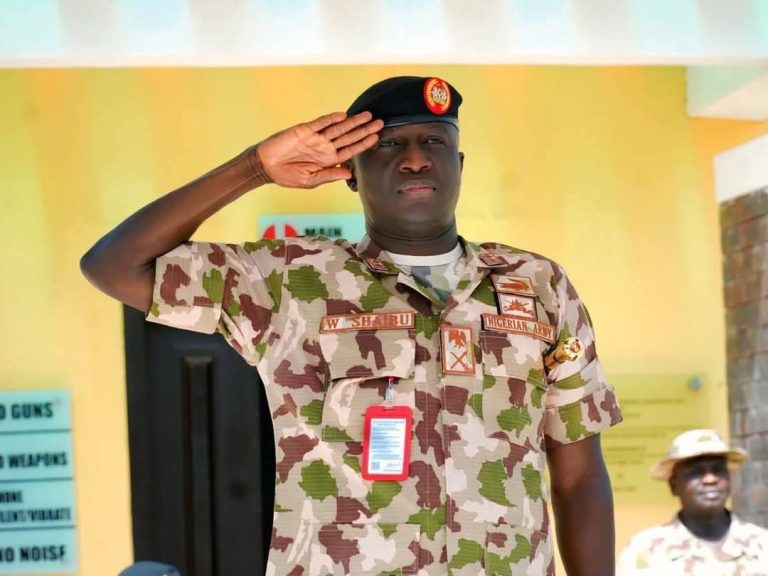
A Leader Forged in Fire
Lieutenant General Waidi Shaibu’s appointment as the 25th Chief of Army Staff (COAS) was met with widespread approval. When he addresses troops, they listen—not because of his rank, but because they know he has lived every word he speaks. His leadership is rooted in experience, not just authority. A decorated commander and seasoned strategist, Shaibu brings a unique blend of operational expertise, academic rigor, and an unyielding commitment to Nigeria’s sovereignty.
Leadership in uniform is often spoken about in lofty terms—duty, courage, sacrifice—but rarely does it find its fullest expression in one individual. In the Nigerian Army today, that embodiment is Lieutenant General Waidi Shaibu, a soldier whose authority is not derived from rhetoric or rank, but from lived experience under enemy fire.
Forged in the Field
Long before his appointment as COAS, Shaibu had already built a reputation for courage in some of the nation’s most challenging theatres of war. From the hostile edges of Lake Chad to the dense, dangerous enclaves of Sambisa, he has led troops in environments where insurgency is entrenched, terrain is punishing, and decisions must be made with clarity that only comes from experience.
His encounters with Boko Haram and ISWAP militants are not second-hand accounts. They are lived realities, marked by nights in the open, days of pursuit, and situations where the difference between success and tragedy rested on quick thinking and steady command.
When he speaks to troops, they listen, not because of his position, but because they know he has lived every word. For Lieutenant General Shaibu, the frontlines have never been optional.
Even with the dusty background and the bush around them alive with tension, both men appear steady, focused, unshaken, and fully present. This image captures more than an operational moment—it represents the kind of leadership that refuses to observe battles from afar.
The Wulgo Story: Where Grit Became Identity
Looking back at his years as a colonel, one mission that many soldiers still recount with pride is the daring assault on Wulgo. This operation remains one of the most demanding episodes of his early career. As a colonel, Shaibu spent days navigating the treacherous waterways of Lake Chad, moving through an environment where danger hid in the water as much as on land. At one point, he was wounded in action. Most would have withdrawn. He pressed on.
The scar from that mission is more than a physical reminder. Within Army circles, it has become a marker of loyalty—to his troops, to the mission, and to Nigeria itself. Those who know him well say the mark on his body reflects the same mark he carries within: a refusal to abandon duty, no matter the cost.
A Nation’s Pride in a Battle-Tested General
For soldiers in the trenches, leadership is never theoretical. They trust those who have stood with them in moments where survival is uncertain. This is the foundation of Shaibu’s bond with the rank-and-file. He understands fear because he has felt it; he understands fatigue because he has marched under it; and he understands faith in the mission because he has had to rely on it in the deadliest moments.
This is why his elevation to Chief of Army Staff was greeted with unusual enthusiasm among many who have fought in Nigeria’s toughest battles. They believe they have a commander who sees them, not as numbers or units, but as men whose lives he has shared responsibility for long before he became the nation’s top soldier.
Thus, at a time when Nigeria confronts complex security pressures, Shaibu represents a reassurance that leadership at the top is not experimental. He has lived through the realities of modern insurgency, confronted the evolving tactics of ISWAP and Boko Haram, and walked terrains that have broken lesser men. Nigeria’s confidence in him is not abstract. It is anchored in what he has already done.
Today, as COAS, Lt. Gen. Shaibu’s Role Extends Far Beyond Battlefields
Those who have followed his trajectory describe his leadership as methodical, disciplined, and unyielding in matters of national security. Yet even in this era of strategic responsibility, the soldier in him remains unmistakable. It is visible in the way he interacts with troops, the way he speaks about the mission, and the way he continues to draw from the experiences that shaped him.
Why His Story Matters Now
Nigeria sits at a crossroads where the difference between insecurity and stability may well depend on the quality of leadership at the highest levels of the Armed Forces. At such a moment, a battle-hardened commander with scars earned in defense of the country becomes more than an appointment but a symbol of what must not waver.
This is because Lt. Gen. Shaibu represents a leader forged by combat, a strategist shaped by study, and a soldier bound by loyalty to the national flag. Essentially, his story is not just his own but that of thousands of men who have stood beside him, followed him, and been inspired by him. It is also the story of a country seeking reassurance in a time of uncertainty and finding it in one of the most seasoned officers of his generation.
Career Trajectory
Born on 18 December 1971 in Olamaboro Local Government Area of Kogi State, General Shaibu was admitted into the Nigerian Defence Academy (NDA) in 1989 as part of the 41 Regular Course and was commissioned into the Nigerian Army Armoured Corps in 1994. A mechanical engineer by training, he holds a Bachelor’s Degree from the NDA and multiple advanced degrees, including a Master’s in Strategic Studies (University of Ibadan), a Master’s in Security and Strategic Studies (National Defence University, Washington D.C.), and a Master’s in Public Administration (University of Calabar).
His career trajectory reflects both grit and intellect. He has commanded formations across challenging theatres of operation, from Borno to Yobe, including his tenure as General Officer Commanding (GOC) 7 Division and Commander Sector 1, Operation HADIN KAI, Maiduguri. His previous appointments include Chief of Training (Army Headquarters), Brigade Commander (21 Special Armoured Brigade, Bama), and Chief Instructor, Nigerian Army Armour School.
General Shaibu’s leadership has been tested in major operations such as HARMONY, LAFIYA DOLE, HADIN KAI, and DESERT SANITY, earning him the Purple Heart Medal for gallantry. He is also a graduate of the Harvard Kennedy School of Government and has served on peacekeeping missions in Liberia and Sudan.
A Fellow of the Defence College (fdc) and recipient of numerous decorations, including the Distinguished Service Star (DSS) and Meritorious Service Star (MSS), Shaibu is expected to consolidate reforms in the Army, enhance intelligence-led warfare, and deepen synergy in joint operations.
Task Defining-Moment
Undoubtedly, Lt. Gen. Shaibu’s journey stands as a reminder that the strength of an army is often defined by the character of the man who leads it. His scars, his battlefield experience, and his unwavering commitment to the Nigerian flag form a legacy that resonates far beyond the trenches of Sambisa or the waters of Lake Chad.
At a time when the nation confronts evolving threats, his steady presence offers reassurance that its security is entrusted to a commander who has lived every danger his troops now face. He is expected to drive reforms that strengthen the Army’s operational tempo, deepen intelligence-led warfare, and enhance synergy across joint forces. The same determination he brought to Wulgo and Sambisa is now being channeled into institutional transformation, training, professionalism, and readiness.
As Nigeria looks ahead, the task before him is both immense and defining. Yet, if his past is any indication, he is a leader prepared for the weight of the moment, one shaped by fire, guided by discipline, and grounded in service.
His story is that of a soldier who earned his place at the helm, not through declarations, but through sacrifice. And as the nation navigates its security challenges, General Shaibu’s leadership stands as a testament to resilience, duty, and the enduring spirit of those who choose to serve in the line of fire.


