-
READ MORE: Rover uncovers signs of ‘vacation-like’ shores on Mars
Unusually large organic molecules have been found.
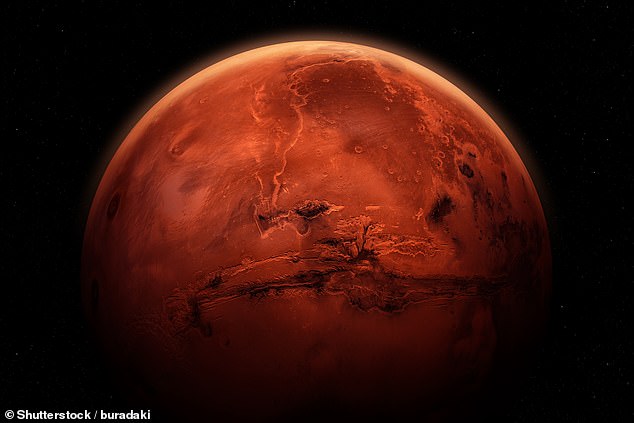
Mars
, providing additional proof that life might have once thrived on Mars.
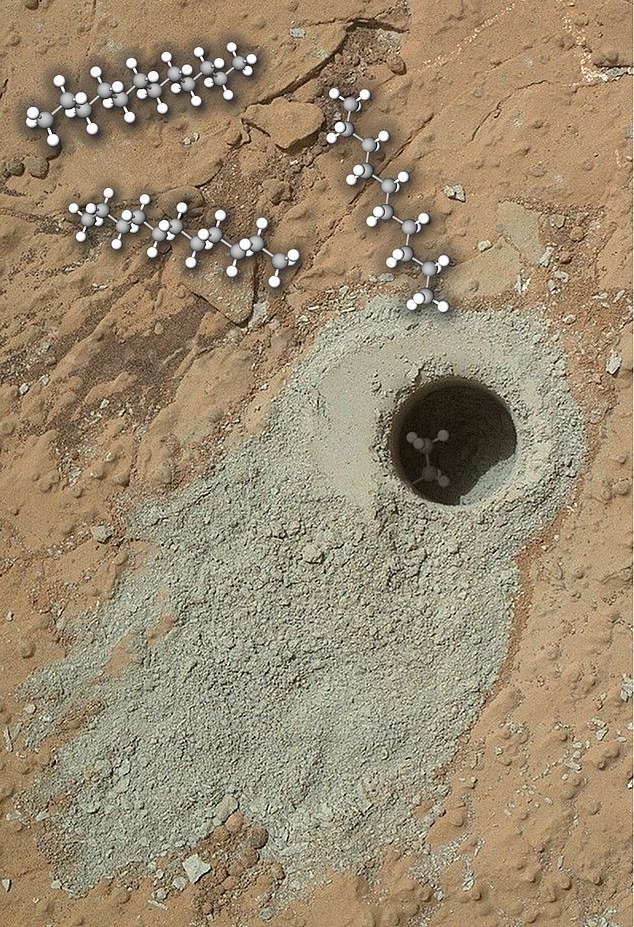
Specialists have discovered lengthy carbon chains with up to 12 linked atoms in specimens of ancient Martian rocks that are several billion years old.
These carbon-based compounds – the most extensive ones detected up to this point – might stem from fatty acids, which serve as fundamental components of fats and oils and are produced on Earth via biological processes.
Scientists stated that the finding is of ‘great interest’ in the quest for possible indications of life.
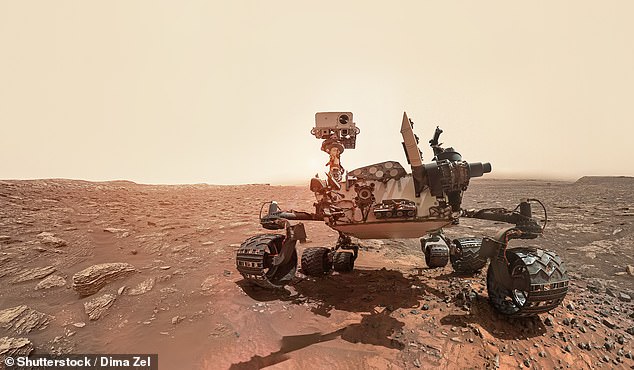
The samples were gathered using SAM, which stands for Sample Analysis at Mars – an instrument onboard the spacecraft.
NASA
The Curiosity Rover, which has been exploring the Gale Crater since 2012.
It features both a gas chromatograph and a mass spectrometer, enabling it to analyze and identify molecules within samples.
The analysis showed that the gathered mudstone includes organic compounds such as decane, undercane, and dodecane.
The absence of geological activity along with Mars’ chilly and dry environment has aided in maintaining this precious organic material over the last 3.7 billion years.
The experts stated that this artifact hails from an era when life initially appeared on our planet.
Although fatty acids are a crucial part of cellular life on our planet, these compounds can also originate from non-biological or purely physical processes, they noted.
In the journal Proceedings of the National Academy of Sciences (PNAS), the research team reported that their achievements open up new possibilities for upcoming missions aiming to discover indications of intricate, life-like chemical processes.
‘They noted that organic molecules conserved within old Martian rock formations offer essential evidence for the Red Planet’s potential to support life in the past and might serve as indicators of biological activity.’
The origin of the long-chain alkanes is still unclear; nonetheless, lab tests suggest they come from the saturated version of straight-chain, primary carboxylic acids—also known as fatty acids.
While abiotic processes may generate these acids, they are recognized as common outcomes of biochemical activities—both earthly and possibly Martian.
‘Hence, the origin and spread of these molecules are highly relevant in the quest for possible biosignatures on Mars.’
Exploring more lifelike chemistry on Mars will be among the objectives of the European Space Agency’s forthcoming ExoMars mission, scheduled for launch in 2028.
The researchers behind this project will develop an apparatus akin to SAM for Dragonfly—the drone scheduled to investigate the surface of Titan, Saturn’s biggest moon, starting in 2034.
A recent study suggested that Mars previously had sunny shores lined with fine sand where calm waters gently washed over them.
Scientists found indications of a ‘getaway-like’ setting on the Red Planet, even though no evident liquid exists on Mars’ surface nowadays.
A global group of researchers leveraged information gathered by China’s Zhurong Mars rover to uncover concealed strata beneath the Martian terrain, providing strong evidence for the existence of an old north sea on the planet.
The latest study provides the strongest proof to date that the planet previously had a substantial amount of water and a more hospitable setting for life, according to the scientists.
Read more

Related posts:

Indian Man Nabbed for Smuggling 100 Exotic Animals from Thailand

Nickel Mining Threatens Tourism in Southeast Asia’s Fastest-Growing Economy


New fossil discovery of an early human ancestor reveals that it walked upright, just like humans

Mammoth de-extinction team produces ‘groundbreaking’ new creature