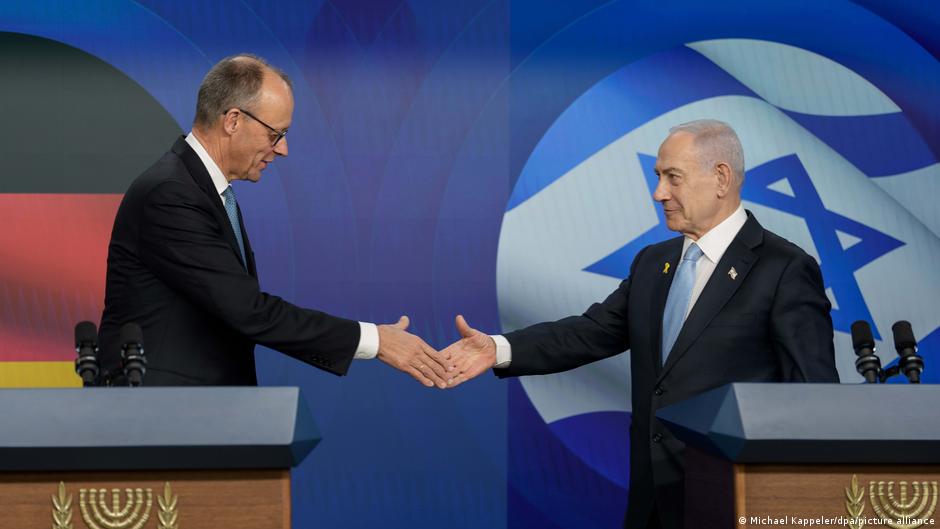
The German chancellor said “lasting peace is possible” in Gaza and that the possible establishment of a Palestinian state, alongside Israel, offered the best prospect for future peace. PasarModern.comhas more.
German Chancellor Friedrich Merz said the best prospect for future peace involved the establishment of a Palestinian state, alongside Israel Merz said this could only be achieved at the end of a process of negotiations Israel’s PM Benjamin Netanyahu spoke of ‘opportunities for peace’ but rejected a Palestinian state Merz’s trip comes after a rare rift in German-Israeli relations after Berlin imposed a since-lifted partial arms embargo on Israel over its conduct in Gaza
Keep reading here for the latest developments during the German leader’s first official trip to Jordan and Israel on December 6 and December 7:
Germany’s Merz says prospective Palestinian state the ‘best prospect’ for future
German Chancellor Friedrich Merz said that work was taking place “toward the goal of a new Middle East” that involved the recognition of Israel.
Merz also said that the possible establishment of a Palestinian state perhaps offered the best chance for such a future.
“Our conviction is that the prospective establishment of a Palestinian state alongside Israel presumably offers the best prospect for this future,” Merz said.
Merz said that any two-state solution would only take place at the end of a process of negotiations, not the beginning, reiterating once again that Germany will not recognize Palestinian statehood just yet.
Israel’s Prime Minister Benjamin Netanyahu, however, has continued to reject an independent Palestinian state.
“We believe there’s a path to advance a broader peace with the Arab states and a path also to establish a workable peace with our Palestinian neighbors,” Netanyahu said.
“But we’re not going to create a state that will be committed to our destruction at our doorstep.”
Merz: ‘A lasting peace is possible’ in Gaza
German Chancellor Friedrich Merz said on Sunday that he believed that a “lasting peace is possible” in Gaza despite isolated violations of the ceasefire currently in place under a US-brokered peace plan.
Speaking at a joint press conference with Israeli Prime Minister Benjamin Netanyahu in Jerusalem, Merz said Germany was providing humanitarian aid to Gaza residents and would help rebuild the Palestinian enclave.
Merz also said there could be “no role for Hamas,” the Palestinian militant group that has held power in Gaza since 2007, in the political future of the Palestinian territory.
The German leader also reiterated his country’s support for Israel, referring to its historical obligation in view of the Holocaust perpetrated by Nazi Germany.
He said this support had been maintained after the October 7, 2023, Hamas-led attacks on Israel that triggered the current Gaza conflict.
However, he called on Israel to adhere to international law in its military response to those attacks, in which more than 1,200 people were killed in Israel, mostly civilians, and 251 hostages taken.
Merz also said Israel should desist from taking any steps toward annexing the occupied West Bank, the other main Palestinian territory.
Israeli-German ties have recently been under strain amid difference of opinion over the proportionality of Israel’s retaliatory offensive in Gaza, in which more than 70,000 Palestinians have been killed.
Among other things, Germany in August imposed a partial embargo on its arms exports to Israel over its conduct in Gaza, but lifted it in November when a ceasefire was established under the US-brokered peace plan.
Netanyahu: Political annexation of West Bank under discussion
Israeli Prime Minister Benjamin Netanyahu said on Sunday that he expected the status quo regarding the occupied West Bank to remain for the foreseeable future, but that the political annexation of the Palestinian territory was a subject of discussion.
His remarks were made in response to a question during a joint press conference with visiting German Chancellor Friedrich Merz, who in his statement called on Israel to refrain from taking steps toward annexing the territory.
Netanyahu says he’ll meet with Trump this month
Netanyahu said he would meet with US President Donald Trump later this month to discuss the implementation of further phases of the Washington-brokered peace plan.
The first phase has involved a ceasefire, along with the exchange of hostages, both alive and dead, held by Palestinian militants in the Gaza Strip for Palestinian prisoners held in Israeli jails.
That exchange is almost at an end, with Netanyahu saying that the remains of one last deceased hostage were expected to be returned soon.
The next phases of the plan foresee the establishment of a technocratic committee to administer the Gaza Strip, the disarmament of Hamas and the deployment of an international “stabilization force” to monitor security in the Palestinian enclave.
Netanyahu says a ‘workable peace’ with Palestinian neighbors is possible
Israeli Prime Minister Benjamin Netanyahu has told a press conference that Israel believes “there is a path to a workable peace with our Palestinian neighbors,” though he reiterated that he did not support any two-state solution.
Speaking at a joint news conference with visiting German Chancellor Friedrich Merz, Netanyahu said Israel believed that any Palestinian state would pose a risk to Israel’s security.
He said the sovereign power of security from the Jordan River to the Mediterranean would always remain in Israel’s hand.
Netanyahu also said there was a path to advance a broader peace with the Arab states.
Merz and Netanyahu holding ‘expanded meeting’ — Netanyahu’s office
German Chancellor Friedrich Merz and Israeli Prime Minister Benjamin Netanyahu are currently in talks at an “expanded meeting” with other leading Israeli and German officials, the prime minister’s office has said.
It named other participants as the Israeli defense and foreign affairs ministers, the acting director of the National Security Council, the director-general of the Defense Ministry, the secretaries of the prime minister and defense minister, the Israeli ambassador to Germany and the German ambassador to Israel.
“After the meeting, the two leaders will issue joint statements at 13:00 (1100 GMT),” the statement said.
IN PICTURES: Merz at Yad Vashem
German chancellors typically visit Israel in the first months in office. Why did Merz wait?
PasarModern.compolitical correspondent Bernd Riegert said the German chancellor took office when the war in Gaza was in “full swing.”
That Friedrich Merz waited until now didn’t have to do with concerns in German-Israeli ties or the “special relationship” between the two countries.
The German foreign minister and president have made visits to Israel since May, Reigert said.
Relations between Germany and Israel were strained this summer after Germany partially suspended German arms exports to Israel, but that has since been resolved.
“It’s a routine visit, under extraordinary circumstances,” Riegert said.
Merz is meeting with Israeli prime minister
German Chancellor Friedrich Merz is meeting with the Israeli prime minister, Benjamin Netanyahu, this morning. The two leaders are scheduled to hold a press conference together later this afternoon.
Background: The German chancellor is holding talks with regional leaders in the Middle East on consolidating the ceasefire in Gaza this weekend.
Merz commemorates Jewish victims of Holocaust at Yad Vashem
German Chancellor Friedrich Merz has underlined Germany’s “enduring historical responsibility” toward Israel as he commemorated the 6 million Jews murdered during the Nazi dictatorship at the Yad Vashem memorial site in Jerusalem.
“We will keep alive the memory of the terrible crime of the Shoah committed by Germans against the Jewish people,” he wrote in the guest book, using the Hebrew word for the Holocaust.
“Here at Yad Vashem, Germany’s enduring historical responsibility is palpable: Germany must stand up for the existence and security of Israel. This is part of the unchanging core essence of our relationship, and will remain so forever.”
What is on Merz’s agenda for Sunday?
Friedrich Merz will visit the Yad Vashem Holocaust Memorial on Sunday morning The German chancellor is then set to meet with Israeli Prime Minister Benjamin Netanyahu
The meeting is scheduled to begin at 11 am local time (9am GMT)
Merz has said he will use the meeting to promote the two-state solution to the Israeli-Palestinian conflict
Netanyahu and members of his government have repeatedly vowed there will be no Palestinian state
Merz is also expected to urge Israel to provide more humanitarian aid to Gaza
The chancellor will also address tensions in the West Bank
Before returning to Berlin, Merz plans to meet with former hostages who were kidnapped by Hamas and with relatives of hostages who were killed
We are pausing our coverage for now. Join us again on Sunday morning for more coverage of the final day of Merz’s inaugural trip to Israel.
Merz hails friendship with Israel
At the beginning of his first trip to Israel as Germany’s chancellor, Friedrich Merz reaffirmed Germany’s commitment to Israel, “especially after the terrible massacre on October 7, 2023.”
“I am visiting Israel at a time that could hardly be more complicated,” Merz said in Jerusalem during a meeting with Israeli President Isaac Herzog.
Main takeaways from Merz-Herzog meeting
Merz acknowledged that the Israeli army’s actions in Gaza had “presented Germany with a number of dilemmas”
Merz noted that Germany had taken steps to address these concerns — seemingly referring to the now-lifted partial halt on weapons deliveries to Israel — adding, “But we have also seen that, to this day, we have no fundamental differences”
On US President Donald Trump’s Gaza plan, Merz said, “We now hope that this peace process can enter the next phase and, in particular, that Hamas can be disarmed, because this war is being waged exclusively by Hamas”
Merz mentioned that if Hamas relinquishes its arms, “then there is a future for the region, there is also a future for Gaza”
Israeli President Herzog voiced optimism that the Gaza plan could create a path forward for the people of Gaza and Israel, as well as for neighboring Arab nations
On deploying the Arrow 3 missile defense system in Germany, Herzog said, “The fact that Germany is being defended in Europe with an Israeli product is unique, very moving and important”
In the guest book at the President’s Office in Jerusalem, Merz wrote: “The friendship between Germany and Israel is a great treasure.”
Eight decades after the Shoah — the Hebrew word normally reserved to refer to the Holocaust — Merz said, it remains “our responsibility to strengthen the bond between our countries from generation to generation.”
Merz praises King Abdullah II’s mediation role during stopover in Jordan
En route to Israel for his first official visit, German Chancellor Friedrich Merz made a stopover in Jordan.
PasarModern.com’s chief political correspondent, Michaela Kuefner, who is accompanying him on his trip, said Merz met King Abdullah II and hailed his mediation role.
Merz also called on all sides to enter the next phase of the Gaza ceasefire agreement and for more aid to enter the Palestinian enclave.
The German chancellor is now on his way to Israel and is expected to land Saturday evening. He will meet Israel’s Prime Minister Benjamin Netanyahu on Sunday.
Merz leaves for Jordan — PasarModern.com’s chief political correspondent
Chancellor Merz has left by plane Saturday morning for the first stopover on his Middle East trip in Jordan, according to PasarModern.com’s chief political correspondent, Michaela Kuefner, who is accompanying his trip.
Merz backs two-state solution in phone call with Abbas, spokesman says
Shortly before setting off for Jordan and Israel, German Chancellor Friedrich Merz had a “comprehensive” phone call with Palestinian President Mahmoud Abbas, government spokesman Stefan Kornelius said on Saturday.
Kornelius said the conversation with the 90-year-old Abbas was held in a “friendly atmosphere.”
According to Kornelius, Merz expressed his support for the Gaza peace plan of US President Donald Trump and welcomed “the cooperative attitude of the Palestinian Authority,” the government body led by Abbas in the occupied West Bank.
Merz was also reported to have called for “urgently necessary reforms” of the Palestinian Authority, saying these would enable it to “play a constructive role” in establishing a post-Gaza-war order.
The US peace plan foresees a technocratic committee to administer the Gaza Strip following the two-year war there, with the EU pushing for its members to be drawn largely from a reformed Palestinian Authority.
Merz was also said to have confirmed that in Germany’s view, a two-state solution — that is, the establishment of an autonomous Palestinian state alongside Israel — provides “the best prospect for a lasting peace and security between Israelis and Palestinians.”
Although President Abbas still holds some power in small parts of the West Bank, he has been marginalized by Israel and is very unpopular with a majority of Palestinians.