It was reported on the 23rd that the military has established a plan to investigate the mine explosion site near the Military Demarcation Line (MDL) in Paju, Gyeonggi Province, which occurred on September 21, along with the U.N. Command after the Chuseok holiday. While the possibility of a North Korean wooden anti-tank mine explosion is strongly suspected, the military decided to proceed with the investigation only after more than a week had passed since the accident, without immediately collecting evidence at the scene. In the 2015 North Korean wooden anti-tank mine incident, the military collected mine fragments at the site on the same day as the accident.
According to sources familiar with the matter, the South Korean military decided to conduct a joint investigation with the U.N. Command at the mine explosion site after the Chuseok holiday. The on-site investigation will focus on identifying the exact explosion point, whether the mine was North Korean, and whether it was a stray mine or intentionally planted by North Korea.
In the August 4, 2015, North Korean wooden anti-tank mine incident, the military collected mine fragments from the explosion site in the afternoon of the same day, approximately 7:30 a.m. Two days later, on August 6, they began an official joint on-site investigation with the U.N. Command. Compared to 11 years ago, there are criticisms that the South Korean military’s response and action speed have noticeably slowed.
Military authorities stated that to investigate the site, which is in a blind spot without South Korean surveillance equipment, soldiers from the search battalion who suffered the accident must act as guides. However, they argued that those still recovering from psychological trauma cannot be deployed to the site, and safety measures must be prioritized.
However, concerns arise that North Korean troops could enter the site without authorization and damage the explosion site and its surroundings during the delay. A military official said, “Even if it’s not North Korean troops, if it rains, evidence at the site could be washed away.”
◇2015 Landmine Incident Investigation Conducted Two Days Later… This Time Delayed Over a Week
Defense Minister Kang Shin-chul met with reporters on the 22nd and explained the delay in the mine explosion site investigation, saying, “As you know, we cannot tell a friend with some trauma, ‘Hey, let’s go to the site today.’ I believe you can understand that.” However, while the military delays the investigation to avoid “hasty assumptions,” there are criticisms that the explosion site may not be preserved, making it impossible to determine the truth forever.
◇18 People Deployed for Search Operation on Day of Incident
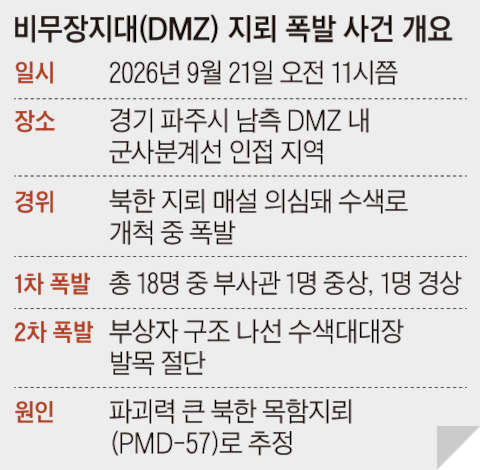
The mine explosion on the 21st occurred while the 25th Infantry Division’s direct-report search battalion was clearing a search route to confirm an area suspected of being shaped by North Korea’s minefield. According to a Joint Chiefs of Staff (JCS) announcement and military sources, a total of 18 people were involved in the search operation on the day of the accident. Among them, three people were injured: two seriously and one lightly. The remaining 15 were hospitalized for detailed medical examinations but have since been discharged.
It was reported that the explosion occurred twice on the day of the accident. First, a non-commissioned officer (NCO) stepped on a mine and suffered a severe injury to his heel, and another NCO nearby sustained minor injuries. Then, as the battalion commander approached to rescue the NCO, he stepped on another mine, causing a secondary explosion that severed his ankle. Defense Minister Kang visited the 25th Infantry Division, which suffered the mine explosion, and said, “Maintaining operational discipline without wavering and completing missions is what our people and wounded comrades in the hospital desire. If the enemy provokes or invades, respond decisively without hesitation.”
In this regard, People Power Party Rep. Yu Yong-weon said the day before, “It is highly likely that two North Korean wooden anti-tank mines exploded, rather than one or two.” There are also reports of testimonies within the military that no mine signals were detected by mine detectors at the points where the soldiers stepped. This increases the possibility that the mines were North Korean wooden anti-tank mines, which are relatively difficult to detect. The explosion site is reported to be 10–30 meters south of the MDL, an area suspected of recent mine planting by North Korea.
◇Military Rejected U.N. Command Investigation Once
While the South Korean military plans to conduct the on-site investigation after the Chuseok holiday, the U.N. Command, which has overall authority over access control and management in the DMZ, is known to support an immediate investigation. A military official familiar with the 1st Corps’ internal affairs said, “We understand that the U.N. Command attempted to conduct an on-site investigation the day before (22nd), but the South Korean military rejected it.”
This has led to speculation within and outside the military that the government is trying to delay revealing the connection to the North Korean mine explosion until after the U.N. General Assembly and Chuseok holiday. President Lee Jae Myung presented a “blueprint for peaceful coexistence on the Korean Peninsula” in his keynote speech at the U.N. General Assembly on the 22nd (local time). There are concerns that if it becomes known that serious injuries occurred due to a North Korean mine during this period, it could affect public sentiment during Chuseok.
However, a JCS official said that day, “The situation is different from the 2015 wooden anti-tank mine provocation.” The 2015 incident occurred in front of a push-through gate on the South’s side, making access easy, whereas this time, the mine exploded while clearing a search route through waist-high bushes, increasing the risk of secondary accidents.
◇Fragments from Seriously Injured Analyzed by National Forensic Service
Experts say the military likely already identified the mine specifications. A military source said, “Analyzing mine fragments from treating the seriously injured can quickly determine if it was a North Korean mine.” North Korean wooden anti-tank mines are made of wood, while the South Korean military’s M14 mines are plastic, making them easy to distinguish. The military reportedly requested the National Forensic Service to analyze fragments collected during treatment, with results expected by the end of this month.
Yang Uk, a research fellow at The Asan Institute for Policy Studies, said, “While it’s understandable that the military is cautious about confirming ‘North Korean mines’ until they have solid evidence, they could at least state that ‘the possibility of it being a South Korean mine is low’ based on various circumstances. Not disclosing factual relationships even two days after the incident invites suspicion of political considerations.”