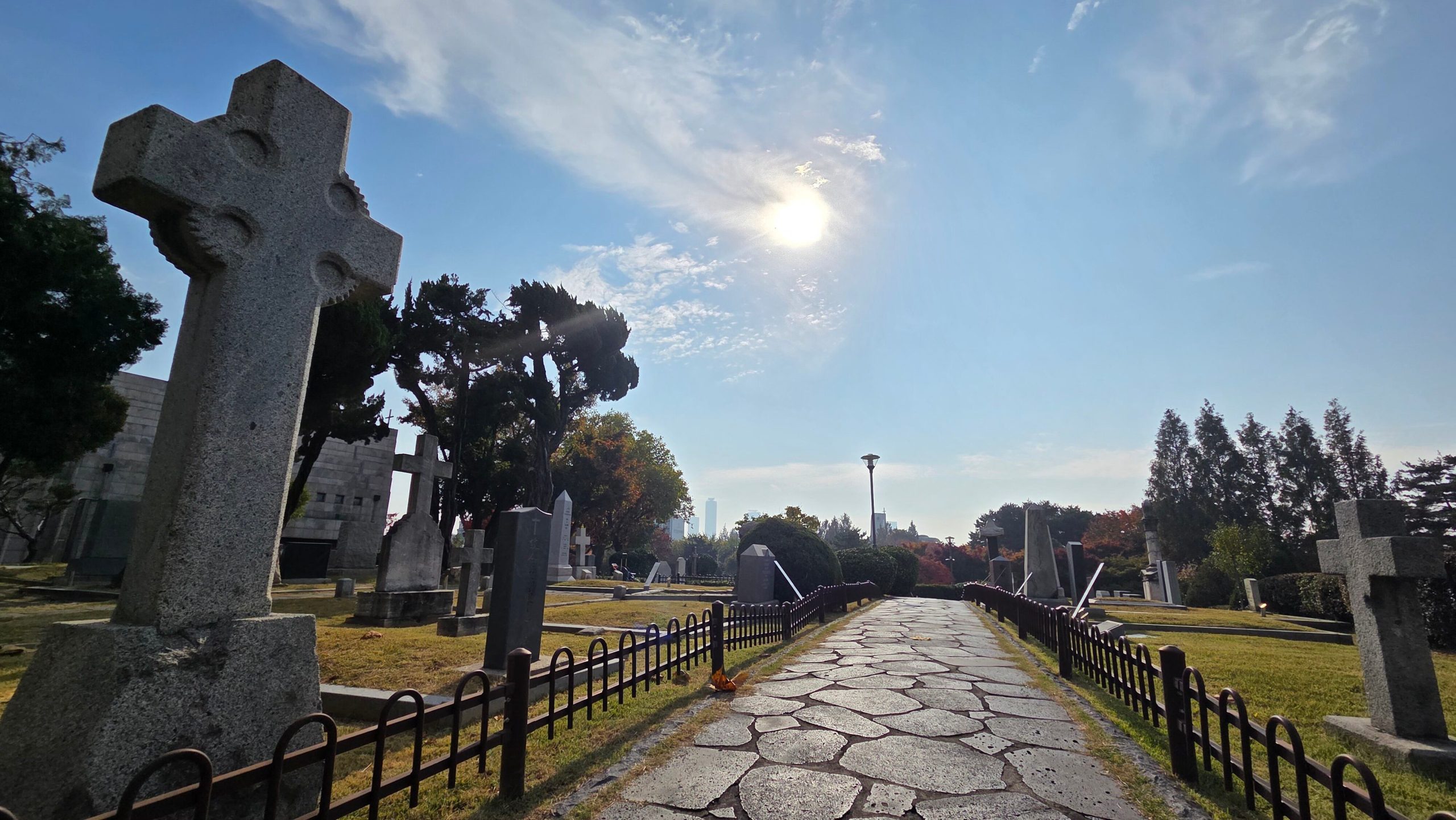
The Yanghwajin Foreign Missionary Cemetery stands as a testament to the enduring legacy of those who came to Korea with a vision of spreading faith, education, and compassion. This sacred ground, which has been the final resting place for missionaries and their families from around the world, holds stories that are both profound and deeply moving.
The cemetery is home to 145 missionaries and their family members, with the total number of interred individuals reaching 417 when including non-missionaries from 15 different countries. These individuals formed unique and lasting connections with Korea, leaving behind not only their lives but also their legacies in the form of epitaphs that speak of dedication, service, and sacrifice.
The Lasting Impact of Missionaries
Reverend Ryu Young-mo described the feeling of being “overwhelmed” when visiting the cemetery, a sentiment that resonates with many who walk its paths. The question often arises: did these missionaries ever intend to return to their home countries? Reverend Lee Young-hoon emphasized that they essentially arrived on a “one-way ticket.” Leaving behind wealth, honor, and a secure life, they ventured into an underdeveloped Korea with the resolve to spread the Gospel, provide education, and offer medical care—often with the intention of being buried in this land.
Stories of the Underwood Family
Among the most notable graves is that of the Underwood missionary family, spanning four generations and seven members. Horace G. Underwood, who founded Saemunan Church and Yonsei University, was originally buried in the Grove Reformed Church Cemetery in New Jersey, USA. His wife and children were laid to rest in Yanghwajin. In 1999, his remains were relocated to Yanghwajin to be with his family, with a commemorative stone now marking his original resting place in New Jersey.
Edel Underwood, the wife of Underwood’s son Won Han-kyung, passed away from a communist’s bullet just one year before the outbreak of the Korean War. Her epitaph reflects the deep love Koreans had for her and the sorrow at her passing:
“She was lively, resolute, affectionate, and righteous. Leaving behind four sons, one daughter, daughters-in-law, and grandchildren, she gave her life for us.” “Her spirit rests in the Lord’s embrace. Her body, like her heart during her lifetime, is one with this land and river.”

The Legacy of Appenzeller and His Family
Another significant figure is Appenzeller, who landed at Jemulpo Port with Underwood on April 5, 1885. As a Methodist missionary, he founded Jeongdong First Church and Paichai School. Tragically, he drowned in a shipwreck off Gunsan while traveling to a Bible translation meeting in Mokpo in 1902. A memorial stone stands in Yanghwajin, inscribed with his first prayer upon landing at Jemulpo:
“We came here on Easter morning. May the Lord, who overcame the power of death, break the bonds that shackle this people and grant them the freedom and light of God’s children.”

Appenzeller’s son, Henry D. Appenzeller, and his wife are also buried in the cemetery. His wife, Ella Dodge, was pregnant with Alice Rebecca Appenzeller when she arrived in Jemulpo. Born in Seoul in 1885, Alice was the first Western baby born in Korea. She later became principal of Ewha Hakdang and elevated it to Ewha Women’s Professional School in 1925. Her gravestone, shaped like an open Bible, bears the inscription: “Not to be ministered unto but to minister” in both Hangeul and English.

A Unique Story of Soda Gaichi
Among the graves, the only Japanese interment, Soda Gaichi, draws particular attention. Two memorial stones—one erected by Korean and Japanese civic groups—stand side by side. Soda, who lived a dissolute youth, collapsed from alcoholism in Taiwan in 1899. A Korean stranger saved him, taking him to an inn, treating him, and paying his bills. Six years later, Soda came to Korea, determined to repay the debt of gratitude.
Under the mentorship of Wonam Lee Sang-jae, he became a Christian. After teaching Japanese at the YMCA, he worked as an evangelist and became director of the Kamakura Orphanage’s Seoul branch in 1921. Even after Japan’s defeat, Soda remained in Wonsan until 1947. The South Korean government posthumously awarded him the Cultural Medal, a first for a Japanese citizen.

Other Notable Figures
Homer Hulbert’s memorial at the cemetery’s entrance is well-known. A founding figure of the YMCA, he advocated for education and missionary work and exposed the injustice of the Eulsa Treaty to the world. His wish to be buried in Korean soil was fulfilled when he died in Korea in 1949. His gravestone, which remained empty for 50 years, was finally inscribed by President Kim Dae-jung.
Bethell (Korean name: Bae Seol)’s memorial at the entrance has a unique two-tone appearance. From behind, it looks like two stones—black and gray—joined together. In reality, it is one stone. Japanese authorities, displeased with Bethell’s activities, chiseled the original inscription. A new stone was erected beside the original in 1964, inscribed with Jang’s original text in calligrapher Kim Eung-hyun’s handwriting.

A Living History
Other notable figures include Methodist missionary Robert Hardie, who led the Wonsan Great Revival; Moore, who promoted equality by allowing butchers and commoners to worship together; Mary F. Scranton, founder of Ewha Women’s University; Campbell, founder of Baewha Women’s University; and Sherwood Hall, who introduced Christmas seals to Korea and fought tuberculosis, along with his parents, William Hall and Rosetta Hall.

The atmosphere of the cemetery is not solely solemn or somber. It feels more like a well-maintained park than a graveyard. Crosses vary by nationality, evoking the ambiance of a foreign city’s cemetery. Located near Hapjeong Station and close to Hongdae, a popular youth district, it is worth visiting if passing through the area. Allow ample time, as exploring the graves and epitaphs makes time fly.


