The Rise of Moore Threads: A New Player in China’s Semiconductor Landscape
Moore Threads, a Chinese graphics processing unit (GPU) start-up, has emerged as one of the most closely watched semiconductor players in the country. Founded by James Zhang Jianzhong, a veteran of Nvidia’s China operations, the company is at the forefront of domestic AI chip design, aiming to challenge the dominance of US chip giants.
The Beijing-based company recently received approval from the Shanghai Stock Exchange for an initial public offering (IPO). The process was remarkably fast, taking just 88 days from filing the application in June to receiving approval. This accelerated timeline highlights China’s growing focus on achieving self-sufficiency in the chips that power AI model development, especially amid the ongoing US-China tech war.
A Founder with a Strong Background
James Zhang Jianzhong, the founder and CEO of Moore Threads, spent 14 years working at Nvidia before leaving in 2020 to start his own company. During his tenure at Nvidia, he served as vice-president and general manager of its China operations, playing a key role in expanding the company’s presence in the mainland market. Prior to joining Nvidia, Zhang worked for US tech companies like HP and Dell.
Zhang’s experience and connections gave Moore Threads immediate credibility. Many of the start-up’s early recruits came from Nvidia and its US rival, Advanced Micro Devices. The company also attracted prominent investors such as GGV, Sequoia China, ByteDance, and Tencent Holdings.
Navigating Challenges and Growth
Despite its strong start, Moore Threads faced challenges due to US sanctions. In October 2023, the company was added to Washington’s Entity List, along with fellow Chinese AI chip start-up Biren Technology. These sanctions restricted access to certain foreign technologies and created uncertainty about the company’s future plans.
Initially, Moore Threads struggled under the sanctions. A month after being added to the list, the firm announced lay-offs and an internal restructuring to focus more on GPU development. However, founder Zhang continued to rally staff, emphasizing the importance of overcoming difficulties for the company’s long-term growth.
In an internal letter, Zhang described the lay-offs as a tough but necessary decision for the sake of the company’s development. He also dismissed suggestions that it was “a moment of darkness” for China’s GPU development, stating that nothing would compromise the firm’s resolve to develop the best general-purpose GPUs in China.
Rapid Revenue Growth and Technological Advancements
Two years later, Moore Threads proved its resilience by achieving rapid revenue growth using a domestic supply chain. In 2024, the company reported revenue of 438.5 million yuan, with an annual compound growth rate of over 200% over the past three years, according to its prospectus.
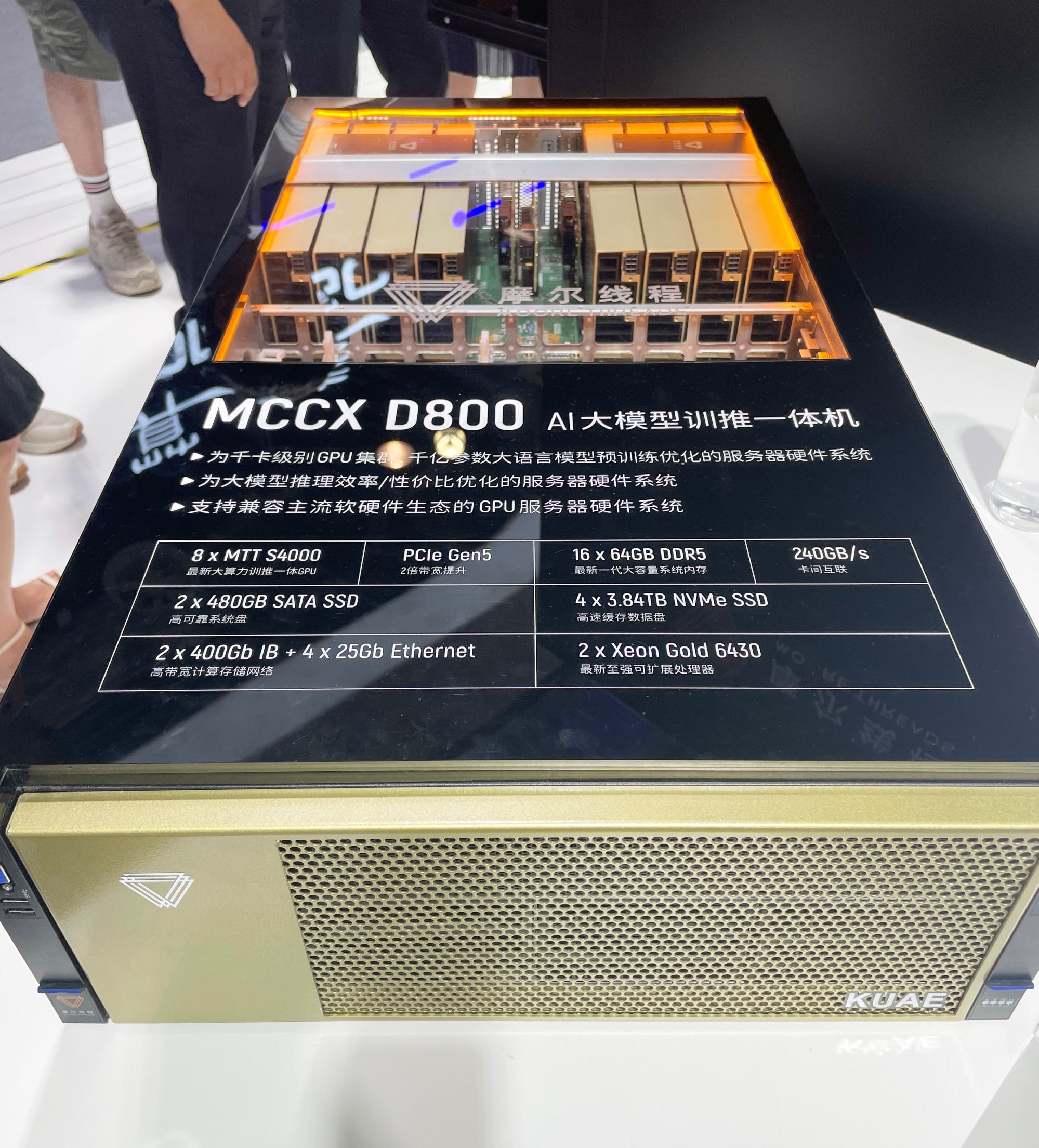
Moore Threads has launched four generations of GPU architecture: Sudi, Chunxiao, Quyuan, and Pinghu. The latest generation, launched in 2024, supports training and inference of AI models with trillions of parameters and can be used for pre-training of cutting-edge large language models.
However, the company has yet to turn a profit due to high research and development expenses and inventory buildouts. It posted a net loss of 1.5 billion yuan in 2024, compared with 1.7 billion a year earlier.
Competing with the Best
Like other Chinese semiconductor companies, Moore Threads still lags behind the US in single-chip performance, software maturity, and wafer fabrication constraints. The company’s future success will depend on its ability to close this gap.
One key partnership is with DeepSeek, the Hangzhou-based AI start-up that gained global attention with its cost-efficient, high-performance models. Moore Threads has committed to supporting DeepSeek’s V3 and R1 models through its proprietary KUAE GPU intelligent computing cluster.
When DeepSeek released its V3.1 AI model in August, it adopted a new data format called “UE8M0 FP8 scale,” which was designed for “home-grown chips to be released soon.” This development sparked widespread speculation about which Chinese firm could supply the AI chips.
Moore Threads, along with Huawei, Cambricon, and Shanghai-based AI chipmaker MetaX, are among the companies with chips capable of supporting FP8. At the World Artificial Intelligence Conference in July, Moore Threads’ vice-president Wang Hua emphasized the company’s commitment to the FP8 architecture.


