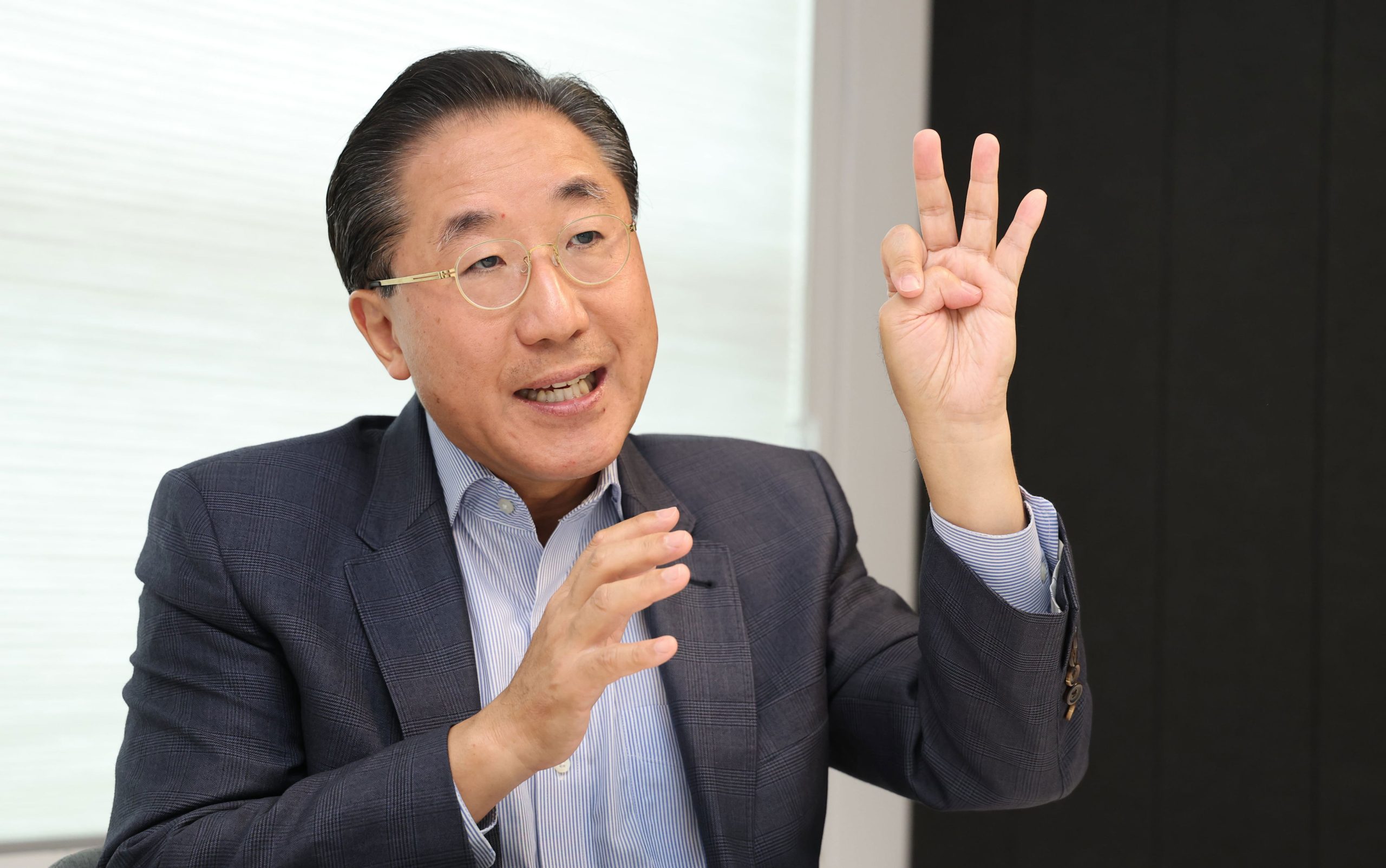
The KOSPI has surpassed the 3,700 mark. Market capitalization has broken through 3,000 trillion Korean won. This is a bullish market unseen before. Although a revaluation of the Korean stock market is underway, the price-to-earnings ratio (PER) and price-to-book ratio (PBR) remain low. President Lee Jae-myung is advocating for a shift “from real estate to the stock market” and criticizes the National Pension Service for its low investment ratio in domestic stocks. We met with Lee Nam-woo, chairman of the Korea Corporate Governance Forum, who has been leading reforms based on the view that the core factors of the Korea discount (undervaluation of the Korean stock market) are the backwardness of corporate governance structures and low shareholder returns, to assess the potential for a qualitative leap in the Korean stock market.
Reasons for Foreign Investors’ Changing Perspective on the Korean Stock Market
Foreign investors are leading the bullish trend. Has their view of the Korean stock market changed?
“The revision of the Commercial Act in July of last year served as a catalyst. With the first and second revisions of the Commercial Act, which included fiduciary duties to shareholders and cumulative voting systems, foreign investors now seem to believe they can invest without worry.”
Why did foreign investors distrust the Korean stock market until now?
“Because they were deceived too many times by the Korean government and companies. Although Korea has risen to the ranks of advanced economies, its capital market trust index is lower than that of China and Indonesia. The sudden ban on short selling under the previous administration is still criticized by foreign investors as an ‘unreasonable measure.’ Hedge funds cannot trade if short selling is banned. Due to the short-selling ban, major Korean investment officers in Singapore were laid off en masse.”
What kind of foreign capital is flowing in now?
“Traditional large funds are entering in earnest, and there is also significant capital from algorithmic trading aimed at portfolio restructuring. Many hedge funds had taken short positions on Samsung Electronics, expecting its future to be bleak, but as the stock price rose sharply, they are urgently buying. There are also increasing cases of U.S. pension funds and Ivy League university endowments, which had not previously invested in Korea, placing investment orders in the hundreds of billions of Korean won. Major sovereign wealth funds are injecting new capital into Korea.”
Can this trend continue, leading the KOSPI to 5,000?
“The Lee Jae-myung government did well in its first four months, but the future is the problem. If the government shows any sign of retreating from corporate governance or capital market reforms, the stock market could face a massive correction. Hedge funds would launch large-scale short selling, and the aftermath could be severe. Unlike us, Japan has earned the strong trust of foreign investors through steady reforms over more than a decade.”
What reforms did Japan implement?
“Ten years ago, the Abe administration executed the ‘three arrows’ policy—monetary easing, fiscal expansion, and structural reforms—and consistently implemented capital market reforms. It shifted corporate management toward shareholder-centric approaches and encouraged capital efficiency. Companies responded by selling unnecessary assets, using excess cash for investments or shareholder returns, and raising ROE (return on equity). Foreign investors highly evaluated this, and the index rose to an all-time high.”
Former President Yoon Lacked Capital Market Philosophy
Former President Yoon Suk-yeol also mentioned revising the Commercial Act in early last year. Why did it fizzle out?
“He lacked a deep understanding of capital markets. Either due to lobbying by large corporations or economic officials uniformly opposing the reforms, it was shelved. Foreign investors often ask why the Lee Jae-myung government can act so quickly.”
How do you respond?
“I explain that it is because the ruling party in the National Assembly is leading the legislation. The Democratic Party’s ‘KOSPI 5,000 Committee’ had long prepared a capital market advancement project since its time in the opposition. The policies developed there were all included in President Lee Jae-myung’s election pledges and are gradually becoming law. Members of the KOSPI 5,000 Committee collaborated extensively with the Korea Corporate Governance Forum while studying and holding seminars.”
Treasury shares worth 72 trillion Korean won held by companies are also a means of management defense. What if they are burned?
“Using company funds to buy treasury shares for management defense is a foul. The global standard is to burn treasury shares to enhance shareholder value. Buying treasury shares without burning them wastes company cash. South Korea is the only country that considers treasury shares as corporate assets.”

SK Group, the holding company of SK, holds 25% treasury shares. If they are burned, won’t it cause issues in controlling subsidiaries?
“Burning treasury shares would increase the SK owner’s stake (currently 27%) further, posing no issues in controlling subsidiaries. If SK burns its treasury shares, its stock price could rise by over 50%, freeing it from various disputes.”
Can the stock market continue to thrive while major industries and corporate competitiveness are declining due to China’s rise?
“China has no concept of cost and uses a strategy of over-supply to kill competitors. I think competing with China in commodity products is impossible. However, we have several competitive areas. Defense industries are one, and automobiles also have competitiveness. In the cosmetics sector, there are many non-listed beauty equipment companies with annual sales of hundreds of billions of Korean won and operating profit margins of 15–20%. These companies could become the sprouts of the Korean stock market.”
Owners Must Step Down If They Lack Confidence
How can the competitiveness of listed companies be enhanced?
“Elon Musk of Tesla presents a 10-year long-term goal and receives compensation based on performance. Owners of the top five conglomerates should also announce 10-year plans and goals and receive stock-based compensation according to performance. If they achieve the goals, they gain wealth and secure more shares. If they lack confidence, they should step down from management. Major conglomerates have excessive debt due to lax management. Like Japanese companies, they should focus on their core businesses, sell the rest, and use the proceeds for new investments. In the AI sector, while Chinese workers labor 80–100 hours per week, we are constrained by the 52-hour workweek. These shackles must be removed quickly.”
The Lee Jae-myung government is discussing the abolition of breach of trust.
“While prosecutors have abused breach of trust, causing negative impacts on companies, abolishing it entirely would make it difficult to prevent major shareholders’ embezzlement and accounting fraud.”
Isn’t the world’s highest inheritance tax rate also a factor in the Korea discount?
“When foreign investors discuss governance, they always ask, ‘What about inheritance taxes?’ They know that high inheritance taxes make major shareholders reluctant to see stock prices rise.”
What is next after mandatory burning of treasury shares?
“Strengthening the stewardship code of pension funds will follow. The biggest difference between Korea and Japan is whether pension funds exercise stewardship. Japan’s Government Pension Investment Fund (GPIF) requires asset managers to report how they exercised voting rights, reasons for voting for or against shareholder proposals, and their involvement in raising appropriate stock prices. New Financial Supervisory Service chief Lee Chan-jin has long served on the National Pension Service’s fund management committee. The market expects the Lee Jae-myung government to strongly drive reforms in this direction.”
Intervention by the National Pension Service, swayed by political winds, raises concerns about pension socialism.
“It is clear that institutional investors’ shareholder rights are a method for global pensions to increase long-term returns.”
“President’s Call to Expand Domestic Investment Is Nonsense”
President Lee Jae-myung pointed out the low domestic investment ratio of the National Pension Service.
“Japan’s pension invests 25% in Japanese stocks, while Korea’s National Pension Service invests only 14%. There is a reason. The 10-year average annual return, including dividends, for Japanese stocks is around 8–9%, but for Korean stocks, it is only 5%—among the lowest globally. Based on 10-year returns, the National Pension Service should not increase domestic stock investments. The president’s remarks are close to nonsense.”
What are the benefits of a larger Korean stock market?
“Chinese companies like BYD (electric vehicle manufacturer) and CATL (battery firm) have market capitalizations of 200–300 trillion Korean won. A 5% capital increase would raise over 10 trillion Korean won. Recently, Samsung SDI’s 20% capital increase raised barely over 1 trillion Korean won. A larger market cap allows companies to raise much more investment funds through capital increases. For the future of companies, the stock market’s size must grow.”
How can leading Korean companies grow in the capital market?
“Taiwan’s TSMC repurchased Philips’ 20% stake in 1997 and listed it on the New York Stock Exchange. Today, TSMC’s shares trade in the trillions of Korean won daily on the NYSE. TSMC is recognized as a U.S. company, and U.S. ETFs buy its shares in large quantities. Leading Korean companies like Samsung Electronics, SK Hynix, and Naver should list in the U.S. to compete with global peers in capital markets.”
Lee Nam-woo
Lee Nam-woo graduated from Seoul National University’s International Economics Department and the University of Chicago Booth School of Business. In his late 20s, he worked as a vice president and analyst responsible for South Korea, Japan, and Taiwan at JPMorgan’s Hong Kong Asia-Pacific headquarters. After serving as co-head of Merrill Lynch Korea, he became the first head of Samsung Securities’ Research Center in his mid-30s. In 2003, he also managed a foreigner-exclusive hedge fund. He is currently a professor at Yonsei University’s Graduate School of International Studies, teaching financial analysis and corporate governance.


