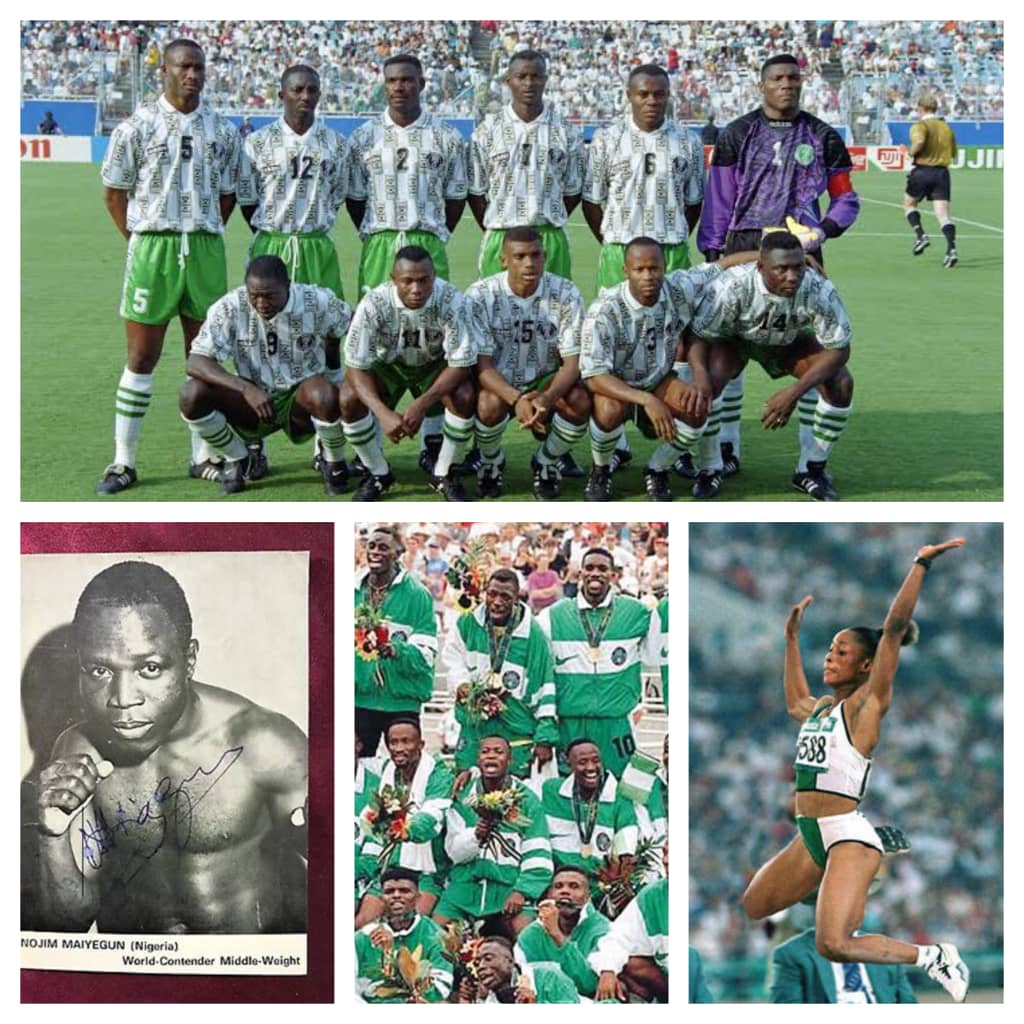
A Legacy of Triumph: Nigeria’s Journey Through Sports
Since gaining independence in 1960, Nigeria has carved out a remarkable legacy in the world of sports. From football to athletics, basketball to boxing, Nigerian athletes have consistently demonstrated excellence on the global stage. Their achievements have not only brought pride to the nation but also established a distinct sporting identity that resonates across continents.
Football: The Heartbeat of Nigerian Identity
Football holds a special place in Nigerian society, acting as a unifying force during times of social or economic hardship. This unity laid the foundation for Nigeria’s early football successes. In 1980, the Super Eagles, led by Segun Odegbami and Muda Lawal, claimed their first African Cup of Nations (AFCON) title by defeating Algeria 3-0 in Lagos. The victory marked Nigeria’s emergence as a continental powerhouse.
In 1994, Nigeria secured its second AFCON title in Tunisia, with players like Rashidi Yekini, Jay-Jay Okocha, and Emmanuel Amuneke leading the charge. That same year, the Super Eagles made their debut at the FIFA World Cup in the United States, defeating Argentina and finishing first in their group. Though they were eliminated by Italy in the Round of 16, Nigeria achieved a FIFA ranking of fifth—the highest for any African nation at the time.
Perhaps the pinnacle of Nigerian football came in 1996 at the Atlanta Olympics, where the U-23 ‘Dream Team’ stunned the world. They defeated Brazil 4-3 in the semi-final and then beat Argentina 3-2 in a thrilling final to claim gold. This victory was more than an Olympic triumph; it was Africa’s declaration of its ability to compete with the best.
After years of near-misses, the Eagles reclaimed continental glory in 2013, lifting their third AFCON title in South Africa under coach Stephen Keshi. Keshi became one of only two men to win the AFCON both as a player and a coach, cementing his place in African football history.
Athletics: Grit, Resilience, and Breakthroughs
Nigeria’s athletic story is one of grit, resilience, and breakthroughs. In 1996, Chioma Ajunwa made history by winning the women’s long jump with a leap of 7.12m, becoming Nigeria’s first-ever Olympic gold medalist. That same Games, Falilat Ogunkoya won bronze in the 400m, the first Nigerian woman to earn an individual Olympic track medal.
Four years later, the women’s 4x400m relay team initially won silver at the Sydney Olympics, but decades later, doping disqualifications upgraded them to gold—a belated recognition of their excellence.
The 2000s and 2010s saw Blessing Okagbare rise to prominence, winning Olympic silver in Beijing 2008 and achieving the rare double of 100m and 200m gold at the 2014 Commonwealth Games. Then in 2022, Tobi Amusan shattered the 100m hurdles world record (12.12s) at the World Championships in Oregon, becoming Nigeria’s first World Athletics Champion and turning the global spotlight on Nigerian talents once more.
Basketball: Emerging as a Powerhouse
Basketball has emerged as a significant sport in Nigeria, with the D’Tigers making a statement in 2015 by defeating Angola to win their first AfroBasket title in Tunisia. The D’Tigress, Nigeria’s women’s national basketball team, have dominated the continent, winning five consecutive AfroBasket titles from 2017 to 2025.
Their dominance extended to the global stage at the Paris 2024 Summer Olympics, where they ended a two-decade wait for victory by defeating Australia and Canada. This achievement made D’Tigress the first African basketball team—male or female—to reach the Olympic quarter-finals. Head coach Rena Wakama was named Best Coach of the Tournament by FIBA, a fitting recognition for her leadership.
Boxing and Table Tennis: Pioneers and Legends
Nigeria’s boxing heritage dates back to before independence, with Hogan ‘Kid’ Bassey becoming the country’s first world champion in 1957. Dick Tiger, who held world titles in two weight classes, became one of the most respected fighters of his era.
In 2008, Samuel Peter won the WBC Heavyweight title, and Anthony Joshua, the Nigerian-British heavyweight, unified multiple world titles between 2016 and 2017. Aruna Quadri became the first African to break into the ITTF world top 10, establishing Nigeria as a force in world table tennis.
Women’s Sports: Excellence and Resilience
No story of Nigerian sports is complete without the Super Falcons, Africa’s most successful women’s football team, with 11 AFCON titles to their name. Their finest moment came in 1999 when they reached the quarterfinals of the FIFA Women’s World Cup, becoming the first African team to do so.
Beyond football, Nigerian women have excelled in the Commonwealth Games and All Africa Games, earning medals in athletics, boxing, wrestling, and weightlifting. These triumphs have made them symbols of resilience and excellence in sport.
A Rich Tapestry of Triumph
From Dick Tiger’s fists in the 1960s, to the Super Eagles’ magical nights in 1994 and 1996, from Ajunwa’s historic leap to Amusan’s world record, Nigeria’s sporting history is a rich tapestry of triumphs. Basketball dominance, boxing legends, table tennis pioneers, and women’s football queens have all added to this heritage.
For a nation often tested by challenges, sport has always provided moments of unity, joy, and belief. These achievements remind Nigerians that no dream is too high, no goal too distant. As the story continues beyond 2025, the world watches, knowing that when Nigeria takes the stage, history is always within reach.


