THEATREIRVING BERLIN’S HOLIDAY INNRiverside Theatres Parramatta, December 6Until December 14Reviewed by KATE PRENDERGAST★★★★
In the 1940s, the legendary Irving Berlin (who was, ironically, Jewish) dreamt of a little number called White Christmas. At Riverside Theatres, audiences dreamt of a Christmas that doesn’t sweat their entrails out, while being razzle-dazzled to distraction by the stage adaptation of Holiday Inn, a two-hour affair featuring a live band, a dizzying array of sparkle-heavy costumes, old-world charm and some vigorously inventive original choreography by Veronica Beattie George.
If you haven’t seen a tap-dancing ensemble perform synchronised jump-rope with green tinsel, are you even in the silly season?
Holiday Inn is the film that launched the world’s best-selling single, which also starred musical history’s most dapper dynamic duo: Fred Astaire and Bing Crosby. Filling those enormous singin’ and dancin’ shoes just fine in this Well Done Creative production are Rob Mallet as Jim Hardy and Max Patterson as Ted Hanover – showbiz characters whose long friendship is put to the test when Jim’s domestic impulses and anxious sentimentality clash with Ted’s big-time ambitions. To put it another way: narrative conflict, thy name is woman.
First it’s Lila (Pamela Renouf is a sensation and a hoot as the squawking, mega-talented, self-obsessed starlet). Then it’s Linda (Mary McCorry, of classically beautiful looks and ravishing vocals), an independent-minded schoolteacher who sold Jim the Mason Farm in Connecticut, where he hopes to start a new chapter away from the insanity of “the lifestyle”.
Life in the country bumpkin seat, however, turns out to be laborious, lonesome and financially challenging. With some sneaky manoeuvring from plucky farmhand Louise (Paige Fallu), he and his New York friends cook up a creative money-making ruse: to transform the property into a “Holiday Inn”, hosting extravagant ticketed shows (also charging guests for board) only on holidays. Cue Shaking the Blues Away!
There are some interesting (and essential) variations from the film. No blackface is one. There are also significant differences in narrative structure and character motivations (with Ted spared the moral grubbiness of “stealing the girl” romantically). Some songs are shuffled about to take on new meaning (a memorable moment comes when the otherwise silent drummer pipes up with his Cinderella plea to Ted: “I’m easy to dance with!” ), with the best comic moments still when Jim lets jealousy undermine his own show.
As with so many crowd-pleasing productions, this one would benefit from being more snappy, with less stuffing. Some added Berlin hits feel interstitial, and the invigorating theatrical bombast under director Sally Dashwood loses a little pizzazz in the second half.
That’s not to say there isn’t a lot to be enjoyed, particularly given the robust technical skills of the actors, which are geared for delight and well-balanced with their acting chops. There’s a worthy takeaway, too, about freedom and autonomy. A line from French poet Guillaume Apollinaire that bookends the show reminds us what holidays are all about: “Now and then, it’s good to pause in our pursuit of happiness and just be happy.”
MUSICKendrick LamarAllianz Stadium, December 10Reviewed by BERNARD ZUEL★★★★
Kendrick Lamar doesn’t exactly want to be a pop star, but he doesn’t not want to be one either.
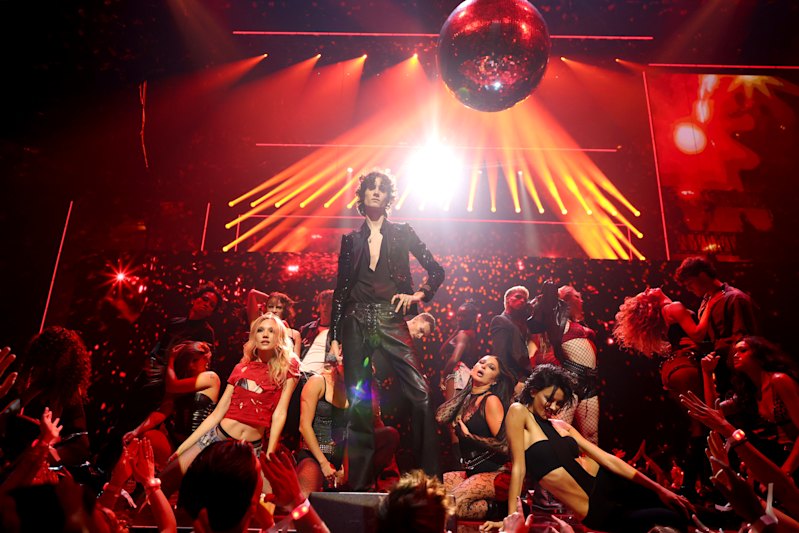
Take the flames left and right and two huge screens, the sparkly-framed glasses and a posse of dancers, the giant furry dice with scented tree ornament and the scaled-up stairs on an otherwise bare stage, the crack of fireworks like cannons and a whispered start with Lamar muttering in the shadows backstage, and the powerful, crisp, clear and just-short-of-overwhelming sound.
All point to production values of a mega pop show. All simple but effective manipulations of an environment effectively inhabited by only one non-dancing, rarely-speaking, charismatic but un-demonstrative man.
But then what is King Kunta but a knee-cracking pop song? Even, or maybe especially in, this condensed version, followed with the skittish, swirling cinematic noir of Element. How many hooks are as elemental as Squabble Up’s barebones lean/shuffle, brought to life by those dancers and given voice by the whole stadium, or the brass-bolstered TV Off, split into two parts, an hour apart? How many stiff-legged grooves are as welcome to people who can’t necessarily dance but can strut in their seats as that offered in Humble?
Kendrick Lamar doesn’t want to be some generational spokesman, but he doesn’t not want to be one either.
Sure, the lubricious Poetic Justice was primarily focused on matters horizontal but the same territory in the old-school soul groove of Dodger Blue was laced with unceremonial frankness, and Good Credit crept into darker corners.
M.A.A.D City peeled back urban sheets and showed how everything runs on tension, and within the folding-in-on-itself progressive bass and counterweight keyboards of Reincarnated was a dense story that was always racing away with his delivery but still landed punch after punch about being that very modern creature, the uncertain adult in a childlike world.
Speaking of which, one thing Lamar very much does want to be is Drake Disser In Chief. Still. See both the shot early in the show, Euphoria, and the stronger chaser to close the set, Not Like Us. Kendrick, that man is down, boxed up and posted already.
While his voice is the lowest profile of the on-stage sounds that’s ultimately irrelevant. If you don’t already know each word of these songs you aren’t serious and you aren’t meant to be here. Kendrick Lamar doesn’t want to be exclusive, but he doesn’t not want to either. Got a problem with that? To borrow from the man, “Put the Bible down and go eye for an eye for it.”
Kendrick Lamar plays Allianz Stadium tonight (December 11) and the Spilt Milk Festival in Canberra on December 13 and Gold Coast on December 14.
MUSICSOMBRHordern Pavilion, December 9Reviewed by MILLIE MUROI★★★★
For a young artist whose fame started with a viral song on TikTok just three years ago, Sombr is surprisingly smooth and unfazed on stage.
On his first Australian tour, the 20-year-old American singer could easily have you believe he is a seasoned pro (apart from a few too many disingenuous “I-love-yous” when he should be getting on with the show).
The setlist begins on the front foot, running through songs from Saviour, showcasing his richer, deeper tones, to We Never Dated, which drifts into an ethereal falsetto.
His range is impressive and, while he may not have an especially powerful voice, he has enough to make an impact as required. Technically, he is consistent and controlled while imbuing all of his songs with that characteristic teenage angst.
The show is prety much bare bones – one man and a band with basic production. But it’s done well.
And while it does drift at points in the second half, the setlist is not long enough to make it tedious. It’s also a comfortable sort of dip: one that still has you swaying to the music and enjoying the atmosphere.
Sombre’s has some similarities to the work of The 1975’s frontman Matty Healy. Their songs share stylistic and thematic similarities and during numbers such I Wish I Knew How to Quit You and Do I Ever Cross Your Mind, the tortured poet bearing seem familiar.
Sombr is, however, a bit softer and more palatable than Healy. Caroline – the song Sombr wrote when he was 16 and which catapulted him to fame – and Perfume, are tender, heartfelt and delivered with precision but also a mesmerising sweetness.
And while most of his lyrics are despondent, devastating or dark, there are bouncy beats, catchy bass segments and playful riffs that keep the energy high. He also finishes strong with funky songs such as 12 to 12 and his biggest hit: Back to Friends.
It may not be a concert for the ages, but it’s a seamless show with solid fundamentals.
THEATREBEAUTIFUL THINGQtopia Sydney, December 5Until December 13Reviewed by KATE PRENDERGAST★★★½
It’s a seasonally fitting, welcome thing to hear happy squeals and warm laughter in response to a queer drama told on stage. Often (unless it’s part cabaret), the audience’s reaction is grim, choked silence – trauma the legitimate yet scarifying seam from which a lot of LGBT+ stories are mined.
Allowing a gay “coming-of-age” love story to have a relatively untroubled trajectory and happy ending was what made Liverpudlian dramatist Jonathan Harvey want to write Beautiful Thing.
Opening in London in 1993, it went on to win a John Whiting Award, was adapted into a popular film, and had its Australian premiere at the 1998 Sydney Gay and Lesbian Mardi Gras. This CODA production brings it back with a uniformly excellent cast, with Finn Stannard making an impressive directorial debut to close Qtopia’s 2025 program.
Harvey would go on to write for Coronation Street for two decades and counting, and there’s a lot of this and other British soaps’ recognisable tones and touchpoints here: a character-driven plot and working-class realism; young and old battling a hard-luck system with whatever’s at hand (in this story, the music of Mama Cass); a matter-of-factness about the realities they’re up against; violence acknowledged if not given too-graphic treatment; neighbours getting all up in each other’s business; and animated dialogue that plumbs its humour from cheek, colourful patois and bluntness.
Willa King as tough-love mum and worn-down barwoman Sandra steals the show on that last one (though her relentless shaming of heroically impudent expelled schoolgirl Leah as “slag” might be a bit dated).
Set in a South London council estate, an environment summed up by three sky-blue doors on a grey tenement wall, the “beautiful thing” in question is the tender relationship that forms between Hello! magazine-reading Jamie (Jake Walker) and much more athletic Ste (Max Dykstra), which begins when Ste takes refuge from an abusive father in his neighbour’s bedroom.
It’s also how frowsy queen Sandra, her new boyfriend Tony (Michael Hogg) and “lost cause” Leah (Poppy Cozens) react. It’s not a big spoiler to say: pretty well! When Tony, a stand-in father figure, wraps trembling Jamie in a bear hug and says with a smiling reassurance “it’s OK” after the boy comes out to his mum, a widespread corneal leakage event was seen in the audience.
It is interesting to follow Tony through the play. He develops into something of a wish-fulfilment vehicle – a fantasy of the even-tempered, open-minded and gently loving guardian we all deserve. A handyman and artist, cheerily chill and twinkle-eyed, he worships Sandra, shares a joint with Jamie, and knows exactly what to do when Leah is tripping Mama Cass Fantastic.
The final scene seems to try to negate the “magical straight saviour” role he may otherwise have slipped into – not wholly satisfyingly, though.
Beautiful Thing might not be cutting-edge queer, but it’s a lovely little slice-of-life story, full of endearing performances, humour and heart.
Must-see movies, interviews and all the latest from the world of film delivered to your inbox. Sign up for our Screening Room newsletter.