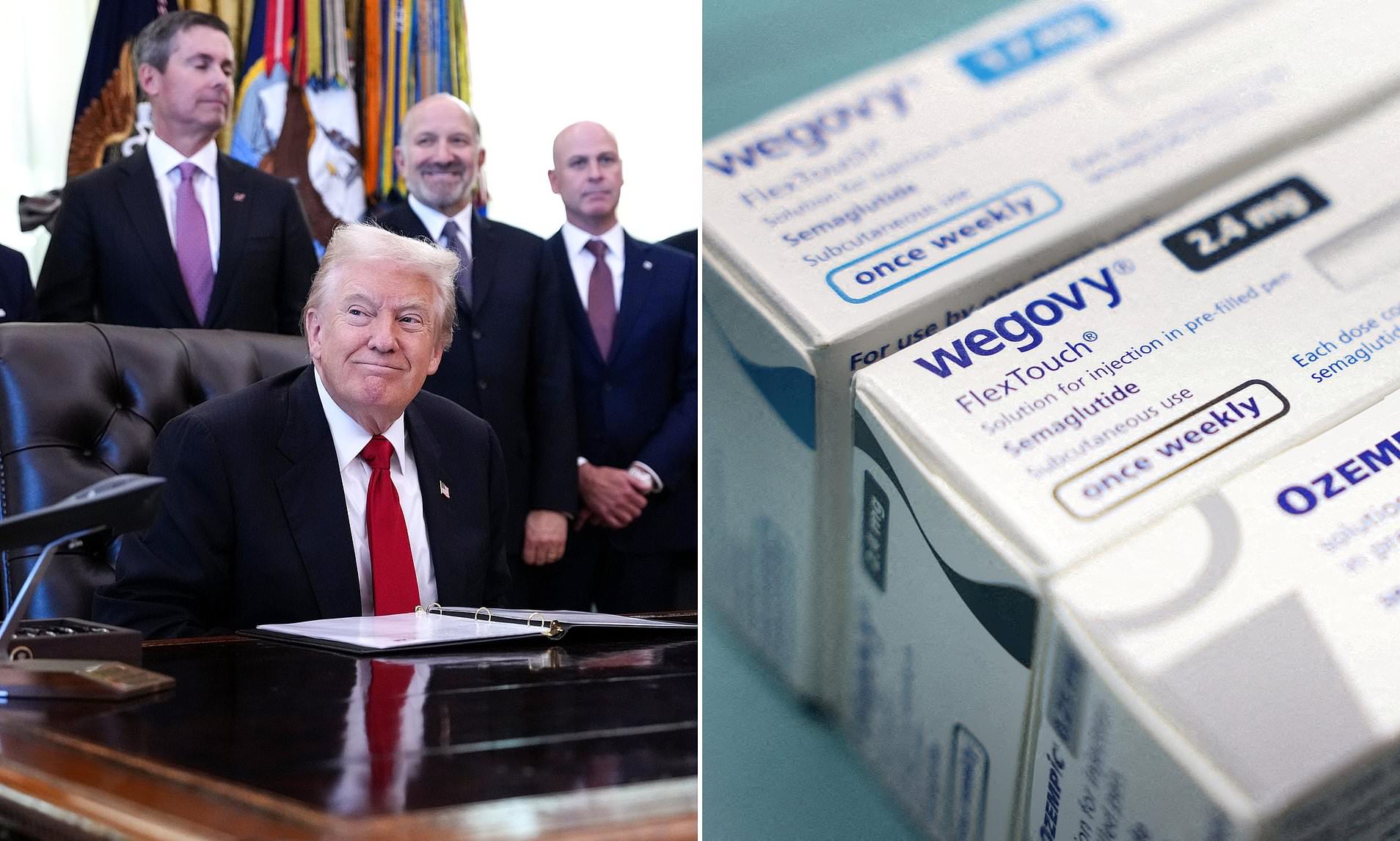
New Deal to Lower Prices of Weight-Loss Drugs Sparks Debate
A significant agreement has been reached between Novo Nordisk, the manufacturer of Ozempic, and the U.S. government to reduce the cost of semaglutide, the active ingredient in weight-loss drugs such as Wegovy. This move is expected to make these medications more affordable for millions of Americans. However, the medical community remains divided on whether this increased accessibility is truly beneficial.
The Denmark-based company announced that it has agreed to lower the price of semaglutide under the Medicare scheme. President Donald Trump highlighted this deal on Thursday, stating it was part of his administration’s plan to implement ‘most favored nations pricing.’ This approach ensures that Americans pay no more than the lowest price offered globally.
‘It’s a tremendous advantage to the American people,’ Trump said. Starting from Thursday, Wegovy will be reduced from $1,350 a month to $250 per month before insurance, while Zepbound will drop from $1,080 to $346 monthly. Future GLP-1 agonists in development are expected to be sold at no more than $149 per month.
Trump also mentioned that Novo Nordisk and Eli Lilly will provide ‘all of their other medications’ at most favored nations pricing. Many of these will be covered by Medicare plans across all 50 states, which cover 60 million Americans over 65.
‘
 ‘
Health Secretary Robert F. Kennedy Jr. estimated that this move could help Americans lose an extra 125 billion pounds by the end of next year, though the source of this figure is unclear. CMS administrator Dr. Mehmet Oz raised the estimate to 135 million pounds.
Despite the positive outlook, physicians have expressed concerns about the long-term use of these drugs and their side effects. Dr. Stuart Fischer, an internal medicine physician in New York, noted that while the price reduction may improve obesity rates, users should be cautious about needing to take the drugs for extended periods.
‘It will be good and bad. It’s good because it helps with obesity and because obesity is one of the biggest crises in American health, and the repercussions are horrible. But it’s bad because the weight loss is often not permanent,’ he added, referencing rebounds patients often have if they stop taking the medication.
Recent data suggests up to three in four GLP-1 users stop taking the drugs within the first year.
Dr. Katy Dubinsky, a pharmacist in New York City and CEO of PostGigs, welcomed the price reduction, stating that these medications have been game-changers for many. She believes that if the reduced list price reaches the pharmacy counter, more people will start these medications earlier and adhere to therapy, which is critical for controlling blood sugars and avoiding diabetes complications.
‘ ‘
Kennedy emphasized that the drugs are not miracle cures but tools for helping Americans lose weight alongside diet and exercise. ‘This is not a silver bullet. It is an arrow in our quiver,’ he said.
Medicare previously covered Ozempic and Wegovy for diabetes and Zepbound for sleep apnea, but coverage does not extend to weight loss.
In September, the Trump administration announced a deal with Pfizer to lower the cost of ‘virtually Pfizer’s entire portfolio of drugs.’ Officials stated these drugs would be offered at lower prices on TrumpRx, a platform set to launch by the end of the year.
‘

 ‘
While GLP-1s improve obesity and conditions like diabetes, Dr. Fischer warned that lowering calories and regular exercise remain necessary for full benefits. Eli Lilly is also planning to submit its in-development obesity drug orforglipron to a Trump administration program meant to fast-track drug approvals.
Trump officials stated that companies moving to lower their prices will receive priority vouchers to expedite FDA reviews when applying for federal drug approval.
Mehmet Oz, head of the Centers for Medicare and Medicaid Services, noted that negotiations on GLP-1 drugs were not yet complete. Dr. Dubinsky warned that insurance coverage and prior authorizations ‘will still be barriers for many, even with a reduced list price. And of course, there is a risk that demand will go through the roof and we will experience further shortages in care.’
All in all, this is an exciting development, but there needs to be appropriate prescribing and additional support for patients who will be on it long-term.


