
Amid controversy over failing to adjust the difficulty level of this year’s college entrance exam, the head of the Korea Institute for Curriculum and Evaluation eventually resigned. The reason the exam is difficult is supposedly to increase discriminative power, but our children are facing problems that even university professors or native speakers cannot solve. It is hard to understand why they must take such a difficult exam, but it seems that this is because students can now solve most problems. A widespread misconception is that the younger generation has low literacy, but this is entirely untrue. In fact, the younger generation has high literacy. This is precisely what the older generation should deeply reflect upon.
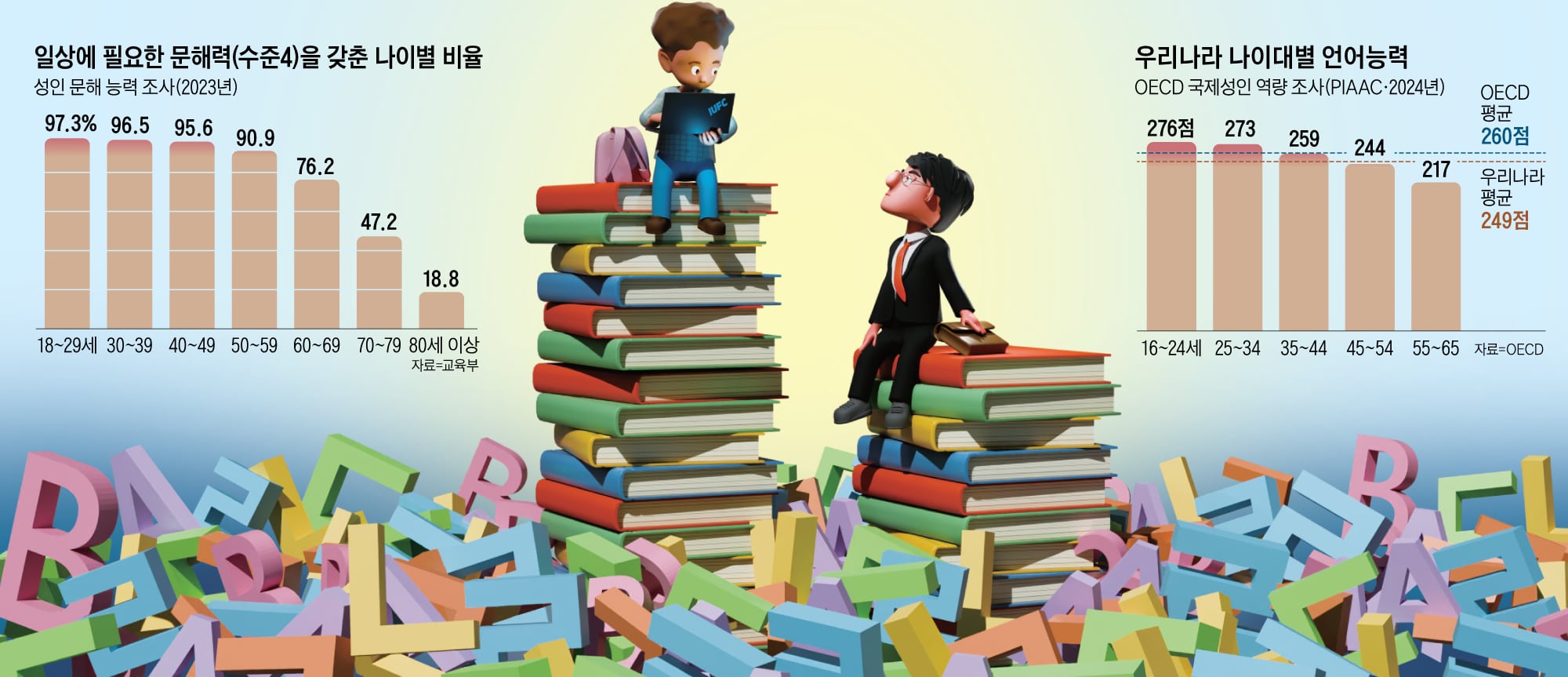
According to the fourth adult literacy survey conducted by the Ministry of Education in 2023, the proportion of people with the literacy necessary for daily life was 97.3% for those aged 18–29, but it sharply decreased to 90.9% for those in their 50s, 76.2% for those in their 60s, and 47.2% for those in their 70s as the generation aged. Evaluations by foreign institutions show the same results. In the 2024 OECD Programme for the International Assessment of Adult Competencies (PIAAC), while South Korea’s adult language proficiency falls below the OECD average, those aged 16–24 surpass the OECD average. Children excel even more. In the 2022 OECD Programme for International Student Assessment (PISA), which targeted 15-year-old students from 81 countries, South Korea ranked fourth in the world in reading, placing it among the top performers.
The misconception about literacy leads to the prejudice that children these days do not read books. However, this is also untrue. According to the 2023 National Reading Behavior Survey conducted by the Ministry of Culture, Sports and Tourism, the comprehensive reading rate among South Korean elementary, middle, and high school students is 95.8%. The comprehensive reading rate refers to the proportion of people who read at least one general book in a year, excluding textbooks, study guides, exam prep books, magazines, and comics. However, this rate significantly decreases with older generations. The highest rate was among those in their 20s at 74.5%, followed by 68.0% for those in their 30s, 47.9% for those in their 40s, and 15.7% for those aged 60 and above. Six out of ten adults do not read a single book in a year. Therefore, while adults read an average of 3.9 books annually, elementary, middle, and high school students read a remarkable 36.0 books.
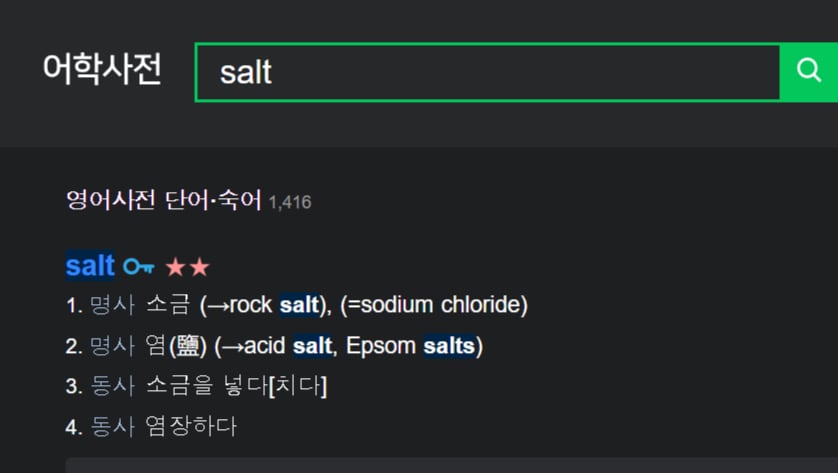
Nevertheless, adults still think that children do not understand them well. Conversely, it is more likely that the older generation fails to properly grasp information that even children understand. Recently, when news broke that China had succeeded in developing a thorium molten salt reactor, some South Korean media outlets absurdly titled their reports, claiming that salt was used instead of water. However, the term ‘salt’ refers to substances produced by acid-base reactions, which is part of the middle school curriculum. This mistake might have occurred due to translating the overseas media’s use of ‘salt’ as ‘table salt,’ but news outlets would hardly confuse “right” as meaning both “correct” and “right-hand side” in translation.
In fact, given this situation, one cannot help but question what the older generation, who do not read books and have low literacy, can teach the next generation. Today’s students are growing up in an entirely different environment from the one adults lived in. To see what children these days are like, visit the ‘Maker Faire’ hosted by the Seoul Municipal Science Museum. There are children creating control boards with Arduino, an open-source electronics platform, and others explaining self-made renewable energy generators like solar and wind power. This is no different in rural areas. Children in Seogwipo also grow up watching the same YouTube videos as those in Silicon Valley. There are even 10-year-old children discussing the ion beam propulsion engine used by Japan’s Hayabusa asteroid probe.
Last summer, many people expressed concern about our reality after watching the broadcast ‘Crazy about Engineering in China, Crazy about Medicine in Korea.’ However, there are still many gifted students entering engineering colleges in our country. The more serious issue is our failure to properly nurture even these talents. Recently, an engineering student uploaded an 11-hour and 24-minute YouTube video that garnered significant attention. It explains the proof of Fermat’s Last Theorem in a way that high school students can understand. This problem, posed by mathematician Fermat in 1637, tormented mathematicians for 358 years until it was finally solved in 1995. Unsurprisingly, many reacted with disbelief that a high school student could understand it. Many of these skeptics were university professors.
However, the generation that shared this video the most was surprisingly middle and high school students. Encouraging and supportive comments continued to pour in. One particularly long comment stood out. It summarized the video’s content by time intervals, added supplementary explanations, and followed along for the entire 11 hours. It concluded, “I am currently a high school student. I can attest that high school students can understand it.” Before blaming medical schools, adults should feel ashamed for failing to properly embrace even the gifted students who come to them on their own feet. While elementary, middle, and high schools use smart pads for learning, our universities still use engineering calculators from decades ago.
Although not all, one characteristic of people with low literacy is their tendency to oversimplify the world and view it in black-and-white terms. Perhaps such stubbornness divides society and prevents recognizing young talents. It is heartbreaking to see prodigy pianist Lim Yun-chan, who expressed in an interview a reluctance to return to Korea, the country of his birth and upbringing, due to traumatic childhood experiences. We have always had gifted individuals, and even now, precious children are pursuing their dreams in various places. If we lack insight, we should at least create a culture of opening our eyes and ears to listen to children’s stories. What is more desperately needed is the inclusivity to embrace the future generation, allowing them to freely express their thoughts.


