Then came October 26. As a child, I felt as if the sky had collapsed. Only much later did I learn that the death of a ruler was called Cheonbong (天崩), and I felt a strange sense of connection. My true sorrow stemmed from the realization that the sturdy 9-ton truck-like system I had believed was safe had been in a traffic accident. The system had already developed cracks and was no longer the same.
A few days later, however, the adults around me began to act strangely. They started to criticize Park Chung-hee as if they could finally speak freely. They mentioned the lack of press freedom. A children’s newspaper reported that textbooks would reduce or omit references to Yushin. Had I been deceived? Were the adults cowardly? Was Park Chung-hee a hero or a villain? What kind of era had I lived through? From my perspective, the Yushin era wasn’t particularly bad for a child. However, the Fifth Republic that followed was extremely difficult for a teenager.
‘History is not a matter of the past but an ongoing process. Amid the flood of news, we capture moments where a cross-section of history emerges and unfold the story.’ Since 2018, the ‘Yoo Seok-jae’s Sudden History Battle’ has been serialized through the Chosun Ilbo’s print edition and Chosun.com until late August. After a brief hiatus, ‘Sudden History Battle’ returns for Season 2. As before, we will meet you every Friday morning with deeper, more refined writing.
==========
During the Yushin era, I was in the lower grades of elementary school. At the time, with portraits of President Park Chung-hee hanging in every teachers’ office, the president seemed almost divine. None of the adults around me spoke ill of him, and it was considered natural. The term “Yushin,” still unfamiliar to only some children, was something we were taught to accept as an extraordinary measure to “make the country even better off.”
Then came October 26. As a child, I felt as if the sky had collapsed. Only much later did I learn that the death of a ruler was called Cheonbong (天崩), and I felt a strange sense of connection. My true sorrow stemmed from the realization that the sturdy 9-ton truck-like system I had believed was safe had been in a traffic accident. The system had already developed cracks and was no longer the same.
A few days later, however, the adults around me began to act strangely. They started to criticize Park Chung-hee as if they could finally speak freely. They mentioned the lack of press freedom. A children’s newspaper reported that textbooks would reduce or omit references to Yushin. Had I been deceived? Were the adults cowardly? Was Park Chung-hee a hero or a villain? What kind of era had I lived through? From my perspective, the Yushin era wasn’t particularly bad for a child. However, the Fifth Republic that followed was extremely difficult for a teenager.
Generally, those in my generation, who attended university in the late 1980s and 1990s, share this sentiment. Memories of the Yushin era, corresponding to our childhood, are not bad. However, after entering university, negative perceptions of Park Chung-hee grew. Yet, at least Park Chung-hee was not a ruler like Chun Doo-hwan, whom we felt had directly oppressed us. While the spectrum ranges from extreme veneration to rejection, direct resentment toward Park Chung-hee is far less than toward Chun Doo-hwan.
Looking back now, something more surprising emerges. Nearly half a century after October 26, the embarrassment and discomfort in evaluating and positioning Park Chung-hee—the awkwardness of still struggling to properly assess him—remains little changed from the immediate aftermath of October 26.
On National Liberation Day, there seems to be little difficulty in commemorating modern Korean historical figures like Kim Koo, Ahn Jung-geun, Yu Gwan-sun, and Yoon Bong-gil. But what about Rhee Syng-man? And Park Chung-hee? They remain uncomfortable figures. However, unlike Chun Doo-hwan, who is almost unequivocally labeled a villain, Park Chung-hee’s contributions are generally considered too significant to dismiss. In summary, praising or positively evaluating Park Chung-hee makes one “far-right,” while criticizing or negatively evaluating him makes one “progressive or left-wing.” There is no middle ground.
Yet, beneath the surface, Park Chung-hee undeniably holds a significant place in Koreans’ political and historical consciousness. From March 22 to April 5, 2024, the Korean Gallup surveyed 1,777 people aged 13 and older nationwide on “Koreans’ favorite president.” Roh Moo-hyun ranked first with 31%, followed by Park Chung-hee with 24% (Roh Tae-woo ranked 10th with 0.4%). This was surprising: a significant portion of respondents had lived through Roh Moo-hyun’s era, while Park Chung-hee was known only through books, yet nearly a quarter still invoked his name.
No explanation may be needed, but between 1961, when Park Chung-hee seized power, and his death in 1979, Korean society underwent fundamental changes. Per capita national income grew nearly 18-fold, from $89 to $1,589, while exports surged approximately 360-fold, from $42 million to $15.06 billion. Heavy and chemical industries, unimaginable in the early 1960s, were fostered alongside the Saemaul Undong. People no longer starved, highways were built, deforested mountains were reforested, and the foundation for medical insurance was laid.
A friend who disliked Park Chung-hee once confessed that after volunteering in Africa, he came to respect Park Chung-hee. Having lived in a society with poor economic and social systems, he wondered: if a leader emerged to industrialize the nation and improve living standards, how should the people evaluate that leader (or dictator)? This reflection led him to finally acknowledge Park Chung-hee as a great figure.
However, just as “Yoon Again” is an empty slogan, “Park Again” is impossible. One historian wrote in a biography’s preface, “I hope a second Park Chung-hee, who may appear on this land someday, will read this book,” but history does not repeat. The 1972 Yushin, an unconstitutional measure, cannot reappear. Perhaps Park Chung-hee emerged precisely at the historical stage when such a figure was desperately needed. His tenure (1963–1979) overlaps mostly with Ferdinand Marcos’s dictatorship in the Philippines (1965–1986). If Korea had had Marcos and the Philippines had had Park Chung-hee, the fates of both nations might have differed.
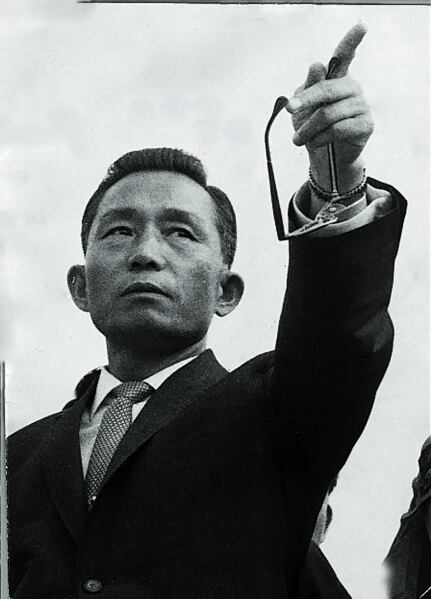
This raises a question: what characteristics allowed the emergence of a unique leader like Park Chung-hee (or politician or dictator)? Some analyses suggest that before the May 16 coup, Park Chung-hee was not a “charismatic commander” but a “planner-type strategist.” (Oh In-hwan, ‘Park Chung-hee’s Times’)
Delving deeper, many overlook that Park Chung-hee was neither a field commander nor the head of an organization like Chun Doo-hwan. In short, his leadership was forged through relentless effort. His essence was that of a “planner.” He stood out as an exceptional operations planner, meticulously executing plans from conception to evaluation. Even while pursuing major projects, he never neglected minor details—a governance skill he honed in the military. This planning ability ultimately led to the coup’s success: planning was revolution.
This analysis continues: a commander needs an eagle’s eye to survey the battlefield and a beast’s heart to boost morale. Quick judgment and command are essential. Few excel as both subordinate unit commander, staff officer, chief of staff, and commander, yet Park Chung-hee possessed this integrated ability.
After May 16, his leadership evolved. Among the revolutionary forces, there were senior military figures, and Kim Jong-pil’s Republican Party was not entirely loyal. Here, Park Chung-hee learned “system politics” to strengthen his political acumen. He pitted Lee Hu-rak’s Cheong Wa Dae secretariat against Kim Hyung-wook’s Central Intelligence Agency, using competition and checks to consolidate power (his failure to pass this skill to his kin later led to the first collapse of conservatism).
Though economically inexperienced, Park Chung-hee learned the fundamentals through self-directed study. He received one-on-one lectures from university professors for three hours daily, convened export promotion meetings to listen to debates, and made decisions after careful consideration. He always evaluated outcomes post-implementation. His flexible mindset, humility, and lack of self-interest contributed to this. The result was the “Miracle on the Han River”—rapid economic growth.

However, this leadership faltered after the 1972 Yushin declaration and especially around 1974, following the death of First Lady Yuk Young-soo. His self-directed learning ceased, and his ability to self-correct slowed. As a planner, he failed to create an exit strategy. When high growth hit limits, he refused to adopt stabilization policies. His personal moral lapses and failure to curb Chief of Security Cha Ji-chul’s dominance in his final years led to the collapse of his political skills. October 26 was the consequence.
Park Chung-hee’s leadership was both a model and a cautionary tale. Yet, his early reign’s foresight still amazes. In a June 1965 special address before the Korea-Japan Treaty ratification, he said: “Why do they [opponents of the treaty] lack confidence, cling to a sense of victimhood and inferiority, and fear Japan unconditionally?” “Why not, at least, feel a sense of superiority, standing on equal footing and leading them?” Those who once dismissed this as unrealistic or absurd might think differently today.