The 2026 Formula 1 Rule Changes: A Major Challenge for Brake Design
Formula 1 is undergoing one of the most significant regulatory overhauls in its history, with changes set to take effect in 2026. These modifications are not only affecting the performance of the cars but also presenting a major challenge for brake design. According to Andrea Algeri, Brembo’s F1 customer manager, this is one of the most complex rule changes his company has faced in recent years.
The primary shift involves the balance between combustion and electric power, which will move from an 80/20 split to 50/50. This means that the MGU-K (Motor Generator Unit – Kinetic) will increase in power from 120 kW (161 horsepower) to around 350 kW (469 hp), while the MGU-H (Motor Generator Unit – Heat) will be removed entirely. Alongside this change, the introduction of active aerodynamics will significantly alter how quickly the cars accelerate and decelerate.
Algeri explained that these changes have created new challenges for brake systems, particularly in terms of regenerative braking. “This is honestly one of the most challenging [regulation changes] for us,” he said. “We’ve gone through different changes in the shape of brakes, cars, tyres, and wheels over the years, but this is unique.”
Key Changes in Brake Hardware
There are two main reasons behind the extensive changes in brake hardware for 2026. First, there is an increased demand for energy recovery from the MGU-K. Second, the new regulations offer more flexibility compared to previous ones.
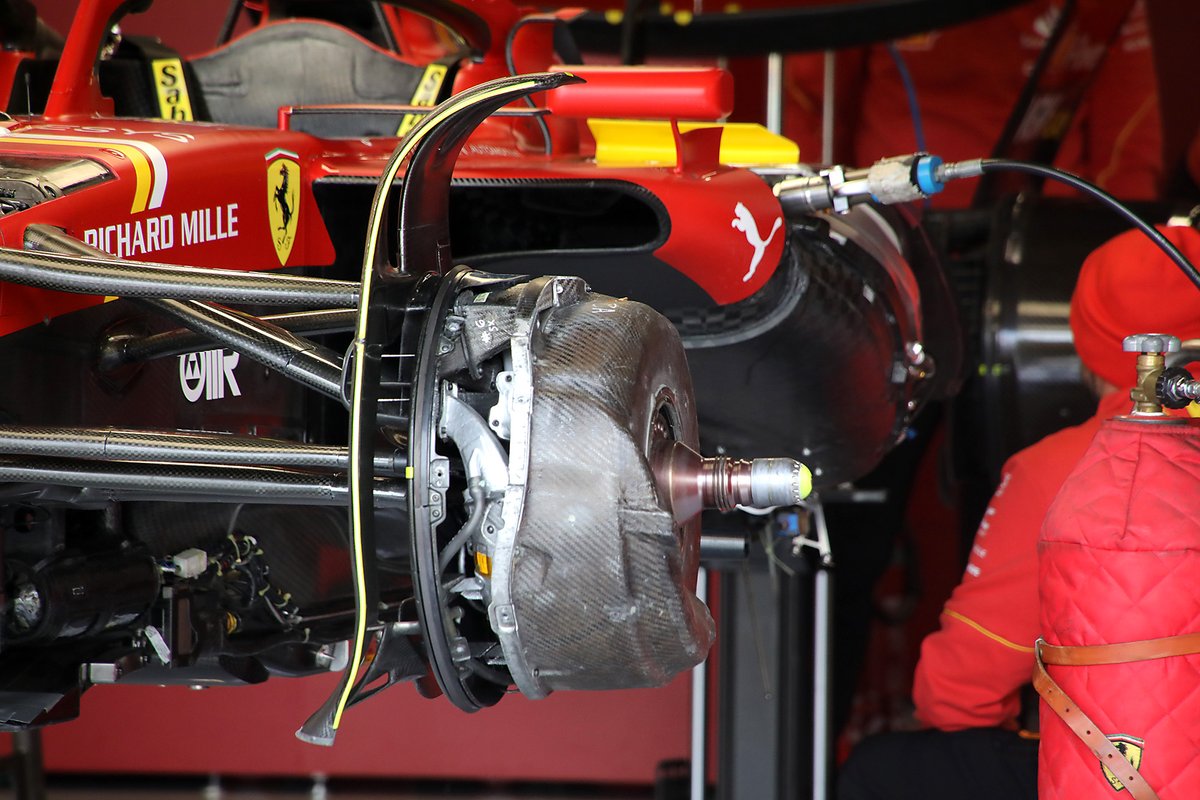
Under the new rules, front brake rotors can range from 325 to 345 mm in diameter, while rear rotors can be between 260 and 280 mm. The maximum thickness for all rotors remains at 34 mm. This allows for greater variation in size, giving teams the option to use larger front discs and smaller rear ones.
Additionally, the regulations now permit up to three attachment points for the callipers, instead of the usual two. This opens up possibilities for more pistons and pads, marking what Algeri called “the biggest change on the calliper side in 20 years.” This flexibility gives engineers more freedom to innovate.

The Concept of Braking Systems
Despite these changes, the actuation of the braking system remains conceptually similar to what has been used since 2014. Front brakes are purely hydraulic, while the rear uses brake-by-wire technology. Driver input from the pedal translates into a torque request, which the car then processes into a combination of friction and regenerative braking.
The Weight Battle
Another critical factor in 2026 is the weight limit. Although battery sizes are increasing, the total minimum weight limit has been reduced from 800 kg to 768 kg. Teams are now under pressure to optimize every gram of weight, which has had a direct impact on brake design.
Algeri noted that teams are seeking the best trade-off between size and weight. Some are opting for larger front brakes, while others are going smaller on the rear. However, there are safety considerations. The FIA mandates a minimum braking torque of 2500 Nm for the rear axle, ensuring that even if the power unit fails, the car can still stop safely.

Rethinking Circuit Ratings
Brake manufacturers will need to rethink their circuit ratings due to the increased reliance on engine braking. Rear discs may require fewer cooling holes, as they will see less use. In contrast, front discs may need more cooling due to the higher speeds expected in 2026.
Algeri also mentioned that different tracks will require different cooling specifications. For example, circuits like Monza, which are high-speed, may require more cooling, while twisty circuits like Monaco may need less. This variability adds another layer of complexity to brake design.
Energy Recovery and Braking Strategy
The energy deployment challenges in F1 mean that the demands on the brakes will vary greatly depending on the track. Algeri explained that tracks like Monaco or Singapore, which are light on torque, could become heavy on the brakes due to the high energy recovery potential.
With a greater reliance on regenerative braking, teams will have more control over how they slow down and how much energy they harvest. This will make the 2026 season as much about software as it is about hardware.
Conclusion
The 2026 Formula 1 season promises to be a fascinating evolution of both technology and strategy. As teams adapt to the new rules, the role of brake design will become even more crucial. With innovations in weight management, energy recovery, and circuit-specific adjustments, the future of F1 looks both exciting and challenging.