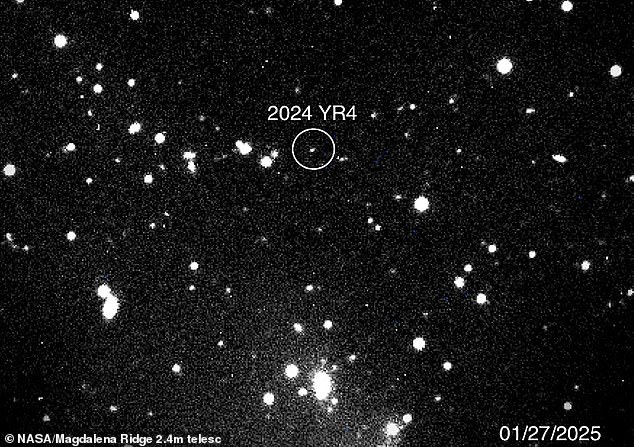
The Growing Concern Over Asteroid 2024 YR4
Scientists have issued a concerning update regarding the asteroid known as 2024 YR4, which is currently on a trajectory that could see it strike the moon. This asteroid, measuring approximately 220 feet (67 meters) in diameter, is classified as a “city-killer” due to its potential destructive power. As of now, there is a four percent chance of impact on December 22, 2032, but fresh observations might increase this probability to as high as 30 percent.
If 2024 YR4 were to collide with the moon, it could create a crater nearly 0.6 miles wide and send debris hurtling toward Earth. Researchers are particularly interested in observing the asteroid using the James Webb Space Telescope (JWST) in February, as this could provide crucial data about its trajectory before it becomes visible again in 2028. Dr. Andrew Rivkin from Johns Hopkins University suggests that these observations could significantly alter the chances of a lunar impact, prompting space agencies to act swiftly.
Discovery and Initial Concerns
2024 YR4 was first detected in December 2024, causing alarm as it initially posed a one-in-32 chance of hitting Earth. Although subsequent observations reduced this risk to near zero, concerns shifted to the possibility of an impact with the moon. The asteroid has been out of sight since mid-last year, complicating efforts to determine its exact path. However, the JWST’s unique position will allow for two brief observation windows in February 18 and 26, providing critical data on its location and speed.

Key Details About 2024 YR4
- First Detected: December 27, 2024
- Estimated Size: 174-220 feet (53-67 meters)
- Speed Relative to Earth: More than 30,000 miles per hour
- Date of Possible Moon Impact: December 22, 2032
- Probability of Impacting the Moon: 1-in-23 (4.3 percent)
Dr. Rivkin and his team predict an 80 percent chance that new observations will reduce the odds of a lunar impact to below one percent. However, there is a five percent chance that the probability could rise to 30 percent, and a 15 percent chance that the odds will remain unchanged or change slightly.

Deflection Strategies and Timelines
NASA’s DART mission has demonstrated that impacting an asteroid with a spacecraft can alter its trajectory enough to avoid a collision. However, such methods require years of preparation and must be initiated well in advance. NASA researchers have considered more drastic measures, including using a nuclear bomb, but these would need to be launched by 2030 at the latest.
The JWST will have another opportunity to observe 2024 YR4 in 2027, but time is running out for space agencies to make decisions. Dr. Rivkin emphasized the importance of early action, stating that waiting until 2028 would be extremely tight. Even though a lunar impact would not be as devastating as one on Earth, it could still pose significant risks to space-based infrastructure.
A lunar collision could release energy equivalent to 500 times the Hiroshima bomb, ejecting 10,000 tonnes of rock into space. If the asteroid hits in the right location, Earth’s gravity could funnel up to 30 percent of this debris toward our planet, potentially damaging satellites responsible for communications and navigation.
Richard Moissl, head of planetary defense at the European Space Agency, noted that while a lunar impact poses no direct threat to people on Earth, it could endanger space infrastructure. However, there are no current missions planned to monitor or deflect 2024 YR4 in the agency’s budget.
Potential Methods for Deflecting Asteroids
Several strategies have been proposed to mitigate the threat of asteroids:
- Multiple Bumps: Scientists have experimented with firing projectiles at meteorites to simulate how to alter an asteroid’s course. For carbon-rich asteroids like Bennu, multiple small impacts may be necessary.
- Nuke: Using a nuclear explosive near an asteroid could potentially disrupt it, but it risks creating smaller, dangerous fragments.
- Ion Beam Deflection: This method involves directing plumes from a spacecraft’s thrusters toward the asteroid to gently push it over time.
- Gravity Tractor: A concept that uses a spacecraft’s gravitational field to slowly pull an asteroid away without physical contact.
Professor Colin Snodgrass highlighted that while various concepts exist, the kinetic impactor remains the most straightforward technology for deflection within a few years to decades of warning.
Final Thoughts
As the world watches closely, the coming months will be critical in determining the fate of 2024 YR4. The decisions made now could prevent a catastrophic event, whether on the moon or Earth. The urgency of the situation underscores the importance of continued research, international cooperation, and proactive measures to safeguard our planet and its space assets.


