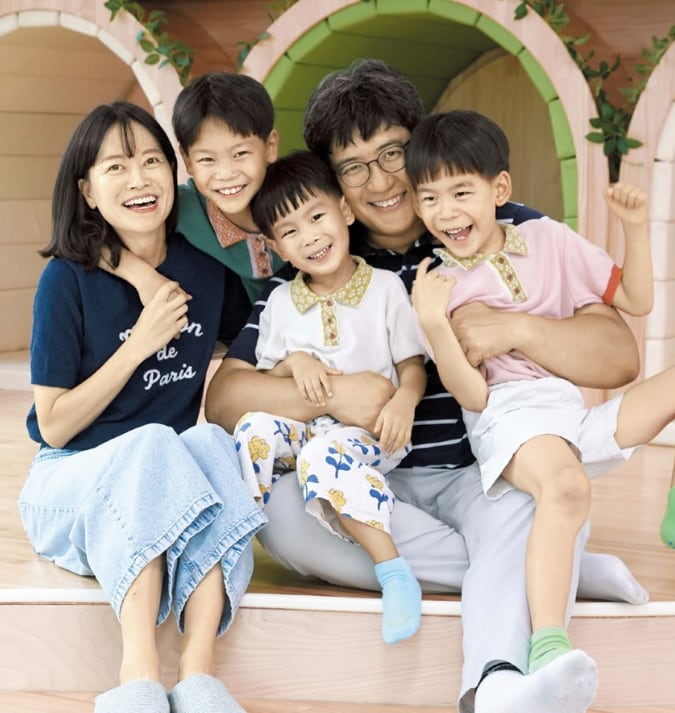
“Is there a rule that only the place you were born can be your hometown? We had three sons here in Jeju and built a house, so for our family, this is now our ‘second hometown.’”
In 2014, the National Institute of Meteorological Sciences, previously located in Dongjak-gu, Seoul, relocated to Seogwipo, Jeju. The workplace address changed from the heart of the city to the southern tip, where typhoons hit first. Researchers at the institute, including Cho Jung-hun, 48, a research civil servant, also moved from Seoul to Jeju. The challenge was leaving behind his girlfriend, 10 years his junior, whom he had just started dating. After 1.5 years of long-distance dating between Seoul and Jeju, they made a decision in 2017: to marry and live in Jeju. Cho said, “When we first decided to move to Jeju, we never imagined we’d put down roots here so deeply.”
Cho Jung-hun and Kim Hwa-jin, 38, have raised three sons in Jeju. After marrying, Kim, who previously worked in Seoul, found employment at a private research institute in Jeju, and they have been a dual-income household for nine years.
With no family ties in Jeju, the couple often relies more on people they met after moving there than on relatives. They recalled the most difficult moment as the birth of their third child, Lee Sol, 4, in 2022. When their second child, Yoo-jun, 7, was born in 2019, Kim’s mother came to Jeju in time for the due date to care for their first child, Ha-min, 8. They thought preparing for the third child’s birth would be similar, but it was a miscalculation. Ten days before the due date, Kim went into labor at 3 a.m. “Even more than the pain, I felt desperate because I had nowhere to leave the kids,” Kim said. “An acquaintance we knew from the second birth had once said, ‘If you ever go into labor in the early hours, call me,’ so I called despite the inconvenience. They gladly came to our house to look after the children, allowing me to go to the hospital and give birth.”
The couple did not initially plan to have three children. However, the environment in Jeju changed their minds. The children grew up playing on nearby oreums (small volcanic hills), doing sandplay by the sea, and collecting hermit crabs and shells. Seogwipo’s warm weather year-round provides ample time for outdoor activities. Cho said, “Both of us have siblings, and even as adults, we rely on each other in tough times. We thought we’d have at least two children. After raising the first two, we realized Jeju’s natural environment was ideal for raising kids, which led us to decide on a third.”
Colleagues and neighbors filled the void left by the absence of family and relatives. Many employees at the National Institute of Meteorological Sciences, like Cho, have no ties to Jeju. The workplace fosters a flexible attitude toward childcare, and the institute actively encourages parental leave and vacations to retain young researchers. Last year, they even created an on-site childcare room called “Mandorong Workplace” to allow employees to bring their children to work during school breaks. Cho said, “Even after moving to Jeju and starting our married life, I was anxious about raising children. Thanks to this understanding and support, we’ve managed childcare without major difficulties.”
Their complete settlement in Jeju began when they decided to build a house. With about three years left on their public housing lease, the couple looked for apartments and standalone houses but found nothing to their liking. Then, Cho jokingly suggested to his wife, “Why not buy land and build a house for our active kids?”
Buying land meant permanently rooting themselves in Jeju, so the couple hesitated. However, seeing their energetic first and second children solidified their resolve. They purchased land and began designing the house while Kim was pregnant with their third child. They nearly gave up due to soaring material costs but eventually completed the house as envisioned. “How much of our house is built today?” the couple said they visited the construction site with their children every day after work during the building process.
“In spring, we plant flowers the kids choose in the garden; in summer, we set up a small pool and an inflatable bounce house; in autumn, we camp with a tent; and in winter, we build snowmen. Jeju, where we came by chance, has now become our hometown with a house we built and where our three children are growing up,” the couple said. They added, “At least until the kids grow up and go to college, Jeju will remain our family’s base.”
Of course, living in Jeju has drawbacks. The first and second children are recently obsessed with “speed cubing,” aiming to solve puzzles quickly. They want to obtain related certifications, but Jeju has no institutions to issue them. Unlike Seoul, limited access to cultural activities like movies, plays, and musicals is another inconvenience while raising children.
However, the couple said, “There’s no need to worry about living in Jeju due to its geographical limitations. The satisfaction and happiness it brings outweigh those concerns.” Cho added, “I’ve heard that young researchers hesitate to join the National Institute of Meteorological Sciences in Jeju. If they’re hesitant because of the burden of raising children in an unfamiliar place, they should let go of some of those worries.” He emphasized, “Raising children in a place without family ties is undoubtedly challenging, but there are colleagues and neighbors facing the same struggles. Raising children in Jeju’s excellent environment with such people holds value beyond measure.”
- 월 5900원 멤버십, 신문 독자에게는 2900원, 조선멤버십
- 55000원 상당의 신문-잡지 8종 마음껏 보기, 조선멤버십
- 현금처럼 쓸 7000포인트 받아 알뜰한 쇼핑, 조선멤버십

Related posts:
Fiction park: He was the best in class. He still wasn’t good enough
Gagan Thapa takes oath as Congress president, vows to regain public trust

Inside knowledge that has locals gripped by fear after gran’s body found decomposing in cattle dip
New property purchase disclosure rule in Japan sparks fears it may curb foreign investment
Dino-mite treasures: inside Singapore’s Fort Knox storing playthings of ultra-rich