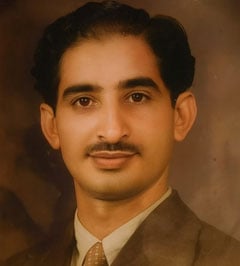
A Legacy of Service and Leadership in Qambar
History has a way of remembering those who leave an indelible mark on the world. Some individuals are remembered not for their wealth or power, but for their contributions to society and their unwavering commitment to the people they served. Major Dost Muhammad Khan Hakro is one such figure whose life and work continue to inspire generations in Qambar and beyond.
Born in 1911 in the Ali Khan Mohalla of Qambar city, Major Dost Muhammad Khan was raised in a family that valued education and service. He received his early education at Sindh Madrassatul Islam, a historic institution that shaped his understanding of the importance of knowledge. Later, he pursued higher studies in Dehradun, India, where he completed his Senior Cambridge. This journey reinforced his belief that education was the key to progress and empowerment.
At a time when politics in the region was often driven by empty promises and exploitation, Major Dost Muhammad chose a different path. Instead of seeking personal gain, he focused on raising awareness among the people of Qambar. He believed that education was the only means to create real change, and this conviction led him to take action.
Education as a Tool for Empowerment
Major Dost Muhammad Khan dedicated himself to improving the lives of the poor youth in Qambar. Many of them lacked the financial resources to pursue education, so he took it upon himself to support them. He not only covered their educational expenses but also provided a place for them to live, eat, and study. His efforts transformed Qambar from a place of ignorance into a center of learning and opportunity.
His contributions extended beyond education. He donated land for the construction of several institutions, including Qambar High School, Qambar Girls Primary School, a sports ground, and the Qambar Police Station. Most notably, he built a temple for the Hindu community, promoting religious harmony in the region. These actions reflected his deep commitment to the welfare of all residents, regardless of their background.
Political Leadership and Public Service
The spirit of public service eventually led Major Dost Muhammad into politics. He was elected Chairman of the Qambar Municipal Committee, a position he held with great dedication. Despite limited resources, he worked tirelessly to strengthen the committee. His efforts were so successful that Qambar became financially stable enough to lend money to the Karachi Municipal Committee, the capital city of Sindh.
One of the most significant events in his life occurred in 1942, when a dangerous flood threatened to destroy Qambar. Acting swiftly, Major Dost Muhammad organized the construction of embankments that saved the city from major destruction. His actions earned him the title of “Robin Hood of Qambar” from an English newspaper, highlighting his selfless nature and deep connection with the people.
After the creation of Pakistan, his influence grew, and he was offered a position in the Pakistan Army, where he served as a Major. Upon retiring in 1952, he entered provincial politics, serving as a member of the Sindh Assembly and later as an advisor in the provincial cabinet. However, he resigned due to his inability to compromise with corruption, demonstrating his integrity and principles.
A Political Dynasty
Major Dost Muhammad Khan’s political career continued through his children. In the 1962 elections, he could not run due to restrictions imposed by the EBDO Elective Bodies Disqualification Order, so he nominated his elder son, Fida Hussain Khan Hakro, as a councillor. Fida Hussain served as a councillor from 1962 to 1965 and later as a member of the West Pakistan Assembly from 1965 to 1968.
In the 1971 general elections, Major Dost Muhammad contested as an independent candidate and won decisively. His victory caught the attention of Zulfikar Ali Bhutto, who invited him to join the Pakistan Peoples Party. His influence extended beyond Qambar, as he was connected to many prominent figures in Sindh, including Zulfikar Ali Bhutto, Mir Rasool Bux Talpur, and others from various tribes.
A Lasting Impact
On October 1, 1979, the death of Major Dost Muhammad Khan Hakro marked a significant loss for Qambar. Yet, his legacy lived on through his family. For 69 years, members of his family held the position of Qambar Municipal Committee Chairman, continuing his tradition of service and leadership.
His younger son, Ali Hassan Khan II, and his elder son, Fida Hussain Khan Hakro, carried forward the family’s political legacy, ensuring that the values of service and integrity remained central to Qambar’s governance. The lamp lit by Major Dost Muhammad Khan continued to shine within his family, symbolizing the enduring impact of his life and work.
Today, the people of Qambar still remember and honor Major Dost Muhammad Khan Hakro. His services and struggle remain alive in their hearts, and the city will always be proud of the man who gave so much to its people.


