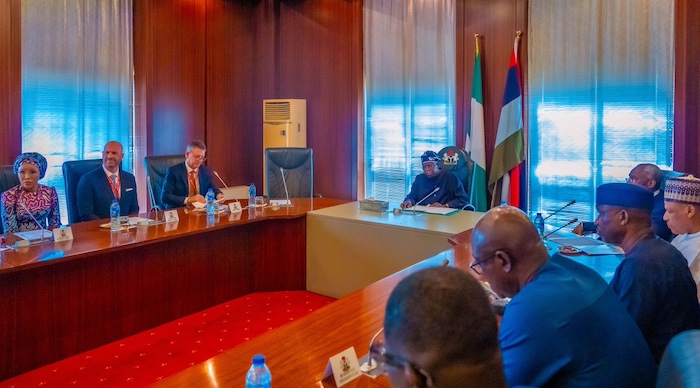
President Bola Tinubu Highlights Government’s Efforts to Resolve Ogoni Disputes and Boost Oil Production
President Bola Tinubu has announced that the government is engaged in advanced discussions with Ogoni leaders to address long-standing disputes that have impeded oil production in the region. This revelation came during the formal commissioning of the Otakikpo Crude Oil Export Terminal in Rivers State, where the President emphasized the continued importance of the oil and gas sector in global energy supply.
Tinubu stated that despite a growing global shift toward cleaner energy, the oil and gas industry will remain a dominant force for decades. He noted that new projections from the International Energy Agency (IEA) highlight the necessity of investing about $540 billion annually over the next 25 years in upstream sectors to prevent an energy crisis. These insights underscore the ongoing relevance of Nigeria’s oil reserves and justify the government’s efforts to engage with host communities, particularly the Ogoni people, to resume production in dormant oilfields.
The President criticized past attempts to abandon Nigeria’s oil and gas resources in exchange for minimal support. He argued that the global landscape has changed, and the current investment appetite for hydrocarbons makes it essential for Nigeria to resolve issues that have stalled production in resource-rich areas like Ogoniland.
“Once these issues are resolved, the Otakikpo terminal will serve as the main evacuation point for crude produced from Ogoni,” Tinubu said. “This project is not just timely but strategic for Nigeria’s production growth.”
The Otakikpo Terminal, developed by Green Energy International Limited at a cost of over $400 million, marks a significant milestone for Nigeria’s upstream operations. Located in Ikuru Town, Andoni Local Government Area, the facility is the first indigenous-built export terminal in over five decades. It enhances the country’s crude evacuation capacity and showcases the potential of local participation in the sector.
Minister of State for Petroleum Resources, Senator Heineken Lokpobiri, highlighted the terminal’s role in easing crude evacuation challenges in the region. He noted that the project aligns with the government’s objective to ramp up production and expand existing oil infrastructure. The terminal serves not only Green Energy but also other operators with contiguous fields, offering a more efficient and cost-effective solution for local firms.
Tinubu also urged host communities, especially those in Rivers and the Niger Delta, to collaborate with investors and government agencies to ensure uninterrupted operations. He stressed the need for collective effort to unlock the country’s vast energy potential.
Lokpobiri disclosed that the Federal Government is in advanced talks with Ogoni leaders to resolve long-standing disputes over oil production in the area. Once resolved, the terminal will become the major evacuation point for crude from Ogoni land, ensuring that the people benefit from these resources through peace and collaboration.
In addition, the minister announced that Nigeria has met all obligations to host the newly established African Energy Bank. This initiative aims to enhance access to financing for African oil and gas projects, addressing one of the continent’s biggest challenges—access to finance.
The minister cited Senegal’s $8 billion gas project, funded by BP and Kosmos Energy, as evidence of the strong returns possible in the oil and gas sector. He commended Green Energy International for reinvesting in the domestic economy, setting a standard for other indigenous operators.
Tinubu warned that marginal field operators must fulfill their minimum work obligations or risk losing their licenses. He reiterated the sector’s central role in solving Nigeria’s economic problems, emphasizing the government’s commitment to collaboration with stakeholders to unlock the region’s potential.
Features of the Otakikpo Terminal
The Chief Executive Officer of the Nigerian Upstream Petroleum Regulatory Commission, Gbenga Komolafe, outlined the features of the Otakikpo Terminal. Initially capable of exporting up to 750,000 barrels of crude oil per day, the facility can be expanded to three million barrels. It represents the first shore-based export facility built in Nigeria in over 50 years and the first entirely developed by an indigenous company.
Komolafe described the project as a historic milestone, signaling a new era for Nigeria’s petroleum industry. For decades, Nigeria’s crude oil exports were handled by a few massive terminals owned by international oil companies. The Otakikpo Terminal breaks this long trend, marking a new chapter in the country’s petroleum history.
The significance of the terminal extends beyond its capacity. It enhances Nigeria’s crude evacuation system at a time when national production averages between 1.7 and 1.8 million barrels per day. By creating an alternative export hub in Rivers State, the terminal reduces dependence on aging facilities that are near capacity and often affected by security and pipeline disruptions.
Komolafe added that the facility benefits indigenous producers by providing direct control over their evacuation process. This improves their margins, reduces delays, and strengthens their competitiveness. Beyond production gains, the terminal serves as an economic anchor for its host communities, stimulating jobs and local businesses in logistics, security, catering, and other support services.
A Bold Statement of Intent
The Chairman and CEO of Green Energy International Limited, Prof. Anthony Adegbulugbe, described the milestone as a defining moment that proves Nigerian companies can conceive, execute, and deliver world-class energy infrastructure. He noted that the terminal was designed and executed entirely by Nigerian engineers and experts, demonstrating that indigenous operators can execute complex projects with excellence, on budget, and ahead of schedule.
Adegbulugbe emphasized the strategic position of the terminal to unlock more than 40 stranded oil fields in the Niger Delta region, with combined reserves of over three billion barrels. These fields could contribute an additional 200,000 barrels per day to Nigeria’s national production.


