The Trump-Takaichi Summit and the Strategic Significance of Yokosuka
U.S. President Donald Trump and Japanese Prime Minister Sanae Takaichi shared a moment that symbolized the strength of the Japan-U.S. alliance during their first meeting on the 28th of last month. After their summit at Tokyo’s Guest House, the two leaders boarded the U.S. presidential helicopter “Marine One” and traveled to the naval base in Yokosuka, Kanagawa Prefecture, south of Tokyo. They then boarded the nuclear-powered aircraft carrier USS George Washington and stood side by side before U.S. military personnel. Prime Minister Takaichi, smiling brightly next to President Trump, received applause as she said, “We will elevate the Japan-U.S. alliance, which has become the greatest alliance in the world.” Earlier at the Guest House, President Trump stated, “We are the strongest alliance, and we will do anything to help Japan,” a sentiment not heard at the South Korea-U.S. summit held in Gyeongju a day later. Within Japan, evaluations emerged that Prime Minister Takaichi, just one week into her term, had restored the “ultra-close Japan-U.S. relationship” seen during the tenure of former Prime Minister Shinzo Abe.
Trump’s Visit to Yokosuka: A Symbol of Alliance Strength
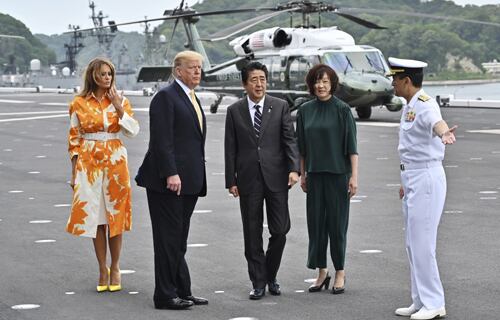
Trump’s choice of Yokosuka as a symbol of the Japan-U.S. alliance’s strength was significant, much like his 2019 visit to Japan. In May 2019, when Trump visited as the first state guest of the newly enthroned Emperor Naruhito, he also visited Yokosuka with then-Prime Minister Shinzo Abe. The visit by the leaders of both countries, accompanied by their spouses, made headlines. Trump boarded the helicopter carrier “Kaga,” which Japan planned to convert into an aircraft carrier, and delivered a speech before Japanese Self-Defense Force members and U.S. Navy personnel. Thumbs up, he said, “This ship will defend the Northeast Asian region from threats.” He added, “The Kaga is a great ship,” and “I feel very safe because of this ship.”

I had the opportunity to tour the Yokosuka base, including the U.N. Command (UNC) rear bases in Japan, six months before Trump’s visit in November 2018. Since the 1951 San Francisco Peace Treaty, which legally ended World War II, the U.S.-led UNC has utilized seven U.S. military bases in Japan for the defense of the Korean Peninsula. Under a 1954 agreement between the UNC and Japan, seven locations—including Yokosuka, Yokota, Sasebo, and Kadena and Futenma bases in Okinawa Prefecture—have been used as rear bases to suppress threats from North Korea. These bases serve as rear hubs for rapidly deploying troops and supplies, logistical support, and troop reorganization in the event of a contingency on the Korean Peninsula. The UNC rear bases have maintained overwhelming military power for over 70 years, acting as a war deterrent. Among them, Yokosuka, where the U.S. Navy and Japan’s Maritime Self-Defense Force share the same port and collaborate, is a key strategic point among the UNC rear bases.
Yokosuka Base: A Hub of International Military Cooperation
During my 2018 visit to Yokosuka, the first thing that caught my eye was the UN flag flying in front of the U.S. Fleet Activities Yokosuka headquarters. The UN flag, displayed alongside the U.S. and Japanese flags, symbolically showed that this was a UNC rear base. Yokosuka housed UNC forces from nine countries, including the U.S., the U.K., France, and Canada, preparing for contingencies. At the time, the commander and deputy commander of the UNC rear bases were military officers from Australia and Canada, respectively.
The diesel fuel stockpiled at Yokosuka base amounts to 110 million gallons, and explosives exceed 2,000 tons—enough explosive power to reduce Pyongyang and nearby cities to rubble. A Tokyo diplomatic source explained, “North Korea’s demand to dismantle the UNC stems from its desire to eliminate such military capabilities.” I boarded the USS Blue Ridge, the command ship of the U.S. 7th Fleet at Yokosuka. The escort ship “Kaga,” which the Japanese government announced it would convert into a de facto aircraft carrier and deploy F-35Bs, came into view. Australian submarines and French warships also frequently entered and exited the port.

Japanese Technicians Repair U.S. Warships
While touring Yokosuka base by bus, I saw the USS John S. McCain, which had been involved in a collision accident, undergoing repairs in a dry dock approximately 30 meters deep. About 30 helmeted technicians were engrossed in repairing the ship. Upon closer inspection, they were all Japanese. The U.S. colonel guiding the tour, who was of Korean descent, emphasized this fact: “All U.S. warships here are repaired 100% by Japanese technicians. Without the support of Japanese technicians, U.S. warships defending South Korea cannot exist.”
This statement seemed to reflect the strained Japan-South Korea relations following the South Korean Supreme Court’s October 2018 ruling on wartime labor compensation. The 10,000 Japanese technicians and workers at Yokosuka are all affiliated with the Japanese government. Witnessing how U.S. warships, maintained by Japanese personnel, guard the Northeast Asian seas and support South Korea’s defense made the remark that the U.S. 7th Fleet could not operate in the Asia-Pacific region without them resonate deeply.
Osprey Deployment and Local Opposition
During a visit to Yokota U.S. Air Force Base, a UNC rear base west of Tokyo, I saw about 10 C-130 transport aircraft lined up on an endless runway—ready to deploy immediately to the Korean Peninsula in case of a contingency. The U.S. military began deploying vertical takeoff and landing aircraft Osprey (CV-22) at this base in 2018. The Osprey is an aircraft that rapidly transports special forces during emergencies on the Korean Peninsula. In 2019, five units began official operations, expanding to 10 by 2024. This was the first time Ospreys were deployed on Japan’s mainland rather than Okinawa. The U.S. Department of Defense decided to deploy Ospreys on the mainland, judging that tensions in Northeast Asia, including North Korea’s nuclear threats, remained high. Despite opposition from local Japanese residents, the U.S. military carried out this plan.
During a visit to Futenma base in Okinawa, dozens of Ospreys were also visible. They were undergoing maintenance near the runway, ready to deploy at any moment. Commander David Steele of Futenma base stated, “We maintain operational readiness to respond to any situation.”

At Futenma, Japan’s Maritime Self-Defense Force 5th Army Aviation Command publicly displayed a P-3C patrol aircraft that monitors North Korea’s illegal oil transfers at sea. Similar in size to a Boeing 737, this patrol aircraft carries enough fuel for 180 drums and conducts surveillance at 650 km/h. Lieutenant Commander Takuya Hatate explained, “Eight countries, including the U.S., the U.K., New Zealand, and Canada, are cooperating to detect North Korea’s illegal oil transfers.”
UNC Rear Bases: A Thorn in North Korea’s Side
The UNC rear bases, including Yokosuka, are frequently visited by South Korean government officials. Ahead of the second U.S.-North Korea summit in 2019, high-ranking officials from South Korea’s Ministry of Foreign Affairs and Ministry of National Defense successively visited the UNC rear bases. Kim Tae-jin, then Director-General for American Affairs at the Ministry of Foreign Affairs (currently Protocol Chief), inspected the bases for two days in January 2019. UNC Chief of Staff Mark J. Quinn accompanied him. Earlier, in late November 2018, Army General Park Jong-jin, then Commander of the First Army, also visited the rear bases. Some analysts suggested these visits were to directly confirm the rear bases in preparation for the possibility of UNC dismantlement. Particularly, the visit by the First Army commander, responsible for the front lines, was considered unusual.
For North Korea, the UNC rear bases are a thorn in its side. After the Moon Jae-in administration took office in 2017 and South-North and U.S.-North Korea summits were held consecutively, North Korea began advocating for the dismantlement of the UNC and its rear bases. At the October 2018 UN General Assembly, North Korean Foreign Minister Ri Yong-ho demanded the UNC’s dismantlement, stating, “The UN Command is showing disturbing movements that obstruct the implementation of the inter-Korean Panmunjom Declaration.” Such claims continue today. Some in South Korea sympathize with these demands, but it is unclear whom this serves.


