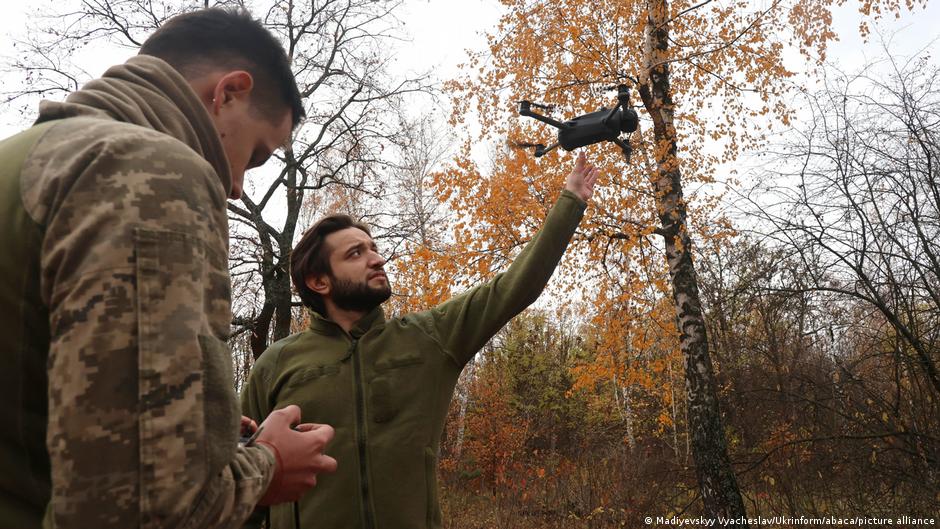
Ukraine’s Drone Production Ambitions and International Developments
Ukraine has made bold claims about its potential to produce up to 20 million drones next year, provided it receives sufficient funding. This statement highlights the growing importance of drones in modern warfare, particularly in the ongoing conflict with Russia. Ukrainian Foreign Minister Andrii Sybiha emphasized that the current arms race is not centered around nuclear weapons but rather on the mass production of inexpensive drones. He argued that the side capable of scaling up drone production more efficiently will be the one to secure peace.
Sybiha stressed that Ukraine needs financial support to compete effectively in this new era of warfare. “Those who can scale up production quicker will secure peace,” he wrote on X. The minister also pointed out that Russian President Vladimir Putin would only consider ending the war if he loses the belief that he can eventually win on the battlefield and if the cost of continuing the war becomes too high.
The international community, according to Sybiha, has the capacity to force Russia to end the war. However, he called for a shift from a “as long as it takes” approach to a “as strong as it gets” strategy. He noted that Ukraine and its allies are racing against time in terms of resources and technology, aiming to achieve parity and an advantage that would compel Putin to stop the war.
Gas Deal with Greece and Energy Security
In a significant development, Ukraine and Greece signed a deal in Athens for Kyiv to import U.S.-supplied liquefied natural gas (LNG) starting next month. The agreement between Greece’s national gas company DEPA Commercial and Ukraine’s Naftogaz will last until March 2026. This energy deal is seen as a crucial step in strengthening regional energy cooperation and enhancing European energy security.
Greek Prime Minister Kyriakos Mitsotakis highlighted the importance of the agreement, stating that relations between the two countries are taking on a new dimension: that of a secure energy artery stretching from south to north, from Greece to Ukraine. Meanwhile, Ukrainian President Volodymyr Zelenskyy thanked U.S. President Donald Trump for enabling Ukraine to receive natural gas not only from Greece but also via Greece.
Zelenskyy also addressed the challenges Ukraine faces during the winter, expressing gratitude for the recent bilateral agreements with Greece to support Ukraine’s energy security. He mentioned that the country has already secured agreements for financing gas imports, which will cover nearly €2 billion ($2.3 billion) needed for gas imports to compensate for losses caused by Russian strikes.
Corruption Scandal and Energy Sector Reforms
Ukrainian President Volodymyr Zelenskyy announced a major shake-up of state-owned energy companies following a corruption scandal involving approximately $100 million (€86 million) being embezzled from energy firms. This scandal has sparked widespread public outrage and led to calls for greater transparency and accountability in the energy sector.
Russian Military Practices and Reports of Abuse
The Russian army has been accused of a brutal culture that includes the murder, torture, and mistreatment of its own recruits. In a video message, Tatjana Bykova lamented the death of her son, Andrej, who was killed by Russian military commanders. The term “annulled” is used to describe such incidents, where soldiers are reportedly murdered by their superiors.
In October 2025, the independent Russian media outlet Verstka launched a project to highlight the prevalence of torture and “annulment” within the Russian military. This initiative aims to shed light on how such behavior becomes acceptable in a military context.
Russian Advances in Southern Ukraine
Russian forces claimed to have seized two more villages in southern Ukraine, specifically Rivnopillia and Mala Tokmachka in the Zaporizhzhia region. According to Russia’s Defense Ministry, troops also captured Yablukove, a village near Europe’s largest nuclear power plant, which is currently under Russian control. These claims, however, cannot be independently verified.
Prisoner Exchange Talks and Ceasefire Prospects
President Zelenskyy confirmed Ukraine’s agreement with Greece on gas imports and expressed hope for resuming prisoner exchanges with Russia. He stated that Kyiv is working to restart these exchanges, which could lead to the release of 1,200 Ukrainians. His security chief, Rustem Umerov, mentioned that consultations mediated by Turkey and the United Arab Emirates had resulted in an agreement to return to the Istanbul agreements, which outline guidelines for large-scale prisoner swaps.
Finnish President Alexander Stubb warned that a ceasefire in Ukraine is unlikely before the spring of next year. He cited three main obstacles: security guarantees for Ukraine, economic recovery, and common ground on territorial claims. Stubb urged European leaders to increase pressure on Russia and to ramp up financial and military support for Ukraine.
Ongoing Developments and Future Outlook
As the conflict continues, Ukraine remains focused on securing its energy needs, countering Russian advances, and seeking diplomatic solutions. With Zelenskyy’s upcoming European tour, including visits to Greece, France, and Spain, the international community will be closely watching developments in the region. Stay tuned for further updates and analysis on the evolving situation in Ukraine.


