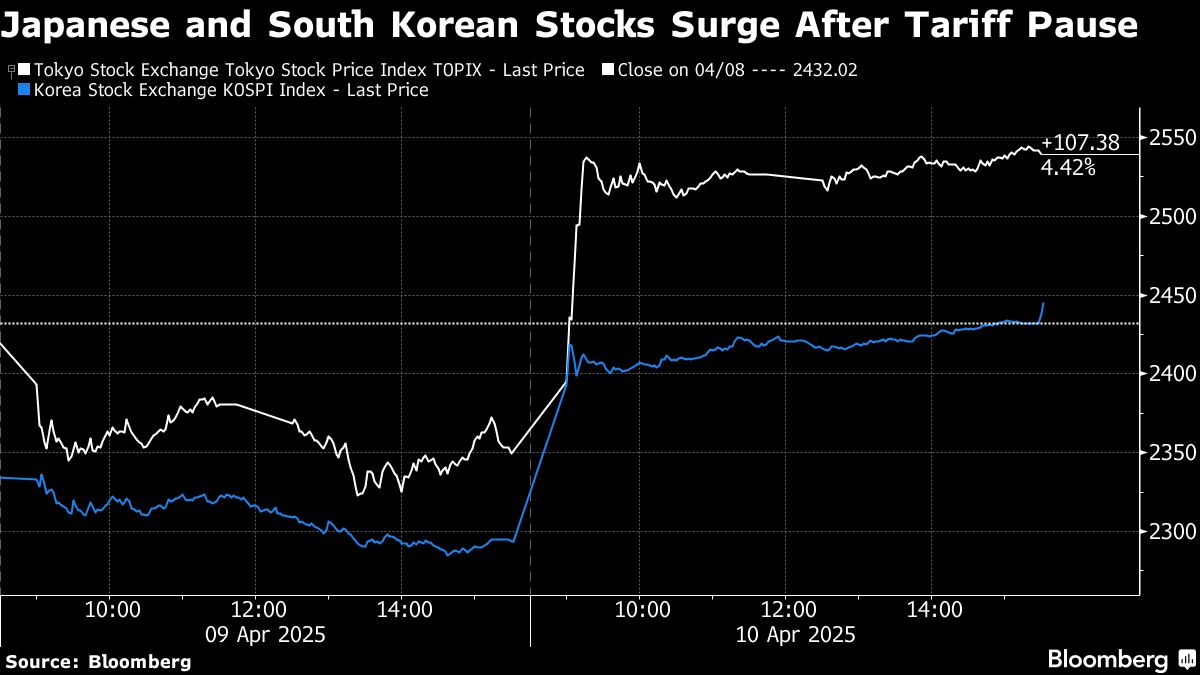
— Shares in South Korea surged by the largest margin in half a decade, whereas Japanese stocks logged their greatest increase since August as
reprieve
Higher U.S. tariffs attracted purchasers back to the previously depressed markets.
The Kospi Index in South Korea surged by 6.6%, following its entry into a bear market one day prior. Meanwhile, Japan’s main indices also saw significant gains: the Topix index climbed 8.1%, and the Nikkei 225 Stock Average jumped 9.1%.
Throughout Asia, stock markets experienced a significant rebound alongside currencies following President Donald Trump’s declaration of a 90-day suspension on increased tariffs affecting numerous trading partners. However, a level of hesitation lingered since dealers were still unsure about the likelihood of achieving a lasting solution to the conflict.
Investors throughout Asia and elsewhere are feeling relieved,” stated Frederic Neumann, co-head of Asian economic research at HSBC Holdings Plc. “The delay in implementing counter-tariffs by the U.S. provides additional time for talks. This is particularly crucial forAsian economies focused on exports, considering how significant US tariff increases could have been for their growth.
The rally in South Korea was spearheaded by major semiconductor export companies. Shares of SK Hynix Inc. soared by 11%, marking its largest single-day increase since 2020, whereas Samsung Electronics Co. climbed by 6.4%. According to traders, this swift and unexpected recovery led short sellers to close their bearish bets.
In Japan, every single one of the 33 sub-sectors within the Topix index saw increases, with notable contributions coming from exporting companies like those in the electronics industry and automobile manufacturers.
The delay in imposing higher tariffs offers the most optimistic outlook for Japan compared to other stock markets in Asia. This is because it seems poised to be the first in the region to secure a significant agreement with the U.S., according to analysts at Morgan Stanley.
Fears of a mounting trade conflict and its effect on the worldwide economy caused stock markets to decline, pushing Japan’s key Nikkei benchmark into a bear market territory. The larger Topix index had dropped more than 10% from when the tariffs were first introduced, as of Wednesday.
Trump’s about-face, occurring approximately 13 hours following the imposition of steep tariffs, triggered the most substantial surge in the S&P 500 index since 2008. In the meantime, China was identified as the primary issue concerning U.S. trade policies, leading to an increase in duties to 125%. This move came shortly after Beijing declared intentions to respond with a 75% tariff hike on American products.
‘Huge Relief’
The 90-day halt on the ‘tit-for-tat’ tariffs provided significant reassurance to investors who were beginning to anticipate an economic downturn,” noted Rajeev De Mello, a global macro portfolio manager at Gama Asset Management. “While this historic upturn in the U.S. market could extend into Asia, I feel it may require some time before we see stabilization following such a pivotal week.
On Thursday, this positive sentiment extended to regional currency markets. The Thai baht surged over 1%, outpacing other currencies in Asia, with the South Korean won, Indonesian rupiah, and Malaysian ringgit also showing gains.
–Assisted by Matthew Burgess.
Additional tales of this nature can be found on
©2025 L.P.

Related posts:

CUProf Sahid Claims FAO/IAMCR Award for Groundbreaking Rural Communication Research
Disney to Acquire Full Control of Hulu for $439M: A Streaming Giant Takes Over
G7 Nations Mull Tax-Free Import Rules Amid Surge of Low-Price Goods

Albert Ojwang: Kenyan TikToker Recreates Chilling Police Scene From Blogger’s Death