A Vision for Africa’s Energy Future
Africa is a continent rich in natural resources and human potential. Born on African soil, I take immense pride in being an African. The Creator has blessed us with an abundance of minerals such as uranium, gold, bauxite, manganese, diamonds, lithium, and vast oil and gas reserves. In addition to these, we have timber, cocoa, and enormous water resources.
Despite the challenges posed by poor leadership, Africa remains our home. Many young Africans would prefer to stay on the continent if its resources were effectively harnessed for the benefit of all. If given the chance to relocate from Ghana, I would consider East African nations or South Africa before choosing any advanced country in the world.
However, there are still significant issues that need addressing. Over 600 million Africans lack access to electricity, and those who do often face frequent power outages. This situation leads many to travel to Europe, Asia, the United States of America, and the Middle East for conferences where cutting-edge energy technologies are discussed. Unfortunately, after spending considerable taxpayer money on these trips, the valuable ideas gained are not implemented upon return.
African governments often lack the long-term strategic initiatives needed due to short-term political goals. Nuclear power technology has existed for over seven decades, with the first nuclear power plant generating electricity for a power grid inaugurated in Obninsk, Russia, in 1954.
Many countries in Europe, Asia, and North America have invested heavily in nuclear energy for energy security and industrialization. According to the World Nuclear Association (WNA), there are currently 440 nuclear power reactors operating across 31 countries, with 70 reactors under construction around the world.
In Africa, only South Africa operates a nuclear power plant—the Koeberg Nuclear Power Station. Egypt is taking bold steps to construct four large reactors, which are progressing steadily. More such projects are needed for Africa to add value to its raw materials, industrialize, and grow the economy.
Addressing Concerns About Nuclear Power
The delay in adopting nuclear energy in Africa can be attributed to the influence of anti-nuclear environmental groups that demonize the technology. These groups often cite the Chernobyl and Fukushima Daiichi incidents. However, it is important to note that the Chernobyl incident was due to human negligence and a faulty reactor design, which would not be licensed today. The Fukushima incident was caused by a tsunami resulting from a massive earthquake.
Since these incidents, nuclear scientists and the IAEA have invested in research and safety innovations to make nuclear power safer and more environmentally friendly. Modern reactors, such as Gen III and Gen III+ reactors, incorporate passive safety systems to mitigate risks. Small Modular Reactors (SMRs) also come with inherent safety systems that operate without human intervention.
Nuclear energy offers one of the lowest greenhouse gas emissions across its lifecycle, thanks to its high efficiency and zero-carbon operation. Despite lingering fears, nuclear incidents remain extremely rare today due to modern safety protocols and technological advancements.
A Personal Experience with Nuclear Technology
In 2023 and 2024, I had the opportunity to join other African journalists to tour Russia’s Leningrad Nuclear Power Plant in St. Petersburg and the world’s first Floating Nuclear Power Plant, the Akademik Lomonosov, located in Pevek, the northernmost part of Russia. Facilitated by ROSATOM, the tour exposed us to the rigorous safety culture underpinning both land-based and floating nuclear facilities.
Since the Fukushima incident in 2011, there have been no major nuclear accidents—thanks to enhanced reactor designs and strict operational protocols. Africans should not fear nuclear energy when their governments consider it. Instead, they should be more concerned about road accidents, which claim thousands of lives annually.
Road Accidents: A Greater Threat
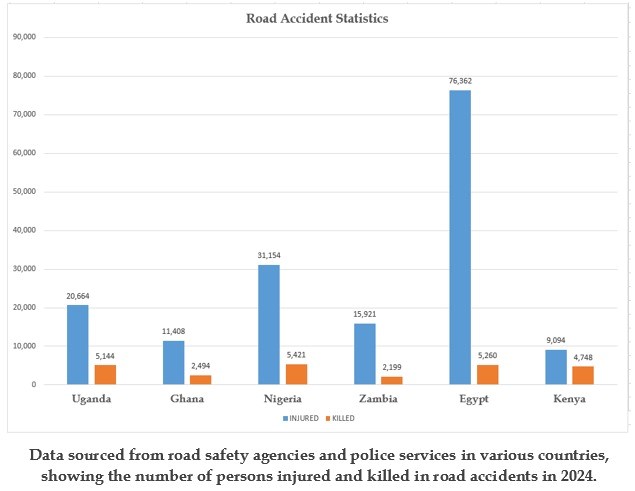
The chart above illustrates the number of persons injured and killed in road accidents across six African countries in 2024, based on data from national road safety agencies and police services. Egypt recorded the highest number of road accident injuries, with 76,362 people injured, far exceeding the other countries in the comparison. It also had a relatively high fatality figure of 5,260 deaths.
Nigeria followed with 31,154 injuries and 5,421 deaths, reflecting a significant road safety challenge in Africa’s most populous nation. Uganda recorded 20,664 injuries and 5,144 deaths, suggesting a high casualty rate relative to its number of injuries. Zambia and Ghana reported moderate figures, with 15,921 injuries and 2,199 deaths for Zambia, and 11,408 injuries and 2,494 deaths for Ghana. Kenya had the lowest number of injuries (9,094) but a comparatively higher fatality rate (4,748 deaths), indicating more severe accidents on average.
These alarming figures demonstrate that road accidents remain far deadlier than the potential risks associated with nuclear power generation, a highly regulated and safety-conscious industry.
The Path Forward
Nuclear technology today is safer than ever before. It provides clean, reliable, and stable baseload power—a critical foundation for Africa’s industrialization and economic growth. The recent lifting of the World Bank’s ban on nuclear power financing should encourage African nations to pursue their nuclear ambitions boldly.
As Egypt’s El Dabaa Nuclear Power Plant makes steady progress, South Africa has reaffirmed its commitment to nuclear energy in its Integrated Resource Plan (IRP) and plans to add 5,200 MW to its nuclear generation capacity.
During the 2025 African Energy Week (AEW) in Cape Town, Eskom’s Chief Nuclear Officer at the Koeberg Nuclear Power Station, Velaphi Ntuli, stated that Koeberg Unit 1 had already received a 20-year operational license extension and was awaiting approval for Unit 2’s license extension for an additional 20 years.
Investors consistently prioritize countries that demonstrate political stability and energy security. Africa has become one of the world’s most attractive investment destinations, and sustaining that confidence requires substantial investment in energy infrastructure—particularly nuclear power—to ensure reliable energy supply for both citizens and industry.


