
Staff at the Dobong District Office in Seoul were surprised on June 13 when the list of newly promoted senior civil servants was released: eight of the 10 promoted to grades 4 and 5 were women. Both of the newly appointed directors—grade 4 officials—were also women.
“Gender balance hasn’t really been an issue in civil service for a while now, but the numbers were still surprising,” a district official said.
Across the public sector, it is increasingly common to see women leading meetings and holding key roles. Observers say the once-rigid “glass ceiling” is no longer as prevalent.
That trend is backed by new government data. On June 30, the Ministry of the Interior and Safety released its latest report on female representation in local civil service. As of the end of 2024, women made up 51.3% of the 315,205 civil servants working for local governments across the country—161,710 in total. It marks the first time that women account for a majority in this sector.
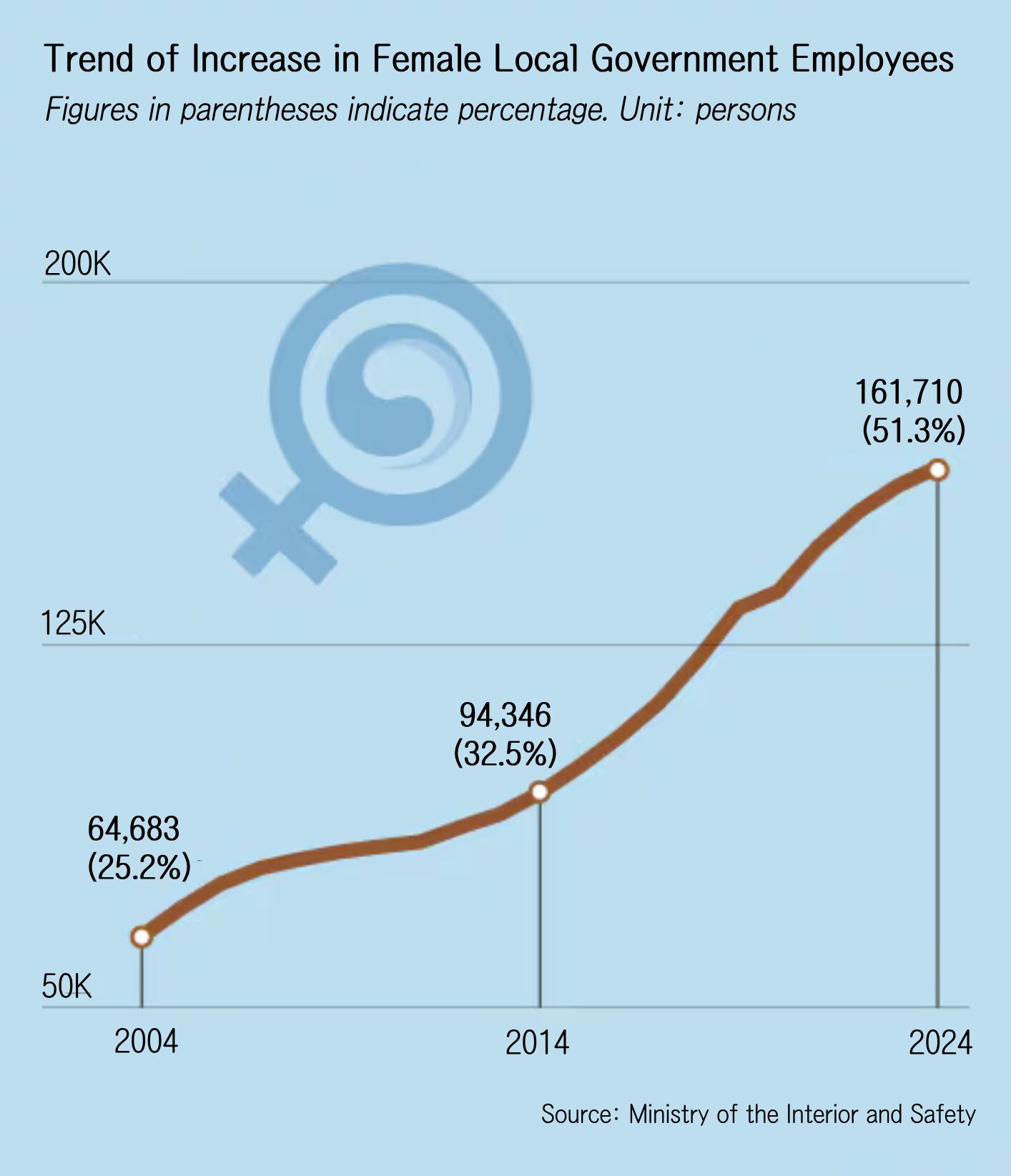
In 2004, when the government first began tracking these figures, only 64,683 civil servants were women—just 25.2%. In two decades, the number has more than doubled.
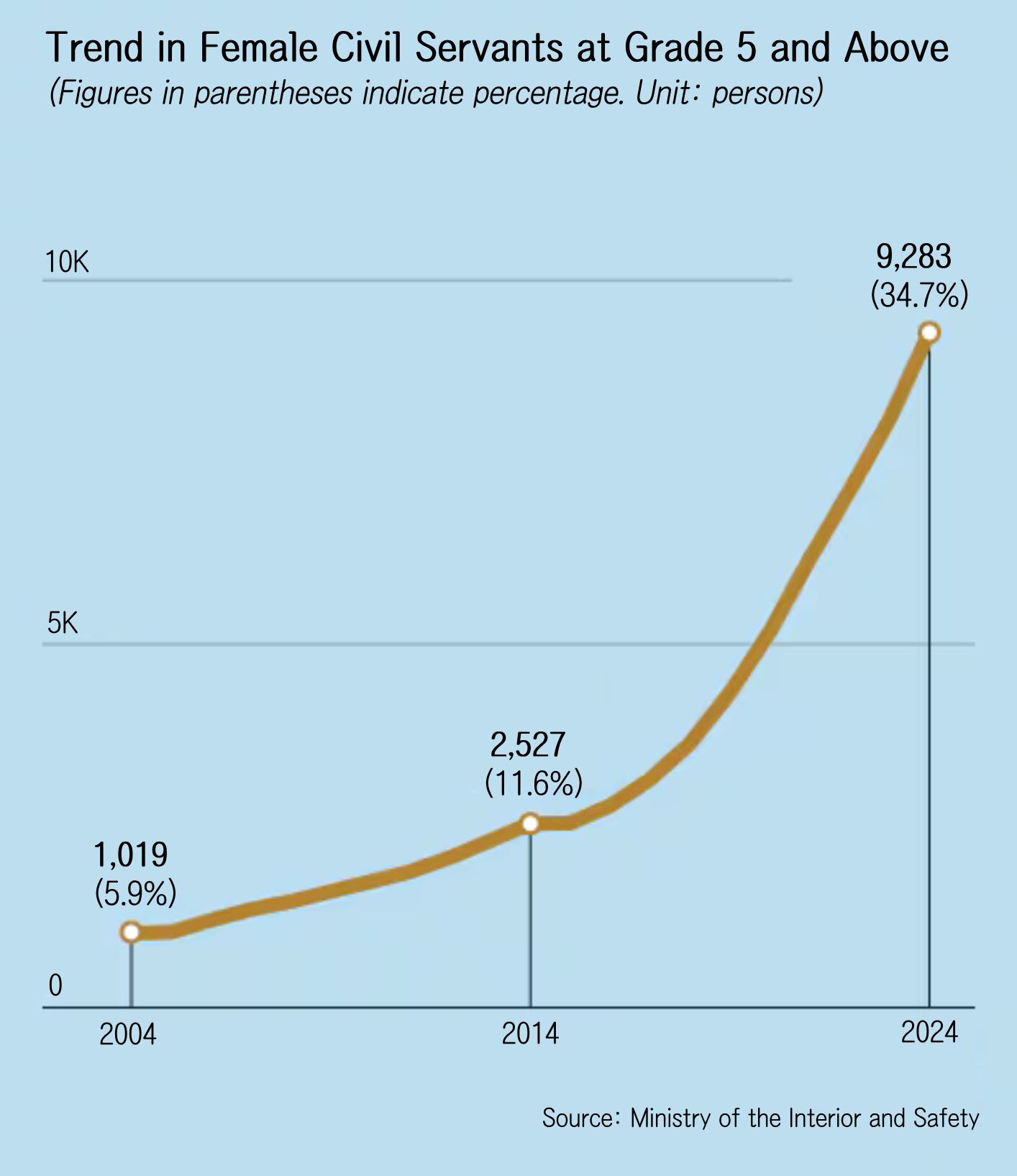
The growth is even more striking in management-level positions. In 2004, only 1,019 women held grade 5 or higher posts. By 2024, that number had jumped to 9,283, nearly a ninefold increase. The proportion of women in those leadership roles rose from 5.9% to 34.7%.
In departments considered central to local governance—such as planning, budgeting, human resources, and auditing—women now make up 50.1% of staff.
In Seoul’s Mapo District, three women were promoted to grade 4 director positions on June 12, bringing the total number of female directors to six out of 10. At Seoul City Hall, 16 of the 44 “main section chiefs”—officials who oversee daily operations in city bureaus—are women, or 36%.
“Women are now standing out even in traditionally male-dominated fields like city planning, transportation and landscaping,” a Seoul official said. Lim Min-kyung, who takes office on July 1, will become the city’s first female spokesperson at the director level.
“It’s not just about the growing number of women in the civil service,” a Ministry of the Interior and Safety official said. “Their roles and authority have grown significantly as well.”
This shift—often referred to as yeopung, or “female wind”—is expected to accelerate. Among grade 6 officials currently eligible for promotion to grade 5, women account for 48.4%.
Regionally, Busan has the highest proportion of female civil servants among major cities. Of its 18,717 public employees, 57.5%—10,769—are women. Seoul follows at 55.4%, and Incheon at 54.3%. In grade 5 and higher roles, Busan again leads at 48.9%, followed by Daegu and Incheon at 41.5% each.
Many civil servants say the influx of women has transformed office culture. One notable example is how workplace socializing has changed. “In the past, drinking after work was basically mandatory,” said a staffer from Yongsan District in Seoul. “Now, lunch gatherings are the norm, and after-hours drinking sessions with multiple rounds are almost nonexistent.”
Parental leave use has also surged. In 2023, 12,235 local government employees took parental leave—12 times the number in 2004, when only 989 used the benefit.
Gendered task divisions have largely disappeared as well. Female civil servants now routinely handle overnight shifts, street vendor enforcement, and snow removal—jobs once reserved for men. Some districts have begun outsourcing physically demanding tasks to avoid issues around reverse discrimination.
“If we only assign those duties to men, we could face backlash,” said an official at a district office in Seoul. “That’s why we’ve recently contracted outside service providers.”
“We’re seeing more and more highly capable women in the public sector,” said Hong Sung-geol, a professor of public administration at Kookmin University. “Now is the time for this trend to spread into the private sector as well.”


