
Sixty-four Koreans who were detained by Cambodian immigration authorities for their involvement in voice phishing and other fraud-related crimes have been repatriated to South Korea. They were transported via a chartered flight on the 18th, marking a significant step in addressing transnational criminal activities. These individuals are believed to have participated in voice phishing and romance scams under the direction of Chinese organizations operating within a Cambodian crime complex often referred to as the “wench.” Fifty-nine of them were arrested during a crackdown on fraud complexes, while the remaining five voluntarily reported to local police and were included in this repatriation.
The Korean Air KE9690 flight, which departed from Techo International Airport near Phnom Penh, Cambodia, landed at Incheon International Airport at 8:35 a.m. the same day after a 5-hour and 20-minute journey. Upon arrival, South Korean police immediately boarded the aircraft and arrested the individuals. A police source explained, “Most of them had arrest warrants issued in South Korea,” adding that under the Nationality Act, the interior of a national aircraft is considered South Korean territory, allowing the execution of arrest warrants.
The repatriated individuals have been distributed to various locations nationwide, including the Chungnam Provincial Police Agency and the Gyeonggi Bukbu Provincial Police Agency, to begin investigations. The police are examining whether these individuals participated in the crimes under coercion after being kidnapped and detained by Cambodian crime organizations or if they did so voluntarily. The investigation aims to determine the nature and severity of their alleged offenses, select those for whom to apply for arrest warrants, and announce the results by the 20th.
Meanwhile, the government has initiated financial sanctions against Cambodian crime organizations such as the “Prince Group” and the “Huiyuan Group,” which have been identified as masterminds behind kidnapping, detention, and murder cases involving Koreans and other foreigners. A high-ranking government official stated on the 19th, “As soon as consultations among relevant agencies are completed, we will begin imposing financial sanctions on these organizations.” If the Financial Intelligence Unit (FIU) under the Financial Services Commission designates individuals involved in Cambodian crimes as restricted financial transaction entities and the Ministry of Economy and Finance bans foreign exchange transactions, the crime organizations’ funds will be frozen.
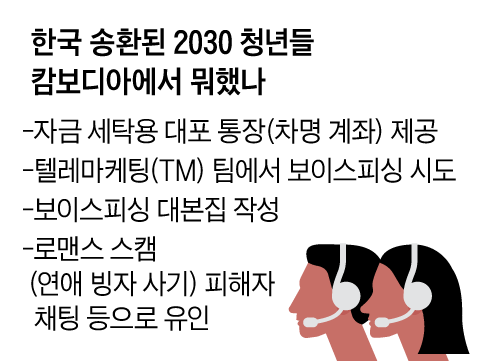
◇ Repatriated Individuals Involved in Investment Chat Room Fraud and Straw Accounts… Also Writing Voice Phishing Scripts
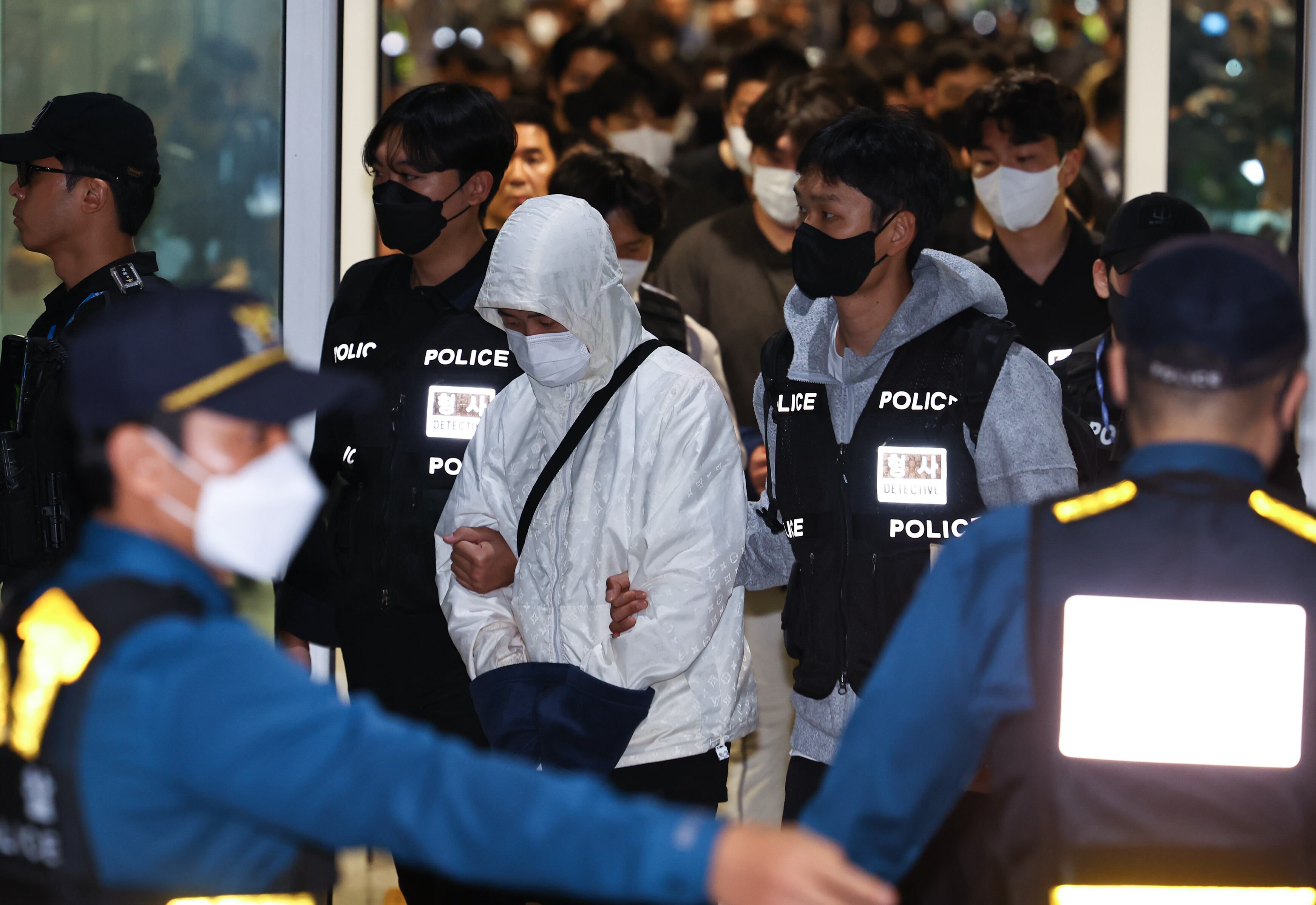
At 9:54 a.m. on the 18th, as the doors to the arrival hall at Incheon Airport’s Terminal 2 opened, 64 Koreans who had been detained by police after being involved in crimes such as voice phishing in Cambodia appeared. Most were men in their 20s and 30s. While defrauding Koreans of money, they were also detained and assaulted by members of Cambodian crime organizations. They covered their faces with masks, hats, and hoodies, and some had tattoos on various parts of their arms. The police officers escorting them linked arms on both sides to prevent escape. During this process, a person presumed to be a voice phishing victim approached them shouting profanities and loud noises but was restrained by the police. The suspects, on their way to immigration, remained silent in response to media questions, kept their heads down, and were led by police directly to the parking lot. They were divided into 23 transport vehicles and dispersed to police stations nationwide.
Of the 64 repatriated on that day, 45 were assigned to the Chungnam Provincial Police Agency and 15 to the Gyeonggi Bukbu Provincial Police Agency. This is because the two Korean National Police Agency jurisdictions have received the most complaints from voice phishing victims, leading to the most investigations into Cambodian organizations. The Chungnam and northern Gyeonggi Korean National Police Agency have been designated as focused investigation agencies for voice phishing this year. A source from the police said, “We judged that investigating through the two Korean National Police Agency agencies, which have the most dedicated investigation experience nationwide, would be efficient.” The remaining suspects are being investigated by the Seoul Seodaemun Police Station, Gyeonggi Kimpo Police Station, Daejeon Metropolitan Police Agency, Gangwon Wonju Police Station, and others.
Many of the suspects transferred to the Chungnam Provincial Police Agency are alleged to have participated in illegal investment chat room fraud. Investment chat rooms are places on platforms like KakaoTalk and Telegram where specific stocks are recommended and buy/sell timing is guided to induce investments. Many of those transferred to the Gyeonggi Korean National Police Agency are suspected of participating in romance scams at Cambodian crime complexes. Romance scams are a new type of fraud where perpetrators approach victims through social media or dating apps with sweet words, then persuade them to invest and steal their money. They pretend to be foreigners planning to visit Korea, gain favor by promising marriage, and then demand coin investments through fake cryptocurrency exchanges to steal the funds.
A source from the police said, “Many suspects are also accused of acting as ‘jangju’ (account name holders) besides voice phishing and romance scams.” Cambodian crime organizations recruit ‘jangju’ for money laundering through so-called ‘jangjip’ (straw account recruiters) in South Korea. They are using South Korean youths’ bank accounts to launder criminal proceeds stolen from Koreans. Most of the repatriated suspects are from the MZ generation. They were detained in crime complexes and deployed in various crimes such as voice phishing, illegal investment fraud, and romance scams. If they did not achieve results, they were assaulted. Although they suffered forced labor and violence in Cambodia, if they are referred to South Korean court trials, they are likely to receive actual prison sentences. A source from the police said, “Regardless of the scale of criminal profits, they may face heavy sentences as organized crime charges are applied.”
The government has initiated financial sanctions against Cambodian crime organizations. The prominent target for sanctions is the Prince Group. Although it advertises itself as a real estate, casino, and financial business, it faced joint sanctions from the U.S. and U.K. governments on the 14th for allegedly operating crime complexes across Cambodia involved in cybercrime and human trafficking. A government official said, “As there are many crime organizations in Cambodia, after the Ministry of Foreign Affairs reviews the criteria for selecting sanction targets and notifies the Ministry of Economy and Finance and the Financial Services Commission, full-scale sanctions will proceed.”
Meanwhile, the autopsy of Korean university student A, 22 years old, who was kidnapped by a crime organization in Cambodia and found dead, will be jointly conducted by South Korea’s National Forensic Service and Cambodian authorities under the leadership of a forensic pathologist on the 20th locally. A left the country on July 17 and was found dead in a vehicle near Bokor Mountain, Kampot Province, three weeks later on August 8. Seven individuals, including a National Forensic Service pathologist and investigators, departed in the evening of the 19th for the autopsy.


