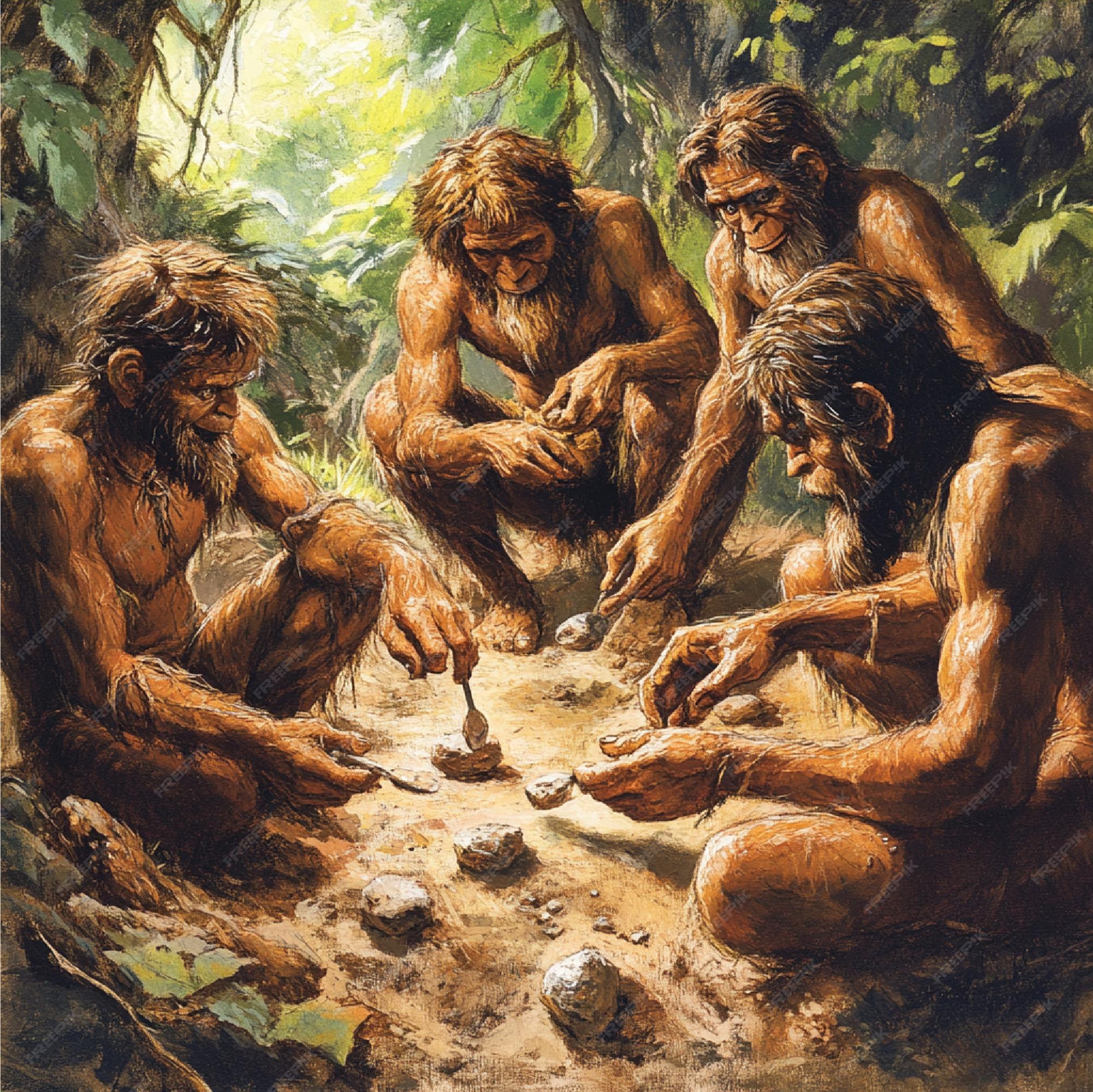
The Evolution of Early Humans and the Role of Homo habilis
Almost 2 million years ago, a young ancient human died beside a spring near a lake in what is now Tanzania, in eastern Africa. This individual’s fossilized bones were discovered by archaeologists in 1960, and they played a crucial role in defining Homo habilis — the earliest known member of our own genus. These early humans are often considered to be the first in the lineage that eventually led to modern humans.
Paleoanthropologists identify the first examples of the genus Homo primarily based on their larger brains and, occasionally, smaller teeth compared to earlier ancestors such as the australopithecines — most famously represented by Lucy. There were at least three types of early humans: Homo habilis, Homo rudolfensis, and the best-documented species, Homo erectus. At least one of these species created archaeological sites where they brought and shared food, and made and used some of the earliest stone tools.
These sites date back between 2.6 and 1.8 million years ago. The artifacts found there suggest greater cognitive complexity in early Homo than observed in any nonhuman primate. For instance, at Nyayanga, a site in Kenya, anthropologists recently discovered that early humans were using tools transported over distances of up to 8 miles (13 kilometers). This behavior indicates planning and forethought.
Traditionally, it was believed that Homo habilis, as the earliest big-brained humans, was responsible for the earliest tool-making sites. The narrative suggested that Homo habilis was the ancestor of later and even bigger-brained Homo erectus, whose descendants eventually led to modern humans.
This idea made sense when the oldest known Homo erectus remains were younger than 1.6 million years old. However, recent discoveries have challenged this view.
In 2015, my team discovered a 1.85 million-year-old hand bone at Olduvai Gorge, the same location where the original Homo habilis had been found. Unlike the hand of that Homo habilis juvenile, this fossil looked like it belonged to a larger, more modern, fully land-based human species: Homo erectus.
Over the past decade, new findings have continued to push back the earliest dates for Homo erectus, placing them around 2 million years ago in South Africa, Kenya, and Ethiopia. Taken together, these discoveries reveal that H. erectus is slightly older than the known H. habilis fossils. We can no longer assume that H. habilis gave rise to H. erectus. Instead, the human family tree appears far more complex and bushier than previously thought.
Who Was Hunting Who?
At Olduvai Gorge, there is overwhelming evidence that early humans were consuming animals as large as gazelles or even zebras. Not only did they hunt, but they repeatedly brought these animals back to the same location for communal consumption. This concept of a “central provisioning place” is similar to a campsite or home today. Dating to 1.85 million years ago, this is the oldest evidence of frequent meat-eating and of early humans regularly acting as predators rather than prey.
All animals occupy a position on a food web, from top to lower ranks. Top-ranking predators, such as lions, are usually not preyed upon by lower-ranking carnivores, such as hyenas. If Homo habilis was acquiring large animal carcasses, either by hunting or by chasing lions away from their own kills, it seems logical that these hominids could effectively cope with predation risks. That is, a hunter is usually not hunted.
In African savannas, apex predators like lions do not typically die from other predator attacks. Humans today also occupy a top predatory niche: For example, Hadza hunter-gatherers in Tanzania not only hunt game but also fend off lions from their kills and successfully defend themselves from attacks by other predators, such as leopards.
However, if Homo habilis was not yet a top predator, then we would expect them to have occasionally been prey to lower-on-the-food-chain carnivorous cats — such as leopards — who often hunt primates.
Most known human fossils at this stage of evolution bear traces of carnivore damage, including the two best-preserved H. habilis fossils from Olduvai Gorge. Was this damage caused after death, by scavenging carnivores? Or did a big cat at the top of the food chain kill these early humans?
AI Suggests H. habilis Wasn’t an Apex Predator
To address this question, my colleagues and I turned to artificial intelligence. Using computer vision, we trained AI on hundreds of microscopic images showing tooth marks left by the main carnivores in Africa today: lions, leopards, hyenas, and crocodiles. The AI learned to recognize the subtle differences between the marks made by different predators and was able to classify the marks with high accuracy.
When we combined different AI approaches, they all pointed to the same result: The tooth marks on the Homo habilis bones matched those made by leopards. The size and shape of the marks on the fossils from those two early Homo habilis individuals align with what leopards leave today when feeding on prey.
Our discovery challenges the long-standing view of Homo habilis as the first skilled toolmaker, hunter, and meat-eater.
But maybe it shouldn’t be too surprising. The only complete skeleton of this species found at Olduvai Gorge belonged to a very small individual — just about 3 feet tall (less than 1 meter) — with a body that still showed features suited for climbing trees. That hardly matches the image of a hunter able to bring down large animals or steal carcasses from lions.
If it wasn’t Homo habilis performing these feats, maybe it was Homo erectus, a species with a larger body and more modern anatomy. But that opens up other mysteries for future researchers: What was Homo habilis doing at the archaeological sites of Olduvai Gorge if it was not responsible for the tools and signs of hunting we find there? Where exactly did Homo erectus come from, and how did it evolve?
My team and others will be returning to places like Olduvai Gorge to ask these questions in the years to come.


