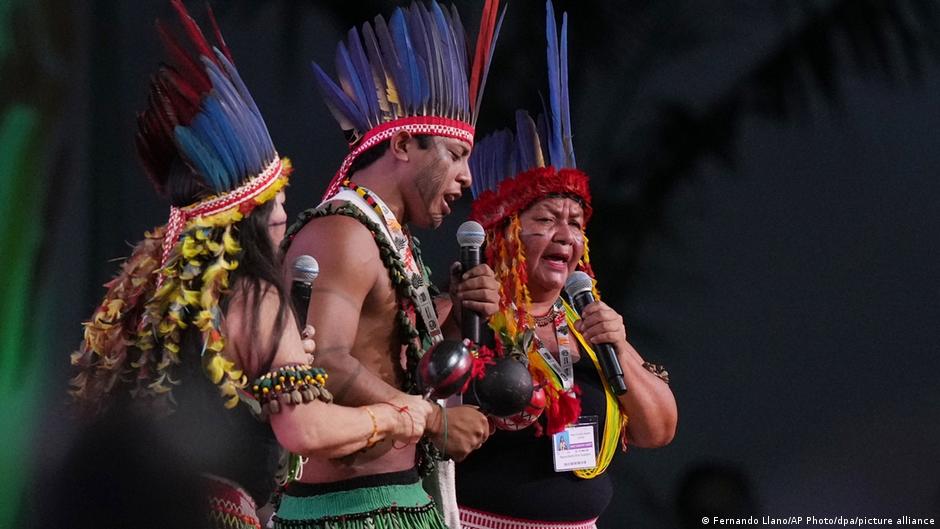
Indigenous Voices Take Center Stage at COP30
Indigenous peoples around the world play a critical role in protecting forests and maintaining ecological balance. Yet, they have often been excluded from major climate policy decisions. At COP30, these communities are hoping to finally see their concerns addressed by global leaders.
The organizers of this year’s international climate conference chose ‘mutirao’ — a Portuguese word of Indigenous origin meaning ‘collective effort’ — as the event’s official slogan. This choice reflects not only the theme of the conference but also the significance of the location: Belem, an Amazonian city. The selection highlights the role of the region’s 1.7 million Indigenous peoples as skilled stewards of the world’s largest rainforest.
These gestures mark a shift from previous climate talks, where Indigenous communities — who safeguard much of the world’s biodiversity — have often felt unheard. However, whether these efforts will translate into meaningful action remains uncertain.

What Are Indigenous Communities Asking For?
There are more than 5,000 distinct Indigenous groups living across 90 countries, representing just 6% of the global population. Despite their small numbers, they are essential to protecting nature and the climate. As guardians of their lands, one of their main demands is greater influence over how that land is managed.
Many of their territories face encroachment from oil and gas drilling, mining, and logging. Lucia Ixchiu, an Indigenous K’iche from Guatemala, emphasized the need for a consensus where Indigenous territories are no longer sacrificed. She traveled through the Amazon for weeks to bring this message to world leaders.
For many communities, land rights remain a pressing issue. Although legal recognition was granted to an estimated 100 million hectares (247 million acres) between 2015 and 2020, claims to a further 1.4 billion hectares are still unresolved.

Alcebias Sapara, a leading member of the Coordination of Indigenous Organizations in the Brazilian Amazon, said they hope COP30 will strengthen the international commitment to demarcating and protecting Indigenous territories. These areas are seen as fundamental for conservation and climate balance.
Sapara also called for direct funding mechanisms for Indigenous-led initiatives, allowing them to manage their territories autonomously and sustainably. Additionally, traditional knowledge should be integrated into climate policies.
Christine Halvorson, program director at the Rainforest Foundation US, added that Indigenous communities want to ensure that any green energy projects impacting their lands and livelihoods occur only after consultation and consent.
Halvorson also highlighted the need for greater protection, as many Indigenous people face threats and violence for defending their land. In 2024, around a third of environmental defenders who disappeared or were killed internationally were Indigenous.

Can Indigenous Communities Help Protect the Climate?
Sonia Guajajara, Brazil’s Minister of Indigenous Peoples, told AFP that without Indigenous peoples, there is no future for humanity. She emphasized their role in ensuring clean water and protecting biodiversity where they live.
Indigenous communities are widely regarded as the best forest guardians. They manage around a quarter of the world’s land and up to half of the remaining intact forests. These forests are vital carbon sinks, storing an estimated 861 gigatons of carbon — roughly equal to 100 years of fossil fuel emissions.
Intact forests have historically absorbed around a fifth of emissions, but they are increasingly under threat from human activity and climate change. Last year, wildfires led to an 80% increase in tropical forest deforestation.
Research shows that granting land rights to Indigenous peoples plays a key role in tackling climate change. “Where Indigenous territorial rights are respected, deforestation declines; where they are denied, destruction advances,” said Guajajara.

Granting communities the power to prevent development projects like oil drilling and mining on their land has also been found to be cost-effective in protecting nature. A 2023 study suggested that ensuring land rights in the Brazilian Amazon could decrease deforestation by 66%. Another study estimated that emissions would be 45% higher in the Amazon without Indigenous protected land.
What Might Indigenous Communities Achieve at COP30?
Before COP30 officially began, there were some positive developments. Dozens of countries pledged to formally recognize land rights by 2030 across 80 million hectares where Indigenous, Afro-descendant, and other communities live. While this move was cautiously welcomed by Indigenous leaders, they warned that implementation can be challenging.
The launch of the Tropical Forests Forever Facility (TFFF), a proposed $125-billion (€108 billion) global conservation fund, also pledged to allocate 20% of its funds to Indigenous peoples. However, Halvorson said the TFFF must guarantee direct and equitable access to resources for Indigenous communities.
If commitments on land demarcation, direct funding, and global recognition of territorial rights are fulfilled, COP30 could become a landmark for climate justice.
Is COP30 Really Paying Attention to Indigenous Communities?
Minister Guajajara stated that this year marks the highest Indigenous participation in COP history and their most significant presence in decision-making spaces. However, only a fraction have access to the restricted negotiation areas.
“Having credentials to enter the venue does not guarantee that the voices and views of Indigenous delegates from Brazil will be heard,” said the Indigenous Climate Action organization.
Despite progress in visibility, Indigenous leaders say it is still not enough. Indigenous protestors interrupted the Belem climate talks twice, demanding their voices be heard. Leaders of the Munduruku Indigenous group presented a series of demands to Brazil, including a rejection of deforestation carbon credits.
Some feel the Brazilian government is not hearing their demands, even though it calls this the “Indigenous COP.” However, with global emissions and temperatures still rising, the concept of mutirao could help drive real implementation of climate action on the ground.
Hayley Walker, associate professor of international negotiation at IESEG School of Management in France, said if mutirao catches on, it could be an important gift from Brazil’s Indigenous peoples to the rest of the world. It has the potential to move the global community significantly closer to addressing climate change.


