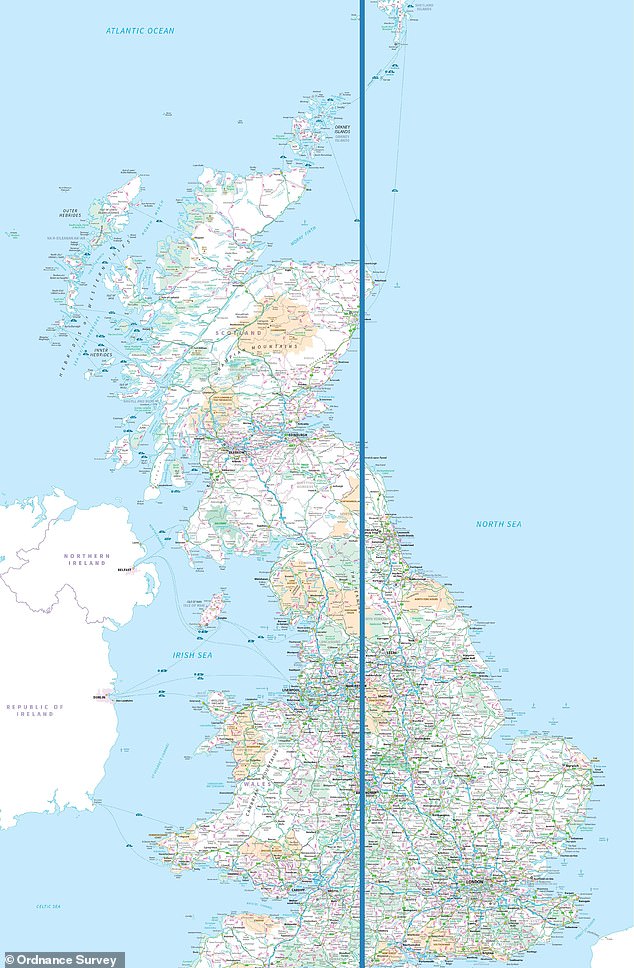
After a three-year journey together through the heart of the country, the ‘three norths’ have left England.
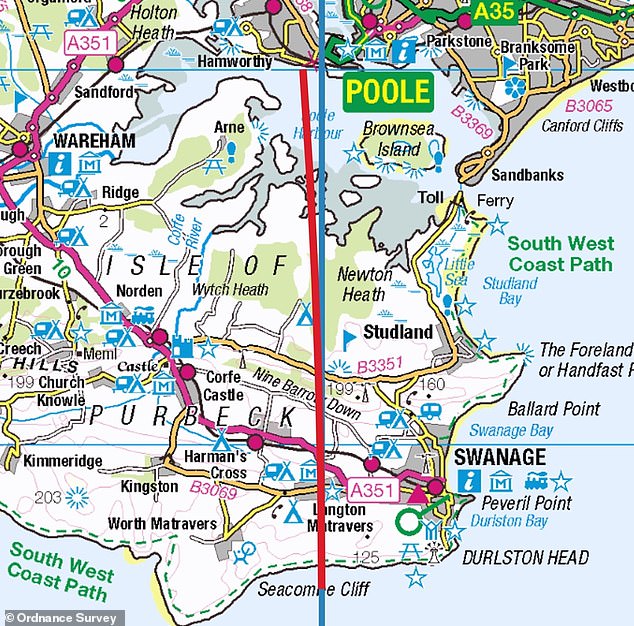
The historic triple alignment of ‘true’, ‘magnetic’ and ‘grid’ north – the three definitions of what north is – met on the south coast of Dorset back in November 2022 before travelling northwards.
On December 13, 2025, the alignment left England at Berwick-upon-Tweed and moved into the North Sea, say experts at the British Geological Survey (BGS).
It will reach Scotland in a few months before eventually leaving the British National Grid – but for how long exactly is unknown.
This alignment – the first here since records began – has been called a ‘once-in-a-lifetime occurrence’ as it may be several hundred years before it comes to Britain again.
‘It’s been a privilege to be able to observe this phenomenon over the past few years,’ said Dr Ciarán Beggan, geophysicist at BGS.
‘Although part of geospatial history, there is no impact for navigators, pilots and captains once the alignment leaves.’
Although the concept of ‘north’ may seem straightforward, there are actually three definitions – true north, magnetic north and grid north.
This map displays a series of locations along the alignment line, from Langton Matravers in November 2022 to Berwick-upon-Tweed this month
True north is the direction to the geographic north pole, while grid north is where the vertical blue lines shown on Ordnance Survey (OS) maps converge.
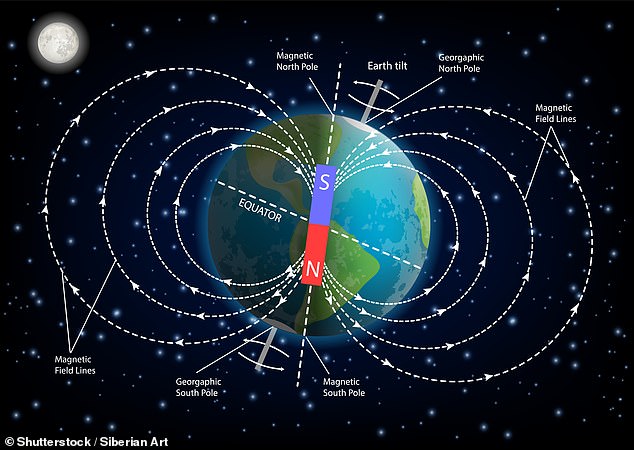
Meanwhile, ‘magnetic north’ is the direction that a compass needle points as it aligns with the Earth’s magnetic field – controlled by molten iron deep down in Earth’s core.
For just over three years, there has been a point in England where the three versions of north have aligned (as of Saturday this point has entered the North Sea).
At this location, a compass, an Ordnance Survey map and the Earth’s axis would all have been aligned with each other – and in agreement on which way was north.
The historic alignment started at Langton Matravers, west of Swanage in Dorset in November 2022 before heading up into Devizes in Wiltshire in May 2023.
It then passed through Lower Dowdeswell in Gloucestershire in September 2023, Woodgate Valley Country Park in Birmingham (January 2024), Leek in Staffordshire (May 2024) and Hebden Bridge in West Yorkshire (October 2024).
By April 2025 it reached Eggleston in the North Pennines, followed by Flotterton in Northumberland in August and Berwick-upon-Tweed, England’s northernmost town, in December.
However, its journey through Britain is not quite done – once it has travelled through the North Sea it will hit land again at the end of October 2026 in Drums, just south of Newburgh in Scotland.
After passing through the large village Mintlaw in Aberdeenshire, its last stop in Scotland will be Fraserburgh around mid-December 2026, before it returns to the North Sea.
Once over the North Sea, the three norths are expected to continue northwards before leaving the Ordnance Survey National Grid, also known as the British National Grid.
They will also stay in alignment for another couple of years before magnetic north separates from true north and grid north.
According to the experts, the alignment’s progress has slowed slightly since the initial predictions back in 2022.
When it crossed the coast at Berwick-upon-Tweed, it had racked up about 358 miles (576km) of travel in 1127 days.
That’s about 1,676 feet (511 metres) per day, or about 0.23-inch (5.9 mm) per second, or about 0.013 miles per hour.
Dr Beggan said the three norths combining in Britain has been ‘a once-in-a-lifetime occurrence’ largely due to the wandering magnetic north.
Magnetic north moves slowly – about 30 miles per year – so it may be several hundred years before this alignment comes around again.
‘The magnetic field is not predictable in the long term, so we don’t know how many hundreds of years it will take for this historic alignment to occur again,’ said Dr Beggan.
Earth’s magnetic field is created by the movement of liquid iron in the Earth’s outer core, some 1,800 miles below our feet.
The iron is super hot (more than 5,432 degrees Fahrenheit) and as runny as water meaning it flows very easily.
As the liquid flows, it drags the magnetic field with it – meaning the magnetic north and south poles are constantly drifting around.
The alignment began back in 2014, when magnetic north became east of grid north for some locations in Britain for the first time in more than 350 years.
This affected navigators using a compass, who needed to adjust their bearing by subtracting instead of adding the difference between magnetic and grid north.
Read more
- Will the awe-inspiring Aurora Borealis light up the skies of northern England and Scotland tonight, as wild geomagnetic storms enthrall stargazers?
- Why is Earth’s magnetic North Pole dramatically drifting towards Russia at a sluggish pace as scientists scratch their heads in confusion?
- Did last night’s geomagnetic storm cause astonishing Northern Lights to illuminate skies across the UK, even as far south as London?
- Why are scientists alarmed by the unprecedented speed of the magnetic North Pole’s drift?
- Why did a rare ‘severe’ geomagnetic storm dazzle UK skies with the Northern Lights as far south as London?


