The Challenges of Narrating Real-Life Stories in Indian Media
In India, creating a film or web series based on real events or people is often seen as an adventurous endeavor. However, it’s not without its challenges, particularly when it comes to addressing political powers. The narrative must be carefully curated to avoid criticism that could lead to legal repercussions or public backlash. When depicting real individuals or organizations, obtaining their consent becomes essential, especially if the portrayal deviates from a heroic or idealistic perspective. This process can become complicated, with legal teams scrutinizing every detail of the script, sometimes making it seem like these productions are crafted more by lawyers than filmmakers.
This situation is further compounded for projects like Made in India: A Titan Story, which is adapted from Vinay Kamath’s book Titan: Inside India’s Most Successful Consumer Brand. The show is partially sponsored by Titan, raising questions about its objectivity. Without access to the Tata archives, the production might lose critical elements that could provide a more comprehensive view of the company’s history. As a result, viewers may expect a corporate advertorial rather than a balanced narrative.
Despite these constraints, the show manages to offer a glimpse into the past, portraying the early days of Titan and its founding team. While some episodes may appear to lean towards being promotional, others present a more nostalgic view of the “good old days.” One particular scene in the second episode stands out, where Xerxes Desai (played by Jim Sarbh) reflects on the concept of “achhe din” (good times), stating, “Achhe din aate nahi hai, unhe laana padhta hai (The good times don’t come by themselves, they need to be summoned through hard work).” This line hints at a deeper awareness of contemporary politics, offering a refreshing contrast to the otherwise sanitized narrative.
A Nostalgic Look at the Past
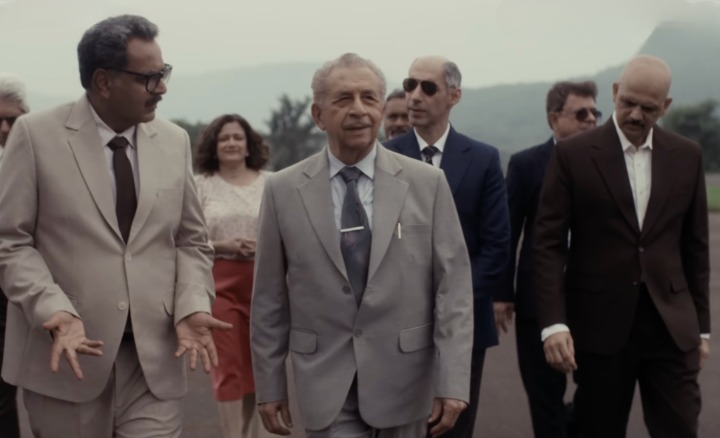
Reconstructing the 1970s and 1980s, the show highlights the journey of Xerxes Desai and his colleagues under the guidance of J.R.D. Tata (Naseeruddin Shah). The narrative captures the optimism of a bygone era, reminiscent of classic Hindi films such as Do Bigha Zameen and Naya Daur, where the spirit of independence and national pride was palpable. The show’s tone is generally upbeat, with a cheerful background score and characters who embody honesty and integrity.
The plot follows Xerxes, a driven individual seeking a challenging project within the Tata group. His relationship with J.R.D. allows him to take on the task of reviving the loss-making Tata Press. A chance encounter with a government employee leads to the discovery of a potential opportunity in the importation of watches, setting the stage for the birth of Titan. Despite the usual ups and downs of a business venture, the show maintains a sense of hope and determination, reflecting the values of the time.
Character Dynamics and Production Elements
Xerxes, portrayed by Jim Sarbh, is depicted as a maverick with unconventional ideas, often met with skepticism. His character is complemented by Akash (Vaibhav Tatwawadi), who represents the more cautious and conservative side of the team. While their dynamic adds depth to the narrative, certain subplots, such as Akash’s father’s Alzheimer’s diagnosis, feel somewhat contrived, aiming to evoke emotional responses rather than contribute meaningfully to the story.
The supporting cast, including Megha Mhatre, Gaurav Dhar, and K.S. Gopalan, brings a warm and engaging energy to the show. Their interactions with Xerxes and Akash create a pleasant viewing experience, even amidst the clichés. However, the show’s focus on the relationship between Xerxes and J.R.D. is evident, with Naseeruddin Shah delivering a performance that feels both authoritative and approachable.
Production and Cultural References
The involvement of Bhushan Kumar and Krishna Kumar of T Series as co-producers explains the inclusion of vintage Hindi film songs, though many of these seem out of place. The use of retro archival footage of Mumbai also adds a nostalgic touch but can become repetitive over time. Additionally, the portrayal of foreigners appears to rely on stereotypes, which may feel outdated to modern audiences.
Conclusion
While Made in India: A Titan Story may not escape the label of corporate propaganda, it offers a unique perspective on a pivotal moment in India’s economic history. It captures the essence of a nation driven by dreams, intellect, and the will to succeed. For those interested in the origins of one of India’s most successful brands, the show provides a compelling, albeit sanitized, look at the past.
Made in India: A Titan Story
Director: Robbie Grewal
Year: 2026
Available: Amazon MX Player