The Complex History of Korea’s Liberation Period
The history of Korea’s liberation period has been a subject of intense debate and interpretation. However, research on this era remains limited due to the scarcity of primary sources that reflect Korean perspectives. During the 1940s, the Japanese colonial regime suppressed Korean-language newspapers and publishing activities, making it difficult to understand the viewpoints of Koreans during this time. Without a deeper exploration of the Pacific War, its conclusion, the U.S. military government, and the establishment of the South Korean government, interpretations of historical events risk being abstract or biased.
Moon Yoo-mi, a professor at Stanford University who has offered new insights into modern Korean history, is now launching a series titled “Writing the Liberation Period Correctly.” This initiative aims to provide a more accurate understanding of this critical period in Korean history.
Three Paths for Building an Independent State
After the liberation, three main paths emerged for establishing an independent state: the Moscow Tripartite Conference’s decision, Syngman Rhee’s approach, and the communist faction’s insistence on the People’s Republic and armed struggle. The Tripartite decision proposed forming a provisional government through an agreement between the U.S. and the Soviet Union, placing Korea under trusteeship for five years. This aligned with the left-right coalition movement.
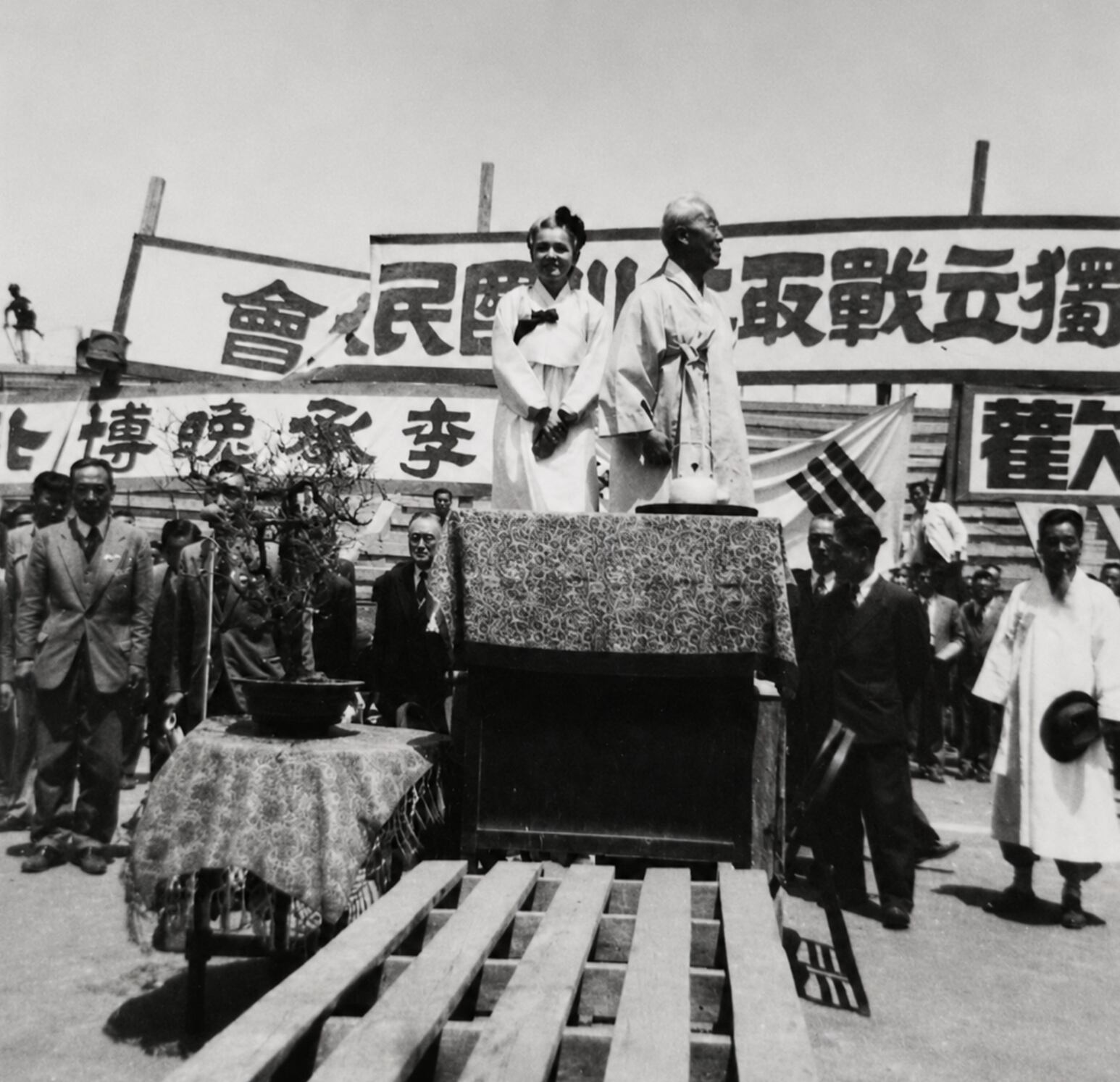
Syngman Rhee, however, opposed trusteeship, arguing that a provisional government should be formed through elections reflecting the will of the Korean people rather than Soviet agreement. He consistently advocated for resolving left-right conflicts through elections until communist factions began challenging the May 10, 1948 general election. His stance was clear and consistent: “self-determination” and “realizing national sovereignty through universal elections.”
The “American Puppet” Slander
The notion that Syngman Rhee was an American puppet originated in mid-December 1945 when he criticized the Soviet Union for turning neighboring states, including North Korea, into satellite nations and imposing communism. Although studies have shown that the U.S. military government’s policies were not exclusively pro-rightist, the view that the U.S. supported Syngman Rhee to contain the Soviet Union remains uncorrected.
In my view, Syngman Rhee’s initial support from the U.S. military government ended by late December 1945, after the Tripartite decision, or at the latest in early March 1946, when the military government began pursuing left-right coalition policies.
General John Hodge, the military governor, judged promoting trusteeship impractical after witnessing Koreans’ nationalist fervor. He proposed “immediate independence” to Washington, but the State Department prioritized Soviet agreement, which scuttled the plan. In Tripartite negotiations, the U.S. made a critical error by failing to guarantee liberal political activities in Soviet-occupied zones while leaving the selection of South Korean participants in the provisional government to Soviet agreement.
U.S. Military Government-Led Left-Right Coalition
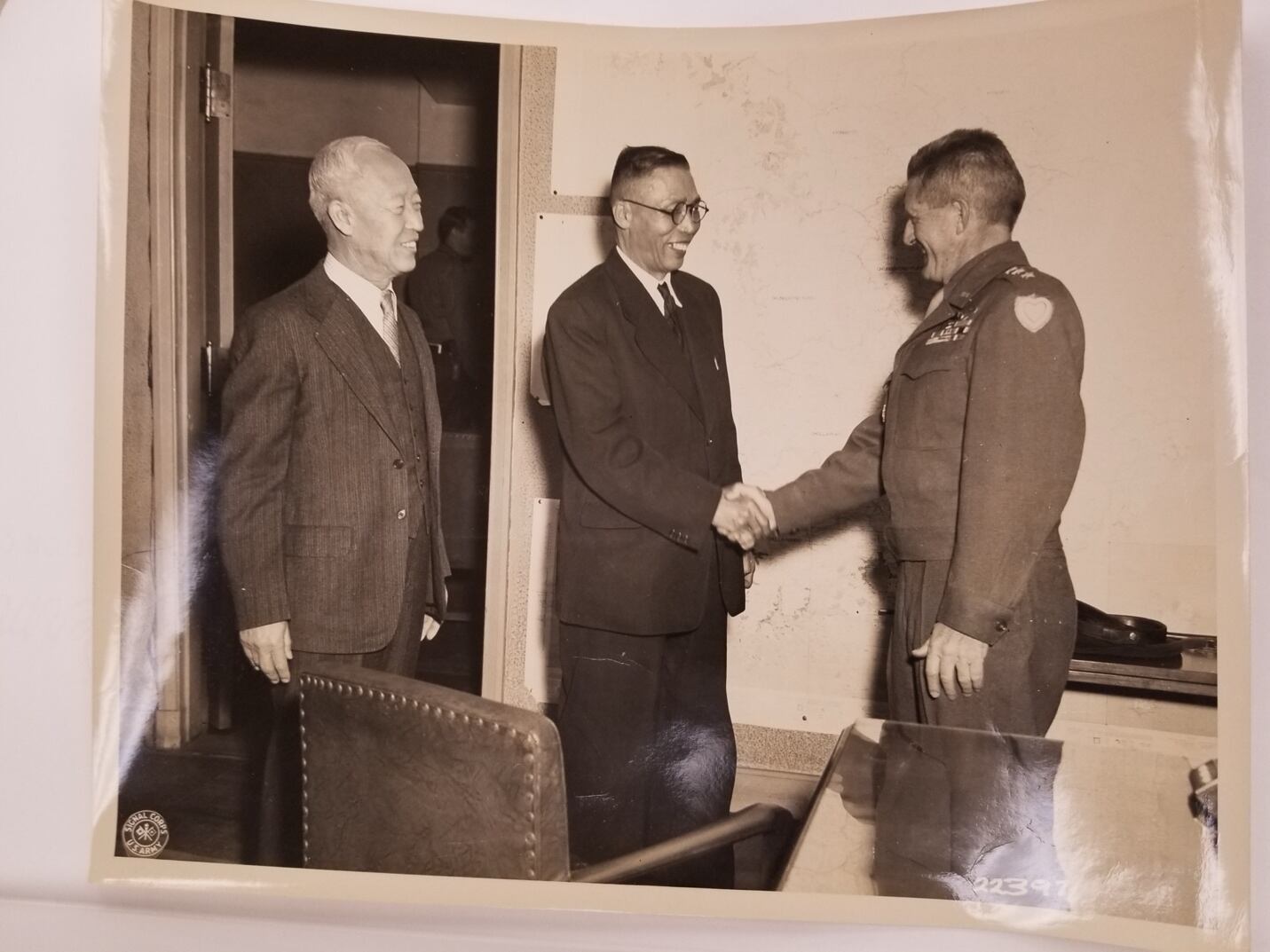
The U.S. military government sought a left-right coalition centered on Lyuh Woon-hyung and Kim Kyu-sik. While existing studies date the coalition’s start to around May 1946, it actually began in early March 1946, concurrent with the launch of the first U.S.-Soviet Joint Commission. Lieutenant Leonard Bertsch, who handled coalition affairs for the military government, visited Lyuh Woon-hyung on March 3, 1946, and discussed directions with Kim Kyu-sik on March 9 and 15.
The military government formed the Democratic Council, nominally reflecting “Korean public opinion,” with Syngman Rhee as chairman. Preston Goodfellow, who led this effort, became Hodge’s advisor upon Syngman Rhee’s recommendation. Kim Kyu-sik emphasized to Bertsch that the Democratic Council could not serve as a coalition organization—a view likely shared by Lyuh Woon-hyung. The coalition committee was later organized separately from the Democratic Council.
Goodfellow departed for the U.S. in May 1946, and despite repeated requests, Hodge denied his return. The military government had shifted its key partners to Lyuh Woon-hyung and Kim Kyu-sik.
Interim Legislative Assembly Elections and Syngman Rhee’s New Path
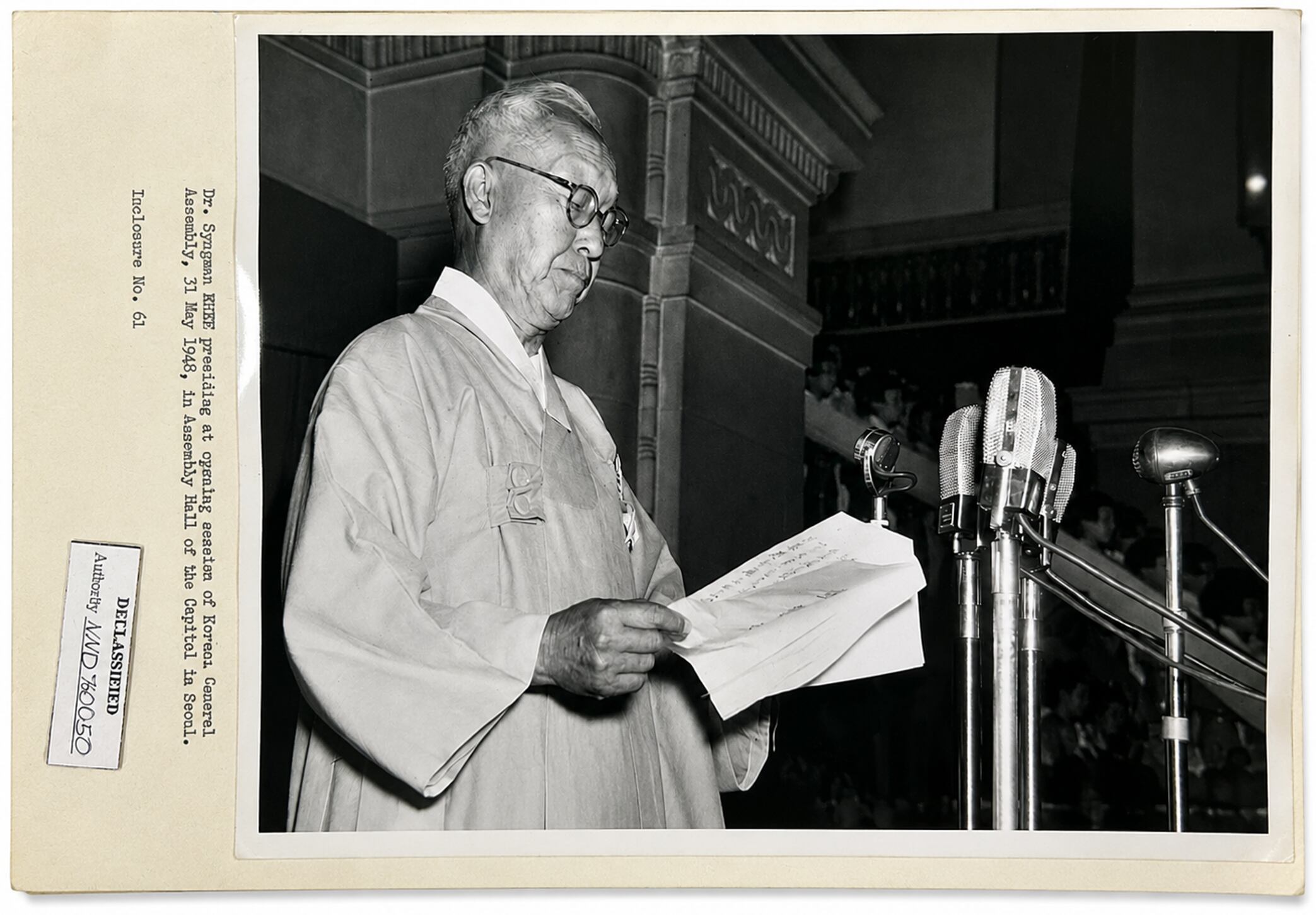
To control the political composition of the Interim Legislative Assembly, the military government filled half its seats through elections and half through appointments. In October 1946 elections, 45 elected members were chosen, and Hodge appointed the other 45. Rightists won roughly 75% of elected seats, but Hodge balanced the assembly by appointing many leftists.
Syngman Rhee, who had observed the coalition movement with Kim Kyu-sik, began clashing with the military government over the assembly elections. He criticized the U.S. stance of prioritizing Soviet agreement as undermining Korean self-determination. In a November 4, 1946 letter to Hodge, Syngman Rhee demanded that all assembly members be elected, condemning the appointed seats as undemocratic.
Through this conflict, Syngman Rhee developed a path to resolve left-right conflicts not through top-down coalitions but via universal elections. This direction was shared by his advisor Goodfellow, who judged after the election results that communism’s threat in the South was limited. If left-right conflicts could be managed through fair elections, the vote would be a pragmatic decision beyond ideological choice. Additionally, relying on guerrilla struggle or obstructing elections was undemocratic and violent. Goodfellow assessed pushing for general elections as a realistic and forward-looking path.
Autonomous Government and UN Transfer
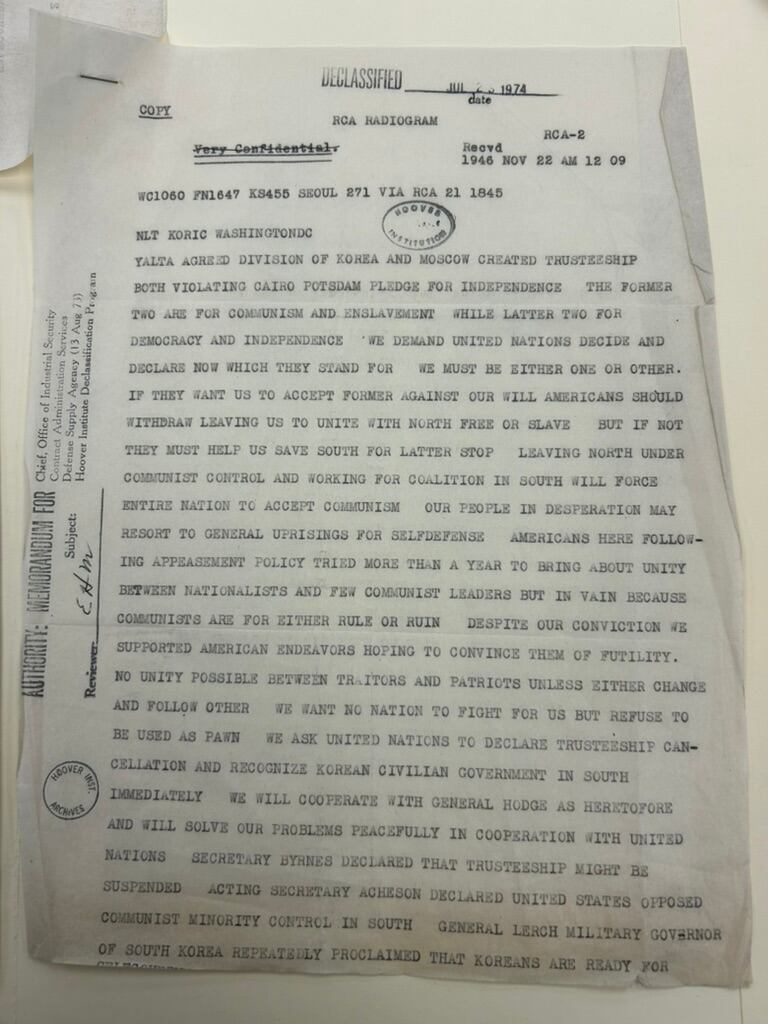
Around his December 1946 visit to the U.S., Syngman Rhee shifted his focus from coalition issues to a Washington campaign against infringing on national self-determination. Through his organization, the Korean Commission to the United States, he requested the State Department recognize a Korean government formed via Interim Legislative Assembly elections and transfer military government authority. If the State Department refused, he would push to transfer the Korean issue to the United Nations (UN). Goodfellow advised first seeking State Department cooperation and postponing UN appeals.
The Hoover Library’s Goodfellow documents include an official telegram sent from Seoul to the Korean Commission on November 22, 1946, likely authored by Syngman Rhee and addressed to the UN. Syngman Rhee argued, “If the U.S. insists on trusteeship and cooperation with the Soviet Union, better for U.S. forces to withdraw so Koreans can unify north and south—and decide their own fate, whether free or enslaved.” He warned that pursuing an artificial coalition government in the South while leaving the North under communist rule would lead to Korea’s full communization.
As Lyuh Woon-hyung was assassinated and the second U.S.-Soviet Joint Commission failed, many Koreans began viewing the Tripartite decision as antithetical to universal elections. This reflected Syngman Rhee’s successful campaign framing independence as a clear choice between left-right coalition vs. general elections, and U.S.-Soviet negotiation vs. Korean self-determination. Amid intense left-right conflict, his argument for resolving disputes through elections rather than elite negotiations or violent clashes was rational. Regardless of personal feelings toward Syngman Rhee, understanding why he politically prevailed is essential. Amid the whirlwind of U.S.-Soviet great-power politics, he presented a clear path—self-determination and realizing sovereignty through elections—and rallied the public to his side.
월 5900원 멤버십, 신문 독자에게는 2900원, 조선멤버십
55000원 상당의 신문-잡지 8종 마음껏 보기, 조선멤버십
현금처럼 쓸 7000포인트 받아 알뜰한 쇼핑, 조선멤버십