The Tragic Case of a Three-Year-Old Girl in Bara
The brutal rape and killing of a three-year-old girl in Bara has left the public in shock. This incident has sparked widespread concern not only about the government’s handling of the situation but also about the adequacy of Nepal’s legal framework to protect victims’ rights.
Six days after the incident, the government reached an agreement with the victim’s family. However, throughout the entire episode, the government, news organizations, social media users, and rights activists have repeatedly failed to safeguard the deceased child’s privacy.
Government ministers involved in the response themselves violated legal provisions that require the victim’s identity to be kept confidential. Even the agreement between the government and the victim’s family, which the government itself made public, contained details that exposed their identities. The official document, signed by several high-ranking officials, named both the victim and her family. In essence, five ministers responsible for making and enforcing laws signed a document that itself breached the law.
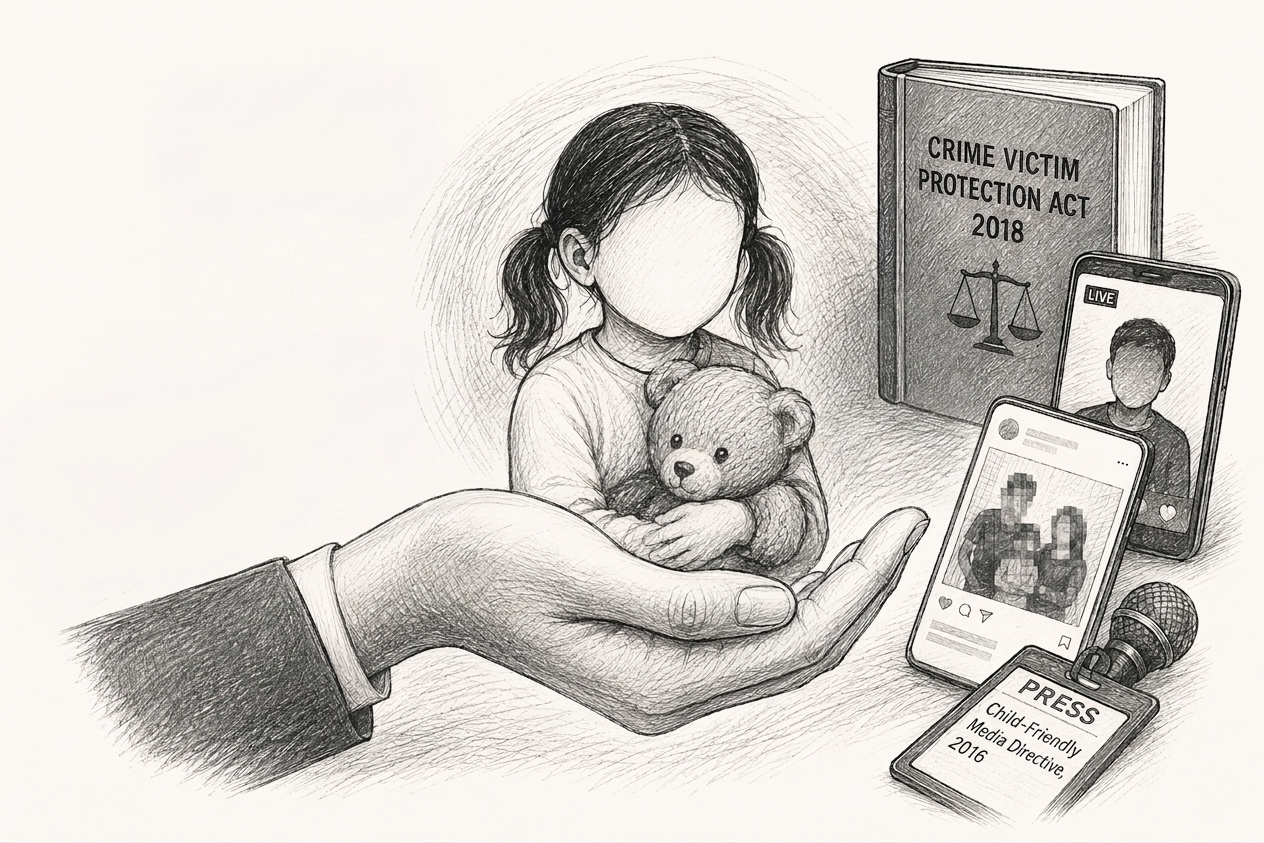
Section 6 of Nepal’s Crime Victim Protection Act, 2018 mandates the full protection of victims’ privacy during serious crime investigations. This includes cases involving rape, incest, human trafficking, and sexual abuse, covering investigation, prosecution, and court proceedings. Subsection 2 of the same section states that no one may disclose the identity of a victim of such offenses in any form.
Yet, ministers and senior government officials disregarded these provisions by posting photographs of the victim’s family on social media. Home Minister Sudan Gurung’s social media post not only described the incident but repeatedly identified the victim by name and age. Similarly, other ministers followed suit, posting photographs of the victim’s family on their social media accounts.
In contrast, Minister for Information and Communication Bikram Timalsina used social media to remind the public of the law. He emphasized the seriousness of publishing material that reveals the identity of victims in serious crimes like rape and sexual violence. He urged media organizations, journalists, and social media users not to publish, broadcast, or repost such material and called for the removal of already published content.
The Viral Video of the Suspect
A video of the suspect being questioned is circulating on social media. Umesh Shrestha, chairperson of Press Council Nepal, stated that making the video public was wrong. He emphasized that while it is natural to question the accused, making public a video of a minor’s statement before a court’s verdict is not part of the judicial process. He reminded everyone that a victim’s suffering is not content and an accused person’s statement is not viral material.
According to a hospital source, the video was recorded while doctors at the hospital were questioning the suspect in the presence of a district police officer and two police personnel stationed at the hospital. The questioning was conducted by doctors Paniya and Saroj, along with a female hospital staff member, Shivani. A hospital employee mentioned that videos of doctors conducting questioning without police presence are kept confidential, but the source of this particular video remains unclear.
The video shows two uniformed police officers, one carrying a rifle, recording the handcuffed teenager’s statement on a mobile phone. Another officer, with a pistol holstered at his waist, is seen striking the teenager on the back of the head as he gives a detailed account of the incident. The footage that was made public shows the teenage suspect giving a detailed account of the incident.
Police have already arrested the head constable who recorded the video. Four others are also under investigation, and criminal proceedings will be initiated against the officer.
Legal and Ethical Implications
Lawyer Prabin Bhatta highlighted that protecting a victim’s privacy goes beyond simply withholding their name. He pointed out that showing the family’s photograph, identifying the village, or naming the parents can also indirectly reveal the victim’s identity. During an investigation, authorities must ensure that parents’ names are withheld, voices are altered, and no material that could identify the family is released.
Lawyer Biraj Thapa warned that such negligence by state authorities could create a false narrative around the case. He emphasized that the criminal justice system and laws clearly require the victim’s privacy to be protected in every respect. It is completely wrong for the home minister or other responsible officials to publish photographs or videos of victims or disclose their real names in agreements. Such actions can create a false narrative.
Article 28 of Nepal’s constitution guarantees every citizen the right to privacy, while Article 39 guarantees children the right to special protection. The Children’s Act, 2018 further specifies this protection. Section 11(3) requires the names, addresses, ages, sex, family background, and any other information that could reveal the identity of children accused of or victimized by an offense to be kept confidential.
Nepal is also a party to the International Covenant on Civil and Political Rights. Article 17 of the ICCPR and Article 16 of the UN Convention on the Rights of the Child protect the privacy and dignity of children and their families.
Global Perspectives on Privacy Protection
Government agencies were not alone in violating the victim’s privacy. Members of the public and media organizations also breached the victim’s confidentiality. Her name and photographs have appeared across social media feeds and on placards carried in the streets.
Many media organizations have abandoned editorial judgment by using the victim’s name and photograph in their reports. The Child-Friendly Media Directive, 2016 prohibits the disclosure of the identity of children who have been subjected to sexual violence or abuse. Section 4(h) bars the disclosure of their identity, while section 4(e) prohibits the use of photographs, drawings, or audio-visual material that could reveal it.
The Journalist Code of Conduct, 2016, as amended in 2019, also prioritizes the protection of victims’ identity and privacy. Sections 5(5)(2) and 5(4)(2) prohibit the publication or broadcast of photographs that reveal a victim’s identity.
For serious violations, the Press Council Nepal has the legal authority under section 7 of the code to take action ranging from issuing warnings to blacklisting media organizations.
Some may ask: if the victim has already died, why does privacy still matter? Menuka Thapa, president of Raksha Nepal, an organization that has worked for years to protect rape survivors, rejects that argument. She emphasizes that privacy must be protected to ensure that a victim’s right to live with dignity is not violated. A person’s body may die, but their dignity and their family’s dignity remain. Respect for the law also requires that photographs and videos of victims not be broadcast.
Lawyer Biraj Thapa agrees. He states that victims’ privacy must be protected so that, if they survive, they can live freely, safely, and with dignity as adults without social stigma. Even when the victim has died, photographs and personal details that remain can cause lifelong psychological suffering to surviving family members. That makes privacy an essential requirement.
Enforcement Challenges
Nepal’s legal framework for protecting privacy is not particularly weak. The bigger problem is enforcement. International practice shows that many countries treat the disclosure of sexual assault victims’ identities as a serious offense.
In neighboring India, the Supreme Court issued a landmark ruling in 2018 holding that protecting the privacy and dignity of victims of rape and sexual violence is an obligation of the state, the media, and society. The court held that victims’ identities should not be disclosed even if they have died or their families have given consent.
Interviews with minor victims are prohibited, and photographs cannot be published even after being blurred. Section 72 of India’s Bharatiya Nyaya Sanhita (criminal code) prohibits the publication of information that could reveal the identity of adult victims, while section 23 of the Protection of Children from Sexual Offences Act prohibits disclosure of the identity of child victims. The Press Council of India’s norms of journalistic conduct also instruct media organizations to protect victims’ identities and privacy.
In the United Kingdom, the Sexual Offences (Amendment) Act 1992 gives victims of sexual offences lifelong anonymity from the moment an allegation is made. Publishing any information that could identify a victim, including their name, address, school, or photograph, can constitute a serious criminal offense, whether the victim is alive or dead.
Australian courts can issue suppression orders preventing the media from publishing details of a case or identifying victims. Strict protections also apply to children, including after their death, to shield families from media intrusion and further psychological trauma.
Canada’s Criminal Code provides for mandatory publication bans in sexual offence cases. The Supreme Court of Canada, in R vs Adams, held that the central purpose of such restrictions is to provide victims with a lasting guarantee of privacy.
In the high-profile Homolka-Bernardo case, Canadian courts not only barred the public and media from accessing graphic videos of sexual abuse but later ordered the destruction of all such video evidence in 2001.
The United States takes a different approach. Because the First Amendment to the Constitution gives strong protection to press freedom, the country relies more heavily on voluntary media codes of conduct than on legal restrictions on publishing victims’ identities. Even there, however, privacy advocates argue that publishing a victim’s name without consent can amount to another grave violation and humiliation of the victim.