Nepal, Oct. 11 — Nepali politics liberally employs the idiom of ideology in manifestos, discourse and elections. It is the most widely used idiom, especially among communist parties. The plurality of communist parties is an important feature of Nepali politics. The oldest Nepali political party, the Nepali Congress, uses terms like socialism and democracy but shies away from overtly using ideology.
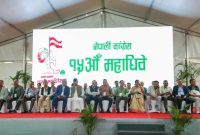
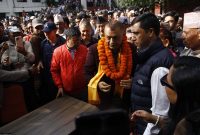
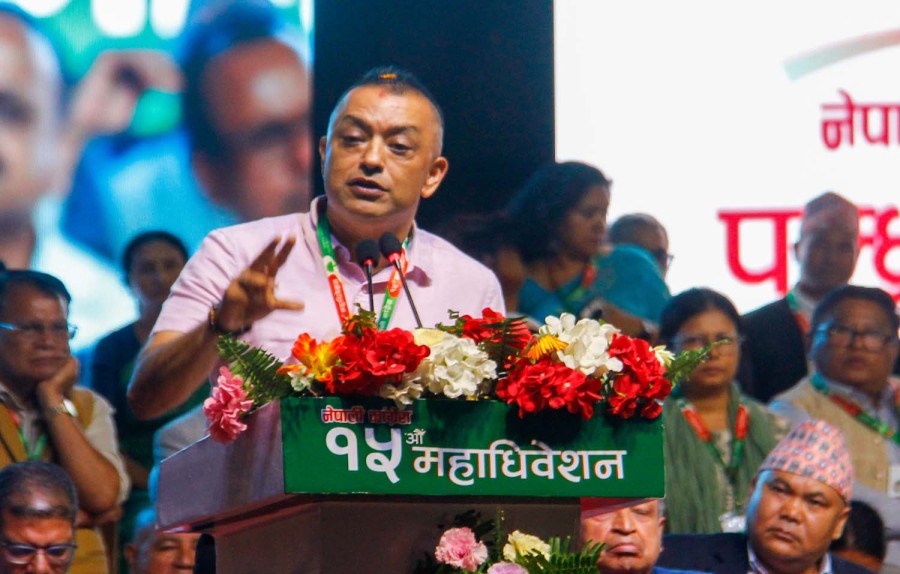
Party president Gagan Thapa spoke spontaneously at the inaugural ceremony of the 15th General Convention of the Nepali Congress at Khula Manch in Kathmandu. He foregrounded the party’s principles and persona in his speech, repeatedly invoking the image of BP Koirala-a common practice at Congress meetings. Attended by the leaders of the other political parties of Nepal, the gathering spoke eloquently about the basic features of the modern Nepali political culture. The gathering was dramatic, metaphorical and symbolic, as leaders of the communist party and the erstwhile Panchayat parties were also present. The importance of the meeting was also highlighted by the fact that these leaders lack a common forum to gather and discuss changing ideologies and the nature of their adherence, scepticism and pursuits.
Throughout his oration, Thapa used syllogism tinged with irony, theory, resolution, dreams and some degree of pique he had developed over months of dealing with his party’s elderly leaders. Idioms about the uprising of youths in Nepali politics and gerontology appear in Nepali political discourse at a rate never experienced before. One interesting feature of the Congress is that its leaders have used generational language meaningfully within the party, unlike other communist parties, where arguments do not stem from the semantics of new and old generations.
Pushpa Kamal Dahal, the erstwhile firebrand Maoist leader, a revolutionary who disbanded his fighters and entered politics of peace and democratic elections, confessed a few important things at the NC convention. Referring to his method of breaking norms, or krambhanga, in politics time and again, he admitted that it has now become history. He also called on the young generation to take up the conundrum and the methodologies he adopted in his political career. The context suggested he was perhaps addressing Gagan Thapa.
I always considered Prachanda’s krambhanga as a sign of flexibility. Shankar Pokhrel, a CPN-UML leader, directly called on Thapa to become President of the Nepali Congress. Baburam Bhattarai, as always, advocated amending the constitution to allow the election of an executive president. Though I am sceptical of this idea, I consider Bhattarai an important politician who declared he had left the communist party, drawing an analogy to an unsafe house labelled red after the great earthquake. Meanwhile, Rastriya Swatantra Party President Rabi Lamichane delivered a cool, pragmatic speech. Pragmatism, not ideology, defined his discourse.
A faction led by older-generation Nepali Congress leaders, with some middle-aged leaders supporting them, is among the old champions of democracy and may either join the NC led by Thapa or form a new party. They appear to be reading the idioms of generational change in politics. The Congress leaders refer to the teachings of BP Koirala, who freely evoked opposite realms and said, “I am a socialist in politics and an anarchist in literature.” That means he did not stick to any so-called ideology in the sense used by the communists. The Khula Manch offered a rare view of political leaders from different parties presenting their failed dreams and new ideas for the future.
Nepali communists claim that Marxist ideology is their guiding principle. They vie to be the truer communists. It involves both epistemological and ideological subjects. Marxist thinkers and politicians outside Nepal believed the communists would come to power in Nepal. They did form governments, but not strictly in the sense of a one-party rule. Communists became part of the multiparty system in this country.
I want to remember one world-renowned American Marxist philosopher and academic, Fredric Jameson (1934-2024). We invited Jameson to Kathmandu as a detour during his lecture tour in India to give a seminar for Nepali scholars and university students who had studied his work. Jameson had a great desire to see a communist become the prime minister of Nepal. At his request, I took Manmohan Adhikari to meet him, and they had a good conversation. As coincidence would have it, exactly one year later, in November 1994, Man Mohan Adhikari became the prime minister of Nepal.
I have cited this story to show how ideology has prevailed in Nepali politics. What is the state of political ideologies in Nepal and India at this stage of history? I mention India here because Nepali political parties have drawn ideas and ideologies from India’s political landscape. Mahatma Gandhi’s ideas have inspired Nepali politicians.
We are all familiar with the events of this country. Currently, the important goals addressed by the ruling and opposition parties are the same as they were when the Panchayat system fell. The Maoists entered the country’s multiparty system by signing a Comprehensive Peace Agreement with the seven parties on November 21, 2006. All parties participated in the 2008 Constituent Assembly election. Landmarks include the constitutional election of 2013, the general elections of 2017 and 2022, and the Gen Z uprising of 2025, which brought current political transformations and evaluations. The Nepali Congress Party, which won an overwhelming majority, and other parties that won seats in the 1959 general election are all committed to the democratic system. Their idioms, ideologies, and principles may differ, but all parties must work towards a stable, functional democratic system.