Kathmandu, Oct. 11 — Angad Murau, a resident of Kapilvastu in western Nepal, was returning from India on a motorcycle carrying chillies and colocasia on June 1 when he encountered an unexpected inspection by the Armed Police Force along the Bargadawa-Purnihawa road.
When security personnel ordered him to stop, Murau set fire to his motorcycle, police said. The vehicle, bearing an Indian registration number and used to transport vegetables, was destroyed in the blaze. About two and a half quintals of chillies and colocasia carried on the motorcycle were also partly burnt.
The incident offered a glimpse into the lengths to which people involved in the illicit movement of goods will go to avoid security checks.
The problem extends well beyond small quantities of vegetables. From fertiliser and sugar to clothing, mobile phones, medicines, poultry and narcotics, a wide range of goods continues to enter Nepal without the required customs duties. Security officials say large consignments moved by trucks and containers have become easier to intercept, but smaller shipments carried throughout the day remain difficult to control.
On November 11 last year, security personnel seized 218 sacks of urea fertiliser near the Maryadpur police post in Yashodhara, Kapilvastu. The fertiliser had been brought into Nepal without paying customs duties and was found abandoned about 100 metres inside the Nepali side of the border. It was handed over to the Suthauli Customs Office, but those responsible for transporting it were not found.
In Bethari, Rupandehi, a year earlier, police officers had to flee to save their lives when a truck suspected of carrying smuggled goods was driven recklessly towards them as they tried to stop it. Footage of the confrontation along the Lumbini-Bhairahawa road went viral on social media.
Such incidents illustrate the risks faced by security personnel and the tactics used to evade arrest. Officials say smugglers have developed their own information networks to monitor police movements and alert one another when security personnel approach. Consequently, although goods are frequently seized, the people behind the operations often escape, leaving couriers to face the consequences.
Moving large consignments across the border at once is difficult, security officials say. Instead, smugglers bring goods in small quantities, store them in warehouses and distribute them to markets later. The approach reduces the risk of losing an entire consignment and makes it harder for security agencies to identify the organisers.
In Parsa, women and children are frequently used to carry goods from India into Nepal through Birgunj. Security officials say the items range from everyday necessities and clothing to mobile phones and narcotics.
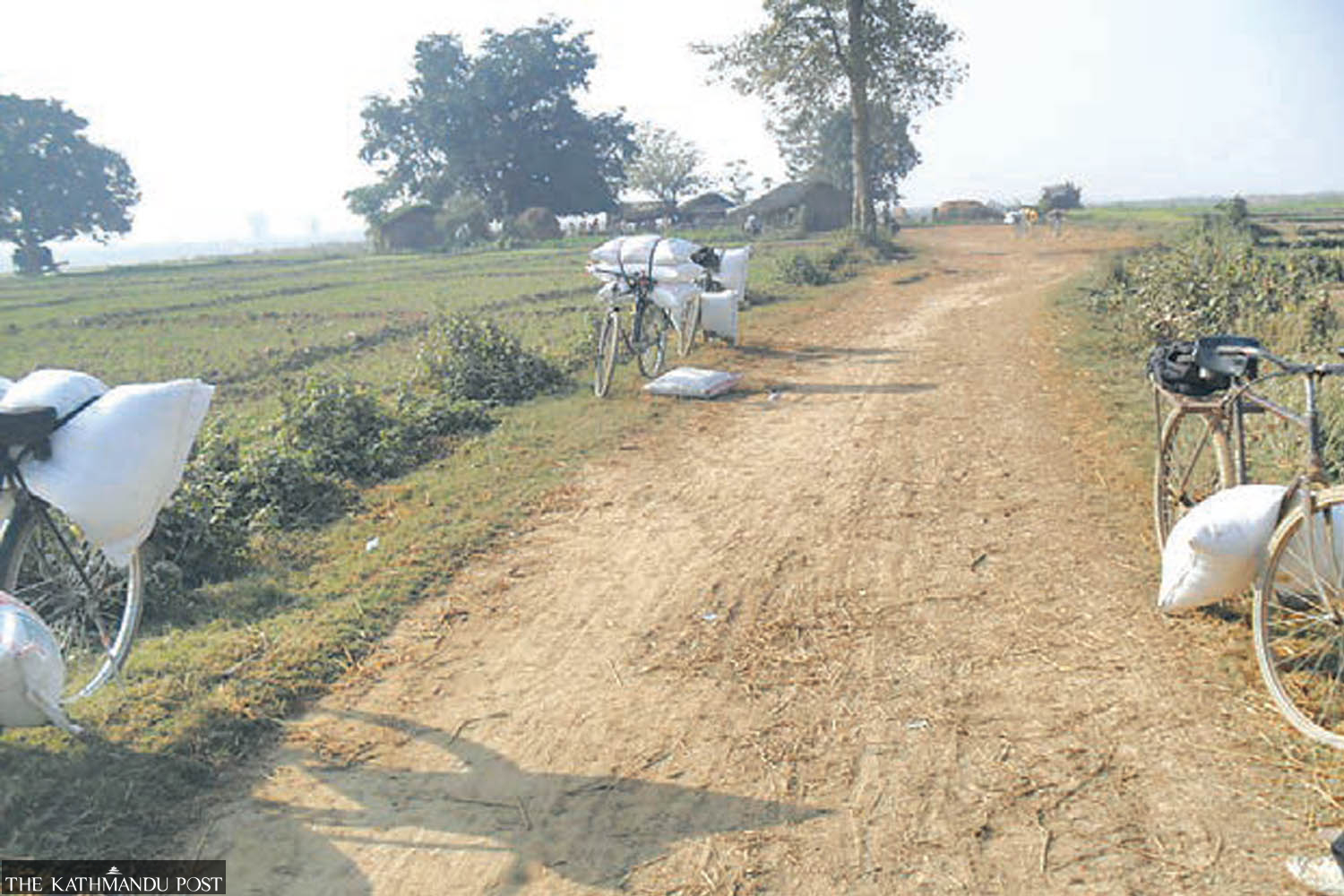
From before dawn until late at night, people carry goods on their heads and cross into Nepal through fields, along raised field boundaries and across the Sirsiya river. Some wait near the border for 24 to 48 hours for an opportunity to avoid security checks.
Tensions flared a few weeks ago at the Sirsiya crossing when Armed Police Force personnel stopped a group of women transporting clothes from India. One woman reportedly broke an officer’s finger, while about a dozen people surrounded security personnel.
Armed Police Force Superintendent Mohan Singh Chhetri said about 500 people, including women, children and men, were involved in carrying small consignments across the border in Parsa. The Alau crossing in Birgunj is a major route for the illicit movement of daily necessities and food grains.
“Although organised smuggling has been brought under control, the movement of goods in small consignments remains a challenge,” Chhetri said.
The goods are subsequently distributed in markets around Birgunj and as far as Jitpur-Simara in neighbouring Bara district. Those involved in carrying small consignments earn between Rs800 and Rs1,000 a day.
In Rautahat, the pattern is similar. Goods brought across the border without paying customs duties are stored within the district, while some traders travel from village to village on motorcycles to sell them.
Many of the people transporting the goods depend on manual labour for their livelihoods. A trader in Gaur said carriers earned Rs2 to Rs3 for every kilogramme of sugar transported, with payments for food grains also calculated by weight.
“They are poor people living in the border area. They make a living by carrying goods across the border,” the trader said.
The price difference between Indian and Nepali markets provides a strong incentive for the trade. Traders say sugar costs about INR64 per kilogramme in India, while cooking oil is Rs20 to Rs30 cheaper per litre. Clothing can cost Rs300 to Rs400 less per item, and mobile phones can be Rs4,000 to Rs5,000 cheaper.
According to the Gaur Customs Office, clothing attracts customs duties and value-added tax totalling 29 percent, while mobile phones face duties of up to 18 percent. Officials say some people exploit provisions intended for personal household use to bring in larger quantities for commercial gain without paying the required taxes.
Deputy Superintendent of Police Basanta Gautam of the Rautahat District Police Office said people carrying small packages from India often mislead security personnel. Those caught rarely identify the people organising the operations.
“They claim the goods are for their own household use,” Gautam said. “Even those arrested with their motorcycles do not name the people who hired them to transport the goods.”
The illicit movement of poultry is another persistent problem in Rautahat. Poultry businesses in the district have repeatedly staged protests demanding action against the trade.
Sitaram Rijal, chief of the Rautahat District Police Office, said large-scale smuggling using containers and trucks had been curbed, but the continuous movement of small quantities remained difficult to stop.
“We seize whatever we find and hand it over to the customs office,” he said. “When we tighten security along the border, they start making one excuse or another.”
A team deployed by the Lumbini Province Police Office seized a variety of goods during an operation in Kothiyaghat, Madhuwan, Bardiya, a few weeks ago. The haul included 70 kurta-suruwal outfits, 30 lengths of fabric, 35 walkers, 35 sets of shirt-and-trouser fabric, 20 chilli firecrackers, 1,000 grenade-shaped firecrackers, six bicycles and two boats.
In Sarawal, Nawalparasi West, police seized mobile phone parts worth more than Rs10 million that had been brought into Nepal without paying customs duties.
Deputy Superintendent of Police Madan Thapa said officers intercepted the parts while they were being transported from India in a pickup truck. The consignment included 1,765 white and 633 black pairs of AirPods, 3,800 black tempered-glass screen protectors, 4,500 white tempered-glass screen protectors and 930 mobile phones.
“Vans, carts and even horses used to transport smuggled goods have also been seized,” Thapa said. “We have found that small-scale carriers bring goods across the border and store them there before moving them by vehicles or horses.”
Other seizures underline the diversity of goods moving through the border. On September 7, police seized gold-plated jewellery worth Rs1.55 million in Mayadevi Rural Municipality, Rupandehi. Officers in plain clothes recovered the jewellery during an inspection, Deputy Superintendent of Police Krishna Kumar Chand of the Rupandehi District Police Office said.
A team from the Butwal Area Police Office also seized kurtas, suruwals and children’s frocks worth about Rs1.2 million from Bikaspur. On August 29, Rupandehi police seized medicines worth Rs1.45 million in Kutta, Mayadevi.
In Kapilvastu, sugar and fertiliser are among the goods most frequently brought from India without paying customs duties. Local traders say smuggling sugar can yield a profit of Rs15 to Rs20 per kilogramme, while a 50-kg sack of fertiliser can generate an additional Rs400 to Rs500.
Hariram Pal of Karjanha said smugglers transport goods through the Rangpur crossing in the evening and at night. Kapilvastu District Police Office spokesperson Deputy Superintendent of Police Ripendra Kumar Singh said police had taken strict measures to control smuggling, but the repeated incidents indicate the difficulty of monitoring multiple routes.
In Nepalgunj, another major commercial gateway in western Nepal, the Armed Police Force says it has intensified patrols, inspections and surveillance at the city’s main and secondary border crossings. It has also deployed sniffer dogs.
“Regular patrols and inspections, along with trained dogs, are being used to control illegal activities,” Armed Police Force Superintendent Bhim Bahadur Chand said. “Controlling narcotics is also a major priority in the border area.”
Further west, several crossings connect Nepal and India in Kanchanpur, stretching from Brahmadev in the north to Punarbas in the south. Police say goods are transported through these routes on bicycles, motorcycles and four-wheeled vehicles, while narcotics are also smuggled in substantial quantities.
The regular arrest of one or two people a day for narcotics-related offences points to the scale of the problem, police say.
Smuggling also has implications for customs revenue. The Kanchanpur Customs Office collected Rs621 million in the last fiscal year against a target of Rs690.2 million. In the first two months of the current fiscal year, it collected Rs104.5 million against a target of Rs105.7 million, information officer Chakradev Bhatta said.
Bhupendra Bahadur Khatri, chief of Lumbini Province Police, said a provincial investigation unit had been established to investigate complex and organised smuggling operations.
“This has led to improvements,” he said.
Figures from the Lumbini Province Police Office show that revenue collected from goods seized in customs-evasion cases rose from Rs368.2 million in fiscal year 2024-25 to Rs575.5 million in 2025-26, an increase of 56.3 percent.
The seizure figures from Madhesh province also show the changing composition and scale of goods intercepted by police. In fiscal year 2023-24, police in the province’s eight districts seized clothing and fashion goods worth Rs865.71 million. They also seized vehicles and vehicle parts worth Rs297.87 million, groceries worth Rs236.68 million and electrical goods worth Rs73.39 million. Gold and silver were also brought into the country illegally during the period, police said.
In fiscal year 2024-25, police seized clothing and fashion goods worth Rs519 million and vehicles and vehicle parts worth Rs420.8 million.
In 2025-26, the value of seized clothing and fashion goods fell to Rs102.1 million, while vehicles and vehicle parts accounted for Rs750.8 million. Police also seized groceries worth Rs97.8 million and electrical goods worth Rs58.2 million.
For legitimate businesses, the concern is that untaxed goods can be sold at lower prices, creating unfair competition for traders who pay customs duties and taxes.
Thakur Kumar Shrestha, president of the Federation of Nepalese Chambers of Commerce and Industry’s Lumbini provincial chapter, said the biggest impact of smuggling was on government revenue.
“Illegal trade also encourages criminal activities and fosters a culture of earning money without working,” he said.
Shrestha argued that enforcement alone would not solve the problem. “Reducing customs duties would automatically help prevent smuggling,” he said. “It cannot be controlled by police using force alone.”
(Reporting by Dipendra Baduwal in Bhairahawa, Manoj Poudel in Kapilvastu, Shankar Acharya in Parsa, Shiva Puri in Rautahat, Rupa Gahatraj in Nepalgunj and Bhawani Bhatta in Kanchanpur.)