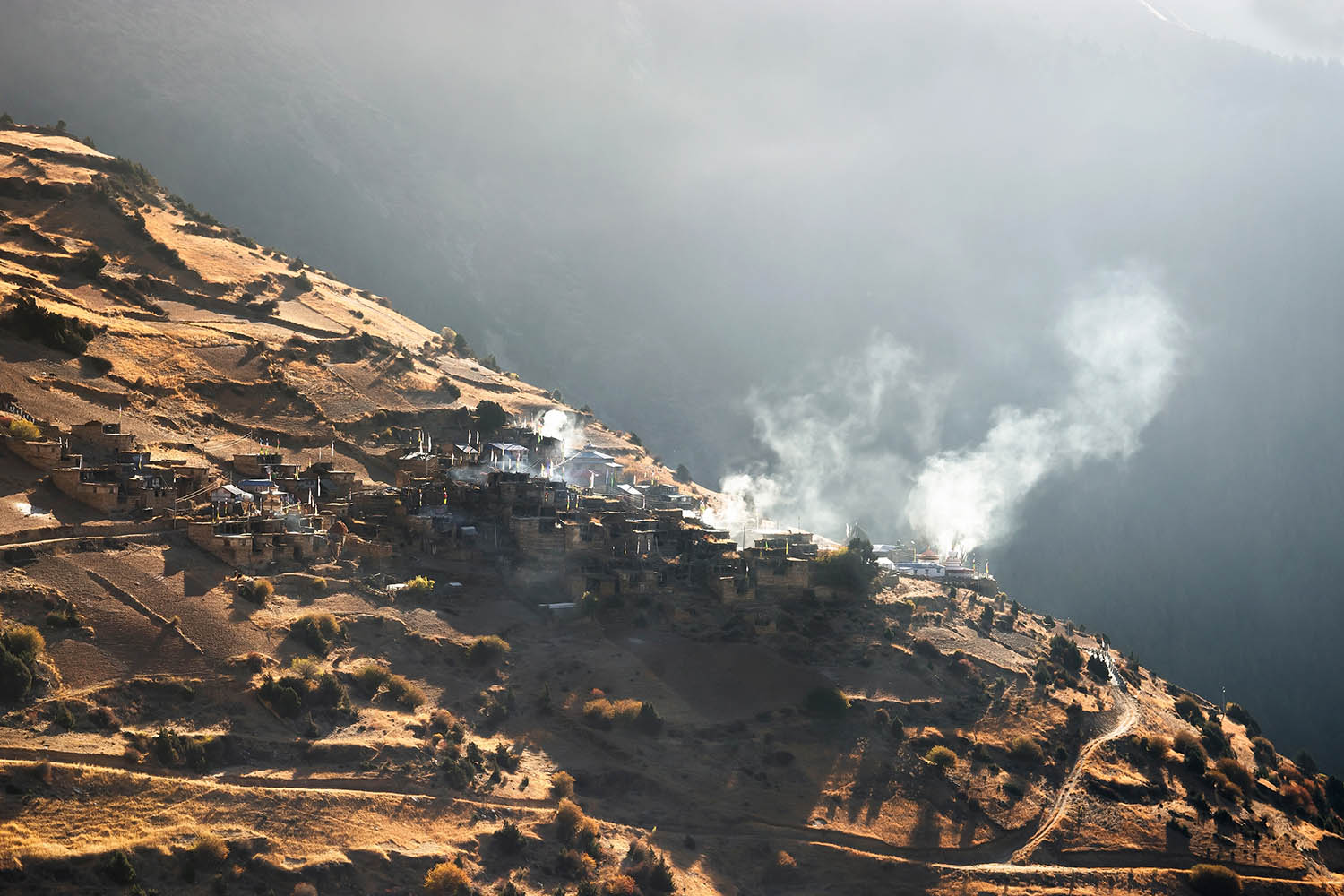
Nepal, Oct. 11 — The morning sun usually brought life to the hills of Kumaltar, but lately, it only revealed the bones of a dying village. Located seventy kilometres away from the bustling hub of Kushma Bazaar, Kumaltar was once a vibrant settlement of terrace farms and singing rivers.
Now, it was a quiet graveyard of empty mud houses with locked doors.
Hira Bahadur, known to everyone as Subedar Ba, stood on his porch. He adjusted his old, stiff Indian Army cap. After thirty years of service and retiring at the prestigious rank of Subedar, he had finally returned home. He expected a warm welcome-the laughter of children running through dusty paths, and the smell of fresh dung and wet soil.
Instead, he found silence.
More than half the village had fled. Some left for Pokhara, others for Kathmandu. A few young men had even flown to the Gulf countries, chasing dreams under the scorching sun.
The culprit was visible from anywhere in Kumaltar: a massive, ugly scar on the mountain’s face. Three years ago, a catastrophic landslide had brought half the peak crashing down. The mountain-sized debris not only blocked the river; it permanently choked its flow, forcing the water into a new channel miles away from the village. No water meant no irrigation. No irrigation meant the fertile terraces turned into cracked, barren steps.
Subedar Ba walked down to the village chautari-the stone resting platform under the giant pipal tree. Only a dozen elderly villagers and a few young men who couldn’t afford to leave were gathered there. Among them was Bir Bahadur, a cynical farmer whose face looked like a dried riverbed itself.
“The government engineers left this morning, Subedar Ba,” Bir Bahadur spat on the ground, his voice dripping with bitter disappointment. “They did their fieldwork, looked at their papers, and shook their heads. They said clearing that mountain of debris would cost more money than our entire district sees in a decade. They rejected our petition. We are abandoned.”
A heavy silence fell over the chautari. The villagers were heartbroken.
To a farmer, land is mother, and without water, the mother is dead.
Subedar Ba rubbed his chin, his eyes fixed on the massive pile of rocks and earth blocking the ancient water route. His military training had taught him one thing: when the front gate is blocked, you find another way through.
“If we cannot move the mountain, we do not need to,” Subedar Ba declared, his voice ringing with the authority of a man who had commanded troops in high-altitude borders. “We go through it.”
The villagers looked up, confused.
“What do you mean, Ba?” asked Maila, a young man who was planning his own escape to Kathmandu the following week.
“We use big, heavy-duty plastic pipes. The high-density ones. We lay them across and through the gaps of the debris, following the natural gravity of the old riverbed. We tap the water from above the landslide and bring it down in enclosed tubes. The debris can stay right where it is.”
Murmurs of doubt instantly broke out. The idea seemed absurd, almost childishly simple compared to the grand machinery the government engineers had talked about.
“That is impossible!” Bir Bahadur scoffed, throwing his hands in the air. “Plastic pipes against a mountain of rock? The weight of the shifting debris will crush them like hollow reeds. And where will the money come from? Plastic is expensive. Moreover, what about the water pressure, Subedar Ba. The water from the upper streams runs furious during the monsoons. It will burst those pipes into pieces. We will be left with plastic trash and no water.”
Subedar Ba stood up, stepping into the center of the chautari. He placed a hand on Maila’s shoulder. “In the army, Maila, we built bridges out of ropes and faith while enemy shells fell around us. Yes, the water is furious, but if we use flexible, thick-walled pipes and anchor them deeply with steel cables into the stable rocks, they will bend, not break. As for the money…” He paused, looking around at the tired faces of his neighbors. “I have my retirement pension. I have my savings. I did not survive bullets in foreign lands to watch my own birthplace die of thirst. I will buy the first batch of pipes.”
The villagers gasped. A man offering his life’s savings for a crazy dream was unheard of.
“But why risk it all, Ba?” Bir Bahadur asked, his voice softer now, touched by the old soldier’s fierce loyalty. “What if it fails?”
“If we do nothing, we fail anyway,” Subedar Ba replied firmly. “If we try, we might give our children a reason to come back. Who is with me?”
It took a moment, but Maila stood up first. Then Bir Bahadur, with a reluctant smile, stood up too. One by one, every man in the chautari rose.
The next three months were a testament to the raw strength of the human spirit.
Kumaltar transformed into a labor camp of hope. Subedar Ba hired a truck to bring massive coils of black plastic pipes from Kushma Bazaar, as far as the dirt road would allow. From there, it was pure human muscle. Men, women, and even the elderly carried the heavy pipes on their backs, navigating the treacherous, unstable terrain of the landslide.
Subedar Ba was everywhere. He wore his old combat boots, shouting instructions, measuring angles with a simple spirit level, and ensuring the pipes were safely wedged beneath the boulders where the sun couldn’t degrade the plastic. He taught the young men how to join the pipes using heat, creating seamless, unbreakable black veins across the gray scar of the mountain.
Finally, the day of testing arrived. The entire village gathered at the main reservoir tank they had built at the top of Kumaltar’s terraces. Miles away, up the mountain, Maila signaled through his hands that he was opening the main intake valve.
For ten agonizing minutes, nothing happened. The only sound was the wind howling through the gorge. Bir Bahadur sighed, looking down. “It’s too long. The friction… the air locks…”
Suddenly, a deep, rumbling sound vibrated through the black pipe entering the reservoir. It sounded like a sleeping beast waking up. A hiss of escaping air screamed from the vents, followed by a violent thud. Then, a thick, crystal-clear torrent of Himalayan water erupted from the mouth of the pipe, crashing into the concrete reservoir with a glorious roar.
Shouts of joy echoed across the hills. Women wept openly, splashing the cold water onto their faces as if it were liquid gold. Subedar Ba stood quietly in the background, a single tear escaping his disciplined eyes, wiping it away quickly before anyone could see.
When water was available, the next task was to maximise use of the water for the benefit of the villagers. Subedar Ba knew that traditional rice and maize farming would not be enough to bring the village back to life quickly. He introduced a new concept: greenhouse farming. Using bamboo frames and clear plastic sheets, the villagers built modern poly-houses.
Within a year, the barren terraces of Kumaltar were transformed into a sea of green. They began growing high-value seasonal and off-season vegetables-plump red tomatoes, crisp cauliflowers, and fiery akabare chilies. The sound of trickling water was now accompanied by the bleating of improved breeds of goats and the clucking of local poultry from the newly established livestock farms.
But growing crops was only half the battle; selling them was the real challenge. The middlemen from the cities tried to buy their produce for pennies. Once again, Subedar Ba stepped forward.
Using his organisational skills from the military, he formed the Kumaltar Agricultural Cooperative. Under his strict guidance, they leased a large plot of land right in the heart of Kushma Bazaar. There, they built a massive, modern store room and selling center. Every morning, a cooperative truck loaded with fresh, dew-kissed vegetables and livestock products left Kumaltar for Kushma Bazaar.
Because they sold directly to consumers and large wholesalers, the profits stayed with the farmers. The lifestyle of the local villagers improved dramatically. Mud huts were replaced by sturdy stone houses with tin roofs. The village school, which was on the verge of closing due to a lack of students, hired new teachers. Electricity and internet followed the wealth into the village.
News of Kumaltar’s miraculous rebirth spread across the country like wildfire.
One evening, two years after the water first flowed through the plastic pipes, a bus stopped at the dirt road junction outside Kumaltar. A young family stepped down, carrying heavy suitcases. It was Shyam, Bir Bahadur’s eldest son, who had left for Kathmandu four years ago to work as a low-paid security guard. He had brought his wife and young daughter back.
Bir Bahadur met them at the road, his eyes glistening. “You came back,” the old man whispered, hugging his granddaughter.
“There is nothing in the city for us, Buwa,” Shyam said, looking out at the glowing green plastic tunnels covering the hillsides. “The news from home told us that now Kumaltar can offer us what even cities like Kathmandu can’t. Buwa, now I want to build my own greenhouse here.”
Shyam was not the only one. Dozens of families who had fled to Pokhara and beyond began returning to reclaim their ancestral lands. The village that was once a skeleton was now pulsing with life. And Subedar Ba also realised that his greatest victory wasn’t won on a battlefield with a gun, but right here, with a length of plastic pipe and a village that refused to die.