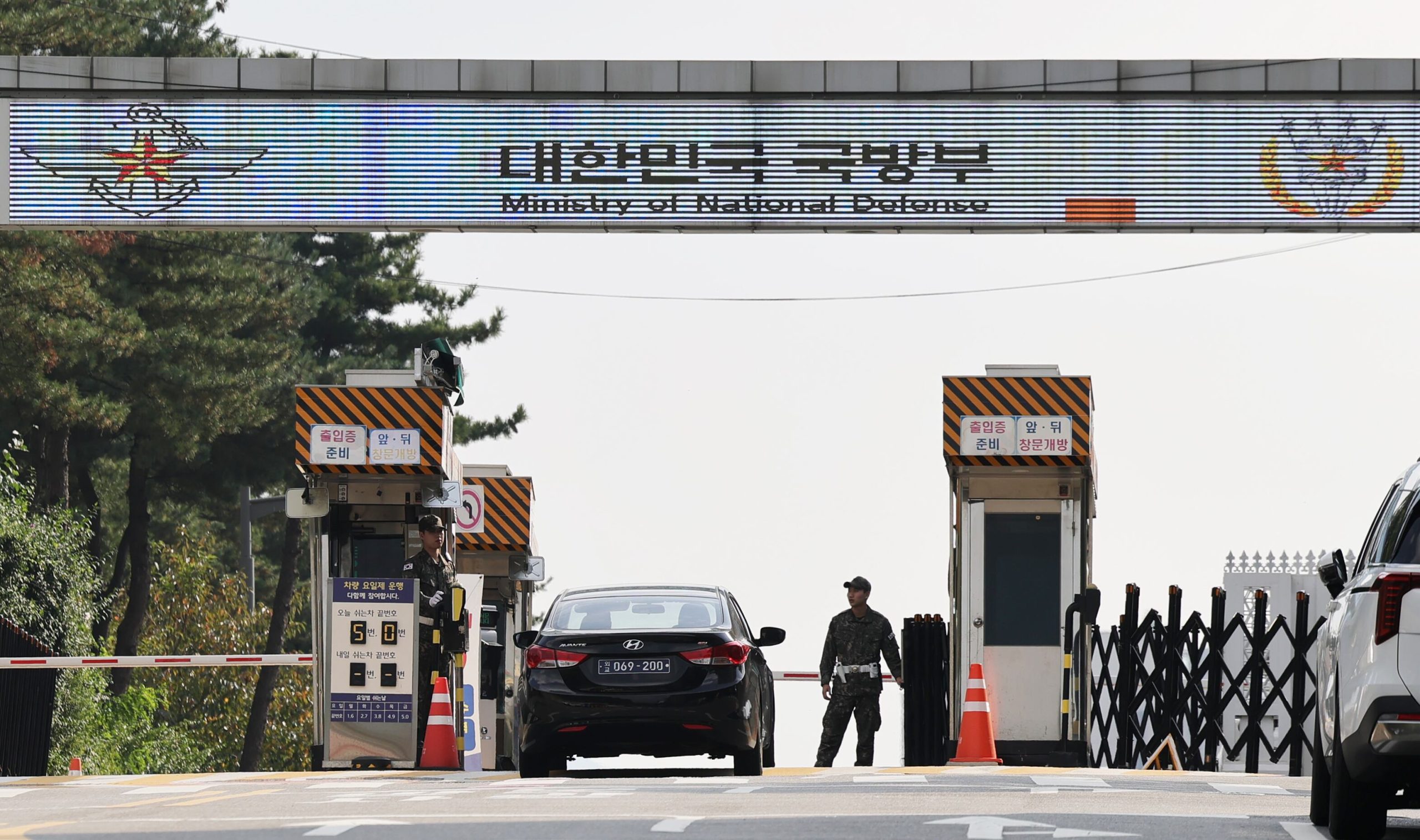
The government was reported on the 16th to have informed the National Assembly as late as a month before its October 13 announcement about relocating most central administrative agencies in the capital region to Sejong that “the relocation of the Ministry of Foreign Affairs·Ministry of Unification had not been reviewed.” Critics question whether the decision to relocate all agencies, including foreign affairs and defense ministries, was hastily made at the last minute.
The Ministry of the Interior and Safety, the agency in charge of relocating central administrative institutions, stated in a written response submitted to the office of People Power Party Representative Ahn Cheol-soo on September 11 that it had not reviewed the relocation of the Ministry of Foreign Affairs and the Ministry of Unification, adding, “Accordingly, no separate review materials for relocating the Ministry of Foreign Affairs and the Ministry of Unification to Sejong exist.” It also said, “We plan to sufficiently gather various opinions through future consultations with related agencies and expert advice.”
Some agencies reportedly had no prior discussions about relocation. One agency head was said to have learned of their relocation to Sejong only after seeing the agenda document at the October 13 Cabinet meeting. Representative Ahn Cheol-soo stated, “Relocating central administrative agencies is not a matter to be handled as casually as a presidential SNS post.”
Some Cabinet members also expressed concerns. During the private session of the Cabinet meeting that day, when President Lee Jae Myung asked for free opinions, Lee Eog-weon, Chairperson of the Financial Services Commission, reportedly said, “Since you asked for free opinions, I will cautiously share one: There are significant concerns about relocating the Financial Services Commission.” With most financial institutions based in Seoul, relocating the Commission to Sejong would weaken its ability to respond to market changes.
Foreign Minister Cho Hyun reportedly mentioned the need for additional measures, such as securing land for foreign embassies in Seoul, if the Ministry of Foreign Affairs relocates to Sejong. A source from the ruling party said, “If the government had sufficiently coordinated with the ministries in advance, would Cabinet members have raised concerns at the meeting?”
However, Prime Minister Han Seong-sook reportedly instructed to proceed with the Financial Services Commission’s relocation as planned, stating, “People will judge whether the administrative capital relocation is actually happening based on whether the Financial Services Commission moves.” Regarding the relocation of foreign affairs and defense ministries, she reportedly said, “We have aligned the timing with Cheong Wa Dae, so there should be no major issues.”
◇“President in Seoul, Defense Ministry in Sejong… Potential Gap in Military Command System in Emergency Situations”
The government and ruling party are preparing to amend the Administrative Central Composite City Act to relocate the Ministry of Foreign Affairs, Defense Ministry, and Ministry of Unification—explicitly listed as “excluded from relocation” in the current law—to Sejong by 2031. Cheong Wa Dae is reportedly planning for President Lee Jae Myung to work in Sejong for 1–2 days a week once his Sejong office is completed.
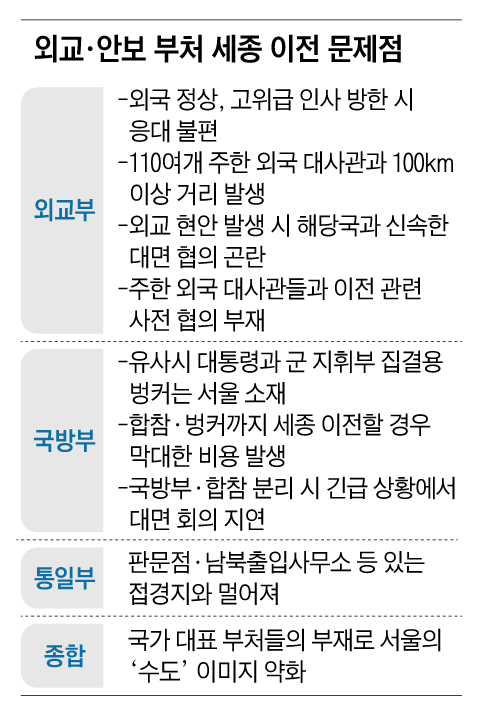
However, foreign affairs and defense ministries argue that relocating institutions representing South Korea internationally or responsible for national security requires more meticulous preparation. A senior Defense Ministry official said, “More public consensus is needed to move military leadership from Seoul to the provinces.” A Ministry of Foreign Affairs official added, “If the Ministry of Foreign Affairs also relocates to Sejong, it could weaken Seoul’s image as a global capital city.”
◇Concerns About Delayed Military Response in Emergencies
If the Defense Ministry relocates to Sejong, the military command system will need reorganization. The October 13 relocation plan did not include the Joint Chiefs of Staff (JCS), and its relocation status remains undecided.
Currently, the Defense Ministry and JCS are both located in Yongsan, Seoul. If only the Defense Ministry relocates, the policy and administrative functions (Defense Ministry) will be in Sejong, while military orders and operations (JCS) will remain in Seoul. Security experts warn this could create a command vacuum during emergencies.
Shin Jong-woo, Secretary-General of the Korea National Defense and Security Forum, said, “In emergencies, the president, defense minister, and JCS chairman must gather in an underground bunker to command. If Cheong Wa Dae, the Defense Ministry, and JCS are split between Seoul and Sejong, establishing a swift command system could become difficult.”
If the president commutes between Cheong Wa Dae in Seoul and the Sejong office, and an emergency occurs while the president is in Seoul, the defense minister and staff in Sejong would need time to assemble—whether in Seoul or Sejong.
◇Where Will the Wartime Command Bunker Be?
During wartime, the president and military leadership gather at the Army Capital Defense Command’s underground B-1 bunker in Namtaeryeong, Seoul, to command operations. Relocating the Defense Ministry raises the question of how to handle this. Yang Uk, a research fellow at the Asan Institute for Policy Studies, said, “Moving the B-1 bunker, equipped with protective and communication facilities, would cost astronomical sums. If it remains, the defense minister would have to travel over 100 km from Sejong to Namtaeryeong during emergencies.”
Relocating the JCS and bunker would require massive costs and years of construction. A Defense Ministry official said, “I got the impression that the government hastily announced the plan without concrete details, such as whether the JCS would move.”
◇Will Foreign Leaders Be Invited to Sejong?
The Ministry of Foreign Affairs worries that coordinating visits by foreign dignitaries will become more complicated. Foreign leaders visiting South Korea typically use airports in the capital region. Their preferred hotels, such as the Grand Hyatt for U.S. presidents and the Shilla Hotel for Chinese leaders, are mostly in Seoul.
Inviting leaders to Sejong would require new considerations for logistics, protocol, and accommodation. If summits are held in Seoul, Ministry of Foreign Affairs staff would need to frequently commute between Seoul and Sejong from the preparation stage.
A Ministry of Foreign Affairs official said, “High-ranking foreign officials and dignitaries often visit Seoul for private-sector events and stop by Cheong Wa Dae, the Ministry of Foreign Affairs, or the Defense Ministry for meetings. This flow will also be affected.”
◇Diplomatic Coordination Delays in Emergencies
The Ministry of Foreign Affairs is also concerned about being over 100 km away from 118 embassies in Seoul and 27 international organization offices in the capital region after relocation. Embassies handle consular services, support for businesses, and visa issuance. Even if the government provides land for embassies in Sejong, many may prefer to remain in Seoul due to its population density.
A senior Ministry of Foreign Affairs official said, “Embassies need to be in major cities to handle consular work, so in countries with separate administrative capitals, embassies often do not follow.” A diplomat added, “If the Ministry of Foreign Affairs moves to Sejong while embassies stay in Seoul, in-person coordination during diplomatic issues will inevitably be delayed.”
A former diplomat said, “From other countries’ perspectives, moving embassies to Sejong, maintaining offices in both cities, or frequently commuting between Seoul and Sejong would cost tens to hundreds of millions of dollars. The lack of prior consultation itself could be seen as a diplomatic faux pas.” The Ministry of Unification also worries about being farther from the inter-Korean truce village of Panmunjom and border checkpoints.
- 월 5900원 멤버십, 신문 독자에게는 2900원, 조선멤버십
- 55000원 상당의 신문-잡지 8종 마음껏 보기, 조선멤버십
- 현금처럼 쓸 7000포인트 받아 알뜰한 쇼핑, 조선멤버십

Related posts:

Yu Seokjong: 20 Years Bridging Visually Impaired with Guide Dogs

Kenyan pilot allegedly left with nothing after dispute with wife shares update on family, new job

Hong Kong touts key advantages over London in bid to become global gold hub

‘Thai people already poor’: Developing nations protest IMF’s austerity call

Teacher, 25, killed in Oregon shooting is identified as family say it was her dream job