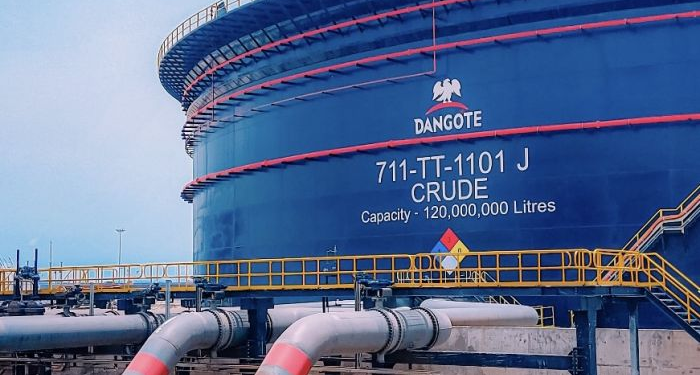
Rising Imports from the United States Reflect Shift in Nigeria’s Crude Strategy
Nigeria has experienced a significant increase in its crude oil imports from the United States during the first half of 2025. This surge is closely linked to the expansion of the Dangote Petroleum Refinery and marks a notable change in the country’s approach to sourcing crude oil.
According to data from the US Energy Information Administration, Nigeria imported 23.35 million barrels of U.S. crude between February and June 2025, compared to 11.69 million barrels during the same period in 2024. This represents a year-on-year increase of nearly 100 percent. The growth in imports was not steady throughout the period, with fluctuations observed each month.
In February 2025, Nigeria imported 3.11 million barrels, which was a slight decrease from 3.61 million barrels in February 2024. However, by March, the figure jumped to 5.25 million barrels, marking a 53.5 percent increase from the previous year. April saw a drop to 2.04 million barrels, but May recorded a sharp rise to 3.79 million barrels, an 82.4 percent increase. June, however, saw the most dramatic jump, with imports reaching 9.16 million barrels—nearly nine times higher than the 1.04 million barrels recorded in June 2024, representing a staggering 782.6 percent year-on-year increase.
Month-on-month trends also showed a clear upward trajectory. Imports in March grew by 68.7 percent compared to February, while April dipped by 61.2 percent. By May, imports climbed by 86 percent from the previous month, and in June, they soared by 141.7 percent from May. These figures indicate a steep escalation in demand for U.S. crude.
The scale of June’s imports, which accounted for nearly 40 percent of total imports during the period, raises concerns about potential long-term dependency on U.S. crude. The volatility and eventual surge in imports suggest that the Dangote Refinery is ramping up its operations, favoring U.S. light sweet crude due to its compatibility with complex refining processes.
Despite being Africa’s largest oil producer and an OPEC member, Nigeria has historically exported its crude while importing refined products due to underdeveloped state refineries. The Dangote refinery was expected to address this issue by using domestic crude to reduce reliance on imports. However, the latest data show that the refinery still depends on foreign supply to optimize operations.
This shift in import strategy highlights a paradox: even as Nigeria increases its production, it continues to rely heavily on foreign crude. The country produced 266.9 million barrels of crude oil between January and June 2025, according to data from the Nigerian Upstream Petroleum Regulatory Commission. This represents a 12.7 percent increase compared to the same period in 2024, when production stood at 236.7 million barrels.
The rise in production was consistent across all six months, with June recording the highest year-on-year increase. When condensates are included, total liquid output reached 303.2 million barrels for the period, compared to 275 million barrels in the first half of 2024.
Despite this increase, local refiners continue to face challenges in accessing sufficient crude. The Federal Government reported that 67,657,559 barrels were supplied to local refiners between January and August 2025. However, this amount fell short of the 123,480,500 barrels requested by refiners, meaning they received only about 45 percent of what they needed.
Refineries such as Port Harcourt, Warri, and Dangote have been struggling to meet their refining targets due to limited access to crude. Producers often prefer selling to international buyers who pay in dollars, leaving domestic refiners at a disadvantage due to exchange rate pressures.
The $20 billion Dangote Petroleum Refinery in Lagos has become increasingly reliant on U.S. imports to feed its processing units. Data from commodities analytics firm Kpler revealed that in July, U.S. crude accounted for approximately 60 percent of the refinery’s 590,000 barrels per day of crude intake. This marked the first time that U.S. crude overtook Nigerian supply, driven by ongoing domestic sourcing challenges.
As the Dangote refinery continues to expand, it remains dependent on U.S. crude to meet its operational needs. With plans to upgrade to 700,000 barrels per day, the refinery’s reliance on foreign supply underscores the broader challenges facing Nigeria’s refining sector.


