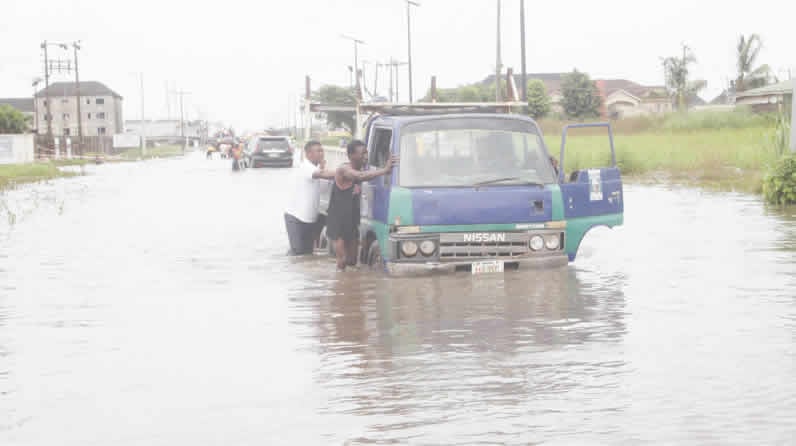
The Impact of Flooding Across Nigeria
From Lagos to Niger, Adamawa to Kaduna states, residents across Nigerian communities continue to face the consequences of heavy rains, rising water levels, and climate change. As of September 22, 233 lives have been lost to floods this year, with a total of 315,762 people affected, according to the flood dashboard of the National Emergency Management Agency (NEMA). Additionally, no fewer than 609 individuals sustained injuries, while 114 persons are reported missing as a result of the flood. The flood has impacted 86 local government areas across 25 states. The data also indicates that 113,367 people have been displaced, with 40,493 houses and 46,304 farmlands affected.
The NEMA flood dashboard lists the 10 most impacted states as Lagos, Adamawa, Akwa Ibom, Imo, Taraba, Rivers, Delta, Abia, Borno, and Kaduna. According to the NEMA report, children are the most affected group, with 143,683 children, 100,079 women, 60,408 men, 11,592 elderly, and 2,265 disabled persons affected by this year’s flood.
Amid repeated alerts from the Nigerian Meteorological Agency, heavy rains have triggered floods across Nigeria, killing hundreds of people, while communities struggle to salvage what is left of their destroyed homes.
Devastation in Mokwa, Niger State
The flood disaster in Mokwa, Niger State, is among the most devastating. The incident killed more than 200 people, while nearly 10,000 were affected. Triggered by heavy rainfall, the flood swept through several communities, leaving widespread destruction in its wake. A joint assessment conducted by the International Organisation for Migration revealed that over 450 homes were destroyed. This is apart from the destruction of 180 hectares of farmland, which were submerged.
In 2025, rising water levels continue to lead to floods across coastal regions, wreaking havoc on homes, businesses, and farmlands. Not only Niger but also various states of the federation have experienced flooding this year.
Lagos: Paralysis and Vulnerability
Typical of Lagos State, vehicular and business activities were paralysed on September 24 after hours of rainfall triggered flash floods across the state. The Lagos flooding wreaked havoc in areas like Maryland, Lekki, Ogba, and Ikorodu, as residents and business owners lamented how their homes and shops were overrun by the flood.
The Lagos Commissioner for Environment and Water Resources, Tokunbo Wahab, said Lagos, being a coastal city, remained vulnerable to flooding, especially heavy rainfall and tidal lock. He noted that the government had continued to invest in drainage infrastructure, desilting, and enforcement of environmental laws to minimize the impact on residents. Wahab urged those living in low-lying areas to be on alert because, with the intensity of the rainfall already experienced, many of the areas would encounter flash floods.
Ogun State Flood Alert
In mid-September, the Ogun State Government issued a flood alert, warning residents of riverine and coastal communities across the state to relocate to safer areas between the last week of September and the second week of October to avoid the dangers of flooding. Communities along the Ogun, Ilo, Iju, Owa, and Yemule Rivers—including Isheri, Warewa, Akute, parts of Abeokuta, Ayetoro, Itele, and Iju—as well as coastline areas such as Makun, Oni, Iwopin, Igele, Ifaara in Ogun Waterside, Ebute-Imobi in Ijebu East, Tungeji Island, and Agosasa in Ipokia Local Government Area, were expected to be most affected.
According to the 2025 Ogun State Midterm Flood Alert Press Statement released by the Commissioner for Environment, Dr Ola Oresanya, the flooding is expected to result from a combination of factors: overflow of rivers, sea water rise, tidal lock, heavy rainfall, inflows from the northern part of the country and the Benin Republic, and possible water release from Oyan Dam.
Fish farmers were advised to urgently harvest their stock to prevent losses, particularly those farming along floodplains in Eriwe, Yemule (Ijebu-Ode), Ilase, and Ayegbami in Yewa. “Fish farmers must not delay in harvesting to avert their investments being washed away. Likewise, residents should avoid consumption of contaminated water as tidal variations will worsen water quality,” he warned.
Kaduna and Adamawa: Rescue Efforts and Displacement
In Kaduna, the National Emergency Management Agency, Kaduna Operations Office, said on September 15, 2025, that it rescued two elderly individuals who were trapped after a building collapse caused by the recent flooding in Kaduna State. The flooding, which began with intense rainfall, displaced hundreds of residents and destroyed numerous homes and properties. Communities most affected were those situated along the River Kaduna and its tributaries, including Kigo Road, Bashama Road, Kinkinau, Malali, Ramat Road, Rafin Guza, and other areas.
Hundreds of displaced residents, particularly from Tudun Wada, took shelter at a temporary camp located at the Arc. Namadi Sambo Skills Acquisition Centre near the Children’s Hospital, Tudun Wada. The camp hosted mostly women, including pregnant and breastfeeding mothers, children, and persons with disabilities. NEMA provided emergency relief items such as mattresses, blankets, and mosquito nets to the camp.
In Adamawa, the Yola Operations Office of NEMA led search and rescue and evacuation efforts after severe flash flooding submerged 13 communities across Yola North and Yola South local government areas of the state on September 16. The downpour, which began around 4 am and lasted until noon, left worship centres, residential buildings, and business premises submerged. Thousands of households were displaced in areas including Damilu, Jambutu, Bachure, Runde, and Shinko, with many families forced to shelter along major roads.
Federal Government Warning and High-Risk Areas
Meanwhile, the Federal Government issued a fresh warning of possible flooding in Bayelsa, Akwa Ibom, Cross River, and several other coastal regions in the southern states. Residents of northern and southwestern states were also urged to be on the alert. According to the Federal Ministry of Environment, the states and communities prone to flooding include Akwa Ibom, Anambra, Adamawa, Cross River, Bayelsa, Delta, Kaduna, Kebbi, Katsina, Rivers, Imo, Sokoto, Ondo, and Lagos.
Why Flooding Persists
Nigeria remains one of the worst-hit African countries by the effects of climate change. This is even though, according to the United Nations Environmental Programme, Africa contributes minimally to the changing climate. With just about two to three per cent of global emissions, Africa stands out disproportionately as the most vulnerable region in the world.
Experts note that melting ice caps and increased rainfall are part of the causes of sea-level rise, leading to flooding. An environmental expert, Abeeb Ajagbe, explained that sea-level rise and coastal flooding in Nigeria could be linked to climate change, but added that human activities such as land reclamation along the coast, sand mining, poor waste management, and unplanned urban expansion have made the problem worse.
Ajagbe emphasized that addressing this requires a holistic approach where both government and residents take responsibility. Communities must be part of planning processes, since past mitigation projects like drainage systems and early warning systems designed without local input have had limited success. He suggested that the government should invest in green infrastructures, advanced early warning systems, enforce urban planning laws to stop building on drainage channels and reclaimed land, and avoid relying only on forced demolitions, which create more hardship without offering alternatives.
A quality, health, safety, environment, and sustainability expert, Hakeem Mukhtar, stressed that melting ice caps and increased rainfall are key drivers of global sea-level rise, a challenge now manifesting in Nigeria’s coastal regions, such as Lagos, Bayelsa, and Rivers states. Citing the Intergovernmental Panel on Climate Change (2021), Mukhtar noted that global sea levels are projected to rise by 0.28m to 1.01m by 2100, placing low-lying communities at heightened risk of flooding, erosion, and displacement.
He said, “Lagos alone, with over 20 million residents, is particularly vulnerable as nearly one-third of its landmass lies below sea level. To mitigate these impacts, government action must be both proactive and community-centred.” He outlined steps such as investment in coastal defence infrastructure, enforcing urban planning regulations, promoting ecosystem-based adaptation, and implementing early warning systems.


