The Struggle of Landless Squatters in Nepal
Kathmandu, May 12 — A growing movement of landless squatters and informal settlers from across Nepal has gathered in the capital to protest against nationwide eviction campaigns. These individuals are deeply concerned that their homes could soon be targeted by bulldozers, leading to further displacement and hardship.
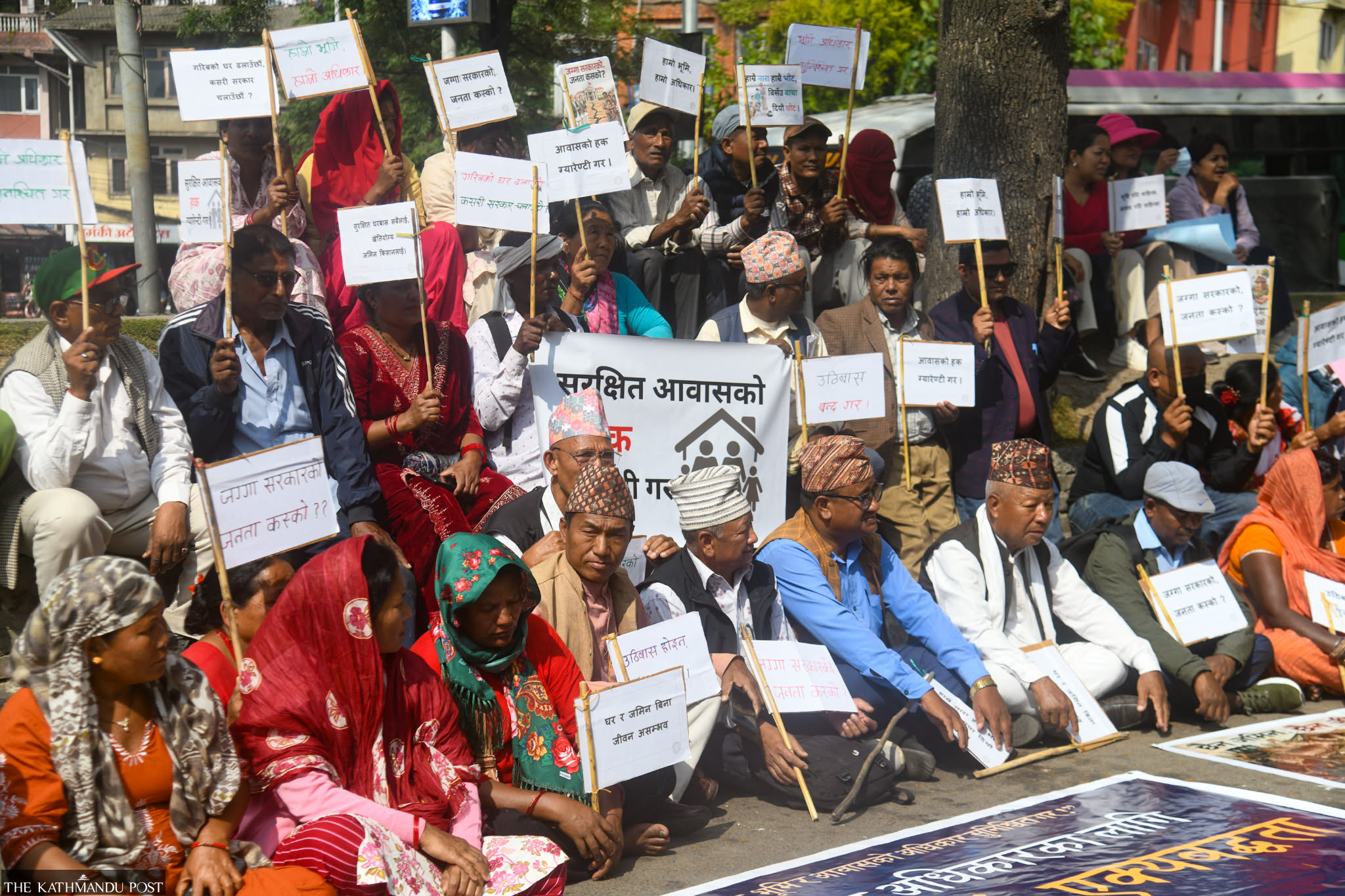
At Maitighar Mandala, a central location in Kathmandu, these communities have come together to share their stories of struggle and to demand accountability from the government. They accuse the state of betraying promises made by Prime Minister Balendra Shah during his election campaign. According to them, the government’s actions have been contradictory, as it claims to support landless communities while simultaneously carrying out evictions without proper rehabilitation.
The protests have gained momentum following forced evictions that have left many families homeless. The situation has escalated across the country, with reports of settlements being demolished in various districts such as Kaski, Mahottari, Dhanusha, Sarlahi, Banke, Bardiya, Surkhet, Rautahat, and Makawanpur.
Under the leadership of the National Land Rights Forum (NLRF) Nepal, around 100 representatives from landless communities across 20 districts have gathered at Maitighar. They are calling for an end to the forced evictions and are demanding better policies that prioritize the rights of the poor and vulnerable.
Slogans and Demands
The protesters have raised several slogans, including:
- “Manage the landless, don’t displace them”
- “End injustice, do not demolish the homes of the poor”
- “Stop forced evictions, stop bulldozer terror”
- “If the land belongs to the government, who do the people belong to?”
- “Our land, our rights, the foundation of our lives and livelihoods.”
These demands reflect the deep frustration and anger among the affected communities. They believe that the government’s policies are inconsistent, as outlined in Clause 91 of the 100-point reform agenda. This clause promised to complete an integrated digital record and verification of landless squatters and unmanaged settlers within 60 days. It also pledged household surveys to resolve landlessness within 1,000 days and to provide integrated housing alternatives in densely populated urban areas.
However, the government’s actions have contradicted these promises. Since April 25, thousands of security personnel and bulldozers have been deployed in the Kathmandu Valley to demolish homes of squatters and informal settlers. This has led to widespread fear and uncertainty among residents.
Personal Stories of Fear and Uncertainty
Several protesters shared their personal stories of fear and uncertainty. Laxmi Bishwakarma, who traveled from Hetauda in Makawanpur, questioned where they would live after their homes were destroyed in eviction drives. She described how her family had built their homes through hardship and sacrifice, and now faces the threat of losing everything.
Renu Tamang of Naya Basti in Chandrapur Municipality, Rautahat, shared her family’s experience of living on public land. Her current home is on community forest land, and she fears the day the government comes to remove them. She expressed the constant anxiety that comes with living under the threat of eviction.
Sanjay Thapa Magar of Namuna Tole in Bharatpur Metropolitan City-20, Chitwan, who is physically disabled due to polio, said his family has lived there since 1988. He described the fear of being evicted from the only home they have known.
Dan Bahadur Gautam of the old airport area in Dhangadhi Sub-metropolitan City, Kailali, shared his family’s experience of facing eviction on June 23, 2024. He described how the government’s actions have created anxiety and uncertainty for his family.
Legal and Policy Changes
On May 3, the government amended several laws through an ordinance, including provisions of the Land Act 1964 relating to landless Dalits, squatters, and unmanaged settlers. One amendment removed a provision under Section 52(a)(3), which had authorized the government to form commissions, committees, or task forces through a gazette notice to distribute land. With that clause removed, the Land Issue Resolution Commission was dissolved.
Following the dissolution, 1,152,870 applications collected from 750 local governments across the country have been left in limbo. Local governments had been verifying records and updating digital data through the commission’s central database.
According to data updated on the commission’s digital portal, there are currently 88,895 landless Dalit families, 168,441 landless squatter families, and 872,181 unmanaged settler families across Nepal.
The amended Land Act has now added Section 52(g)(1), allowing the government to form committees or task forces at the central and district levels to provide land to landless Dalits and squatters and manage informal settlers.
Court Orders and Ongoing Protests
After bulldozers began clearing settlements in the Kathmandu Valley and elsewhere, a writ petition was filed at the Supreme Court. On May 8, the court issued an interim order directing authorities not to forcibly remove or displace squatters and unmanaged settlers without following due legal process. It also instructed authorities to ensure displaced families receive access to basic facilities such as housing, education, healthcare, and food.
However, activists say local administrations in districts, including Banke, continue to demolish settlements despite the court order.
Under Sections 52(a), 52(b), and 52(g) of the Land Act, the government is authorized to provide land to landless Dalits and squatters who do not own land elsewhere in Nepal. The law also allows the state to formalize unmanaged settlers living on public or government land, including forest land, if they have continuously occupied and cultivated it for at least 10 years before February 11, 2010.
The protesters at Maitighar say they have one question for PM Shah and his government: when will the state stand for people, livelihoods, and justice?
For many squatters, their journey has been marked by repeated hardship. Protesters gathered at Maitighar say their right to live with dignity is under threat. “We are restless,” they said.